
Are Sympatex Boots Waterproof for Shooting? UK Guide

Table of Contents
- What Makes Sympatex Boots Waterproof for Shooting
- Sympatex vs Gore-Tex for Country Boots
- How to Waterproof Leather Boots for Shooting
- Mink Oil for Leather Boot Care: Long-Term Protection
- Boot Height, Fit and Volume for Shooting Fields
- Traction, Terrain and Durability in Rugged Conditions
- Long-Term Performance: How Sympatex Boots Hold Up Over Seasons
- Frequently Asked Questions
Last Updated: September 21, 2026
What Makes Sympatex Boots Waterproof for Shooting
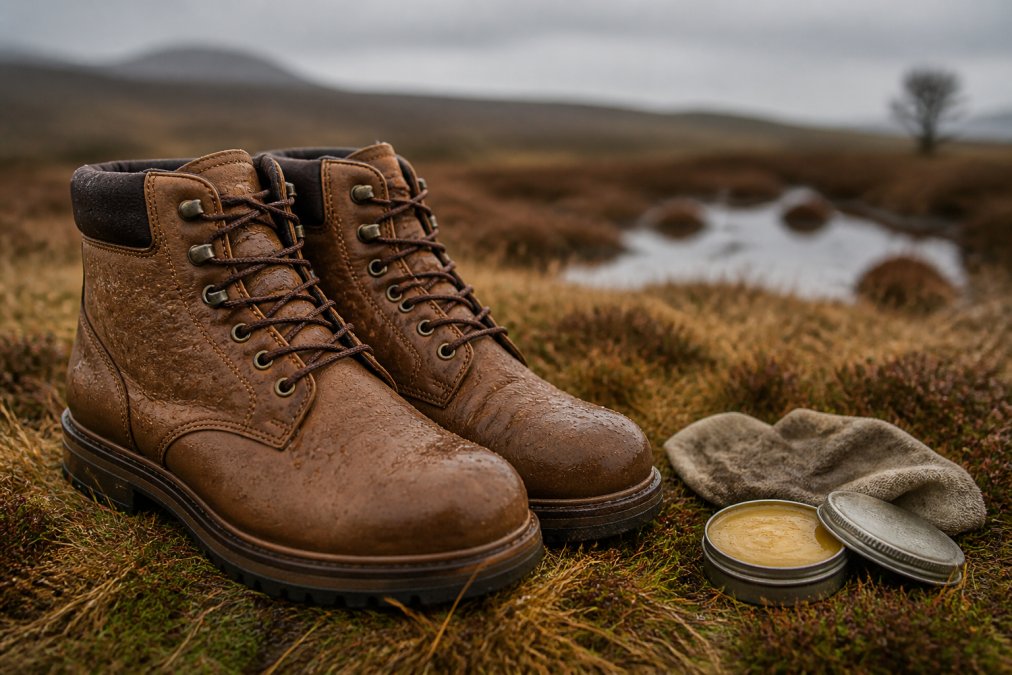
If you have ever stood in a wet stubble field at first light and felt the cold creep through your socks by mid-morning, you already know why this question matters. Sympatex boots are waterproof for shooting because the lining is a solid, non-porous membrane that blocks liquid water completely while still allowing sweat vapour to escape. At Field & Moor, our country boots feature a Sympatex lining, thick leather uppers, and Goodyear welting.
The result is a boot that keeps river water, bog, and driving rain on the outside where they belong. Field & Moor Blog: Waterproof Breathable Boots for All-Weather Comfort
But "waterproof" is a word the outdoor trade throws around loosely, and a great many boots sold for shooting are merely water-resistant. The difference matters enormously once you are standing in wet heather for six hours. Below, we break down how the membrane actually works, how it compares with the alternatives, and what you need to do to keep a leather boot waterproof season after season.
How the Sympatex Membrane Works
Sympatex is a hydrophilic polyester membrane with no pores at all. Rather than letting water vapour pass through microscopic holes, it absorbs moisture vapour on the warm inner side and transports it through the molecular structure of the film to the cooler outer side.
That distinction is the whole story. Porous membranes rely on holes small enough to stop liquid water but large enough to let vapour through. Those holes can clog with sweat, oils, and dirt over time, and once they do, breathability drops. A hydrophilic membrane has nothing to clog.
The membrane is laminated to the outer material and a synthetic lining, then seam-sealed so no water enters at the stitching. In practice, this means a properly constructed Sympatex boot handles full immersion in a puddle or a stream crossing without leaking.
Waterproof vs Water-Resistant: What the Terms Actually Mean
Waterproof means the boot will not let liquid water through under normal use, including sustained rain and standing water. Water-resistant means the material repels water for a while, then eventually wets out and soaks through.
The gap between those two definitions is where most disappointing purchases live. A water-repellent finish on a leather upper will shed a shower. It will not survive an hour in wet grass, and it offers nothing at all if you step into a ditch.
For shooting, where you are stationary for long periods in wet cover, water-resistant is not good enough. You need a membrane that is genuinely impermeable, plus a leather upper that has been treated to keep the outer from saturating. The membrane stops water getting in; the finish stops the leather becoming heavy and cold.
Sympatex vs Gore-Tex for Country Boots
Both membranes keep water out and both breathe. The meaningful difference is what they are made of, how they are manufactured, and what happens to them at the end of their life. That is where Sympatex pulls ahead on green issues, and it is the main reason many country boot makers have moved toward it in recent years.

A Sympatex membrane is a single-material hydrophilic polyester film. There are no pores, no expanded PTFE, and no fluoropolymer chemistry. Because it is one material, it can be recycled rather than separated into layers and sent to landfill. Gore-Tex laminates combine expanded PTFE with other textiles, and those layers are difficult to separate. The PTFE itself belongs to the per- and polyfluoroalkyl substance family, which has come under increasing scrutiny for its persistence in the environment. Sympatex contains none of that chemistry.
That is not a trivial point for anyone who spends their weekends on a shoot and cares about the ground they walk over. A membrane that avoids fluoropolymers and can be recycled at end of life is a cleaner proposition than one that cannot. It is the single biggest reason Sympatex is the better choice on environmental grounds.
Performance-wise, the two are close. Both are fully waterproof. Both breathe. But for a country boot worn in wet grass, mud, and the occasional stream crossing, the environmental gap is significant.
Breathability and Moisture Management Compared
Breathability is measured as moisture vapour transmission: how much sweat vapour can pass through the membrane in a given time. A hydrophilic membrane like Sympatex moves vapour steadily and consistently, even when the outer leather is damp. Maintaining this level of moisture control is just as vital for the comfort of your canine companion as it is for your own feet, which makes protecting hunting dogs from harsh terrain and damp conditions an essential part of responsible field preparation.
A hydrophilic membrane keeps working because it moves moisture by absorption and diffusion rather than by a pressure gradient across open pores.
In practical terms, both will keep your feet drier than an unlined leather boot. The gap shows up over a long day, particularly if you are walking in and out of wet cover and your outer leather never fully dries. Pair the boot with a moisture-wicking sock and the effect compounds.
How to Waterproof Leather Boots for Shooting
Leather is naturally water-repellent, but that quality fades with use, mud, and repeated wetting and drying. Re-treating the upper is what keeps a Sympatex-lined boot performing at its best, because a saturated outer leather cannot breathe and becomes cold and heavy.
Here is a straightforward routine that works on full-grain country boots:
- Clean first. Brush off dried mud with a stiff brush, then wipe the leather with a damp cloth. Never apply product over dirt; you will just grind grit into the grain.
- Dry slowly. Let the boots air-dry at room temperature, away from radiators or direct sun. Heat cracks leather and can damage the membrane's lamination.
- Warm the leather slightly. A little warmth helps the product penetrate. A few minutes in a warm room is enough.
- Apply a conditioner or wax sparingly. Work it in with your fingers or a cloth, paying attention to the flex points at the toe and the creases behind the ball of the foot.
- Let it absorb. Give it time, then buff off any excess with a clean cloth.
- Repeat through the season. How often depends on use, but a boot worn weekly on wet ground benefits from attention every few weeks.
Do this and the leather stays supple, sheds water, and keeps the membrane underneath working as designed.
Mink Oil for Leather Boot Care: Long-Term Protection
Mink oil is a soft fat that penetrates deep into leather, conditioning it and adding a strong water-repellent layer. It is one of the most effective long-term treatments for full-grain country boots, particularly in wet, muddy conditions.
Applied regularly through the autumn and winter, mink oil keeps the leather from drying out and cracking at the flex points. It also darkens leather slightly, so bear that in mind on a lighter tan finish.
10 " Country Boot in Tan Leather →
A few things worth knowing before you reach for it:
- It works best on smooth full-grain leather, not on suede or nubuck
- Apply thinly; a heavy coat leaves a greasy residue that attracts grit
- It softens leather.
- It is not a substitute for the membrane; it protects the leather, not the lining
Used sensibly, mink oil is valuable for extending the working life of a leather shooting boot.
Boot Height, Fit and Volume for Shooting Fields
Boot height is a functional decision, not a style one. A boot that covers the ankle and lower calf, approximately 25cm in height, is the right compromise for most shooting: enough protection when you cross wet ground or push through cover, without the weight and stiffness of a full wellington.
Fit and volume matter just as much, and this is the area most guides skip. Two people with the same shoe size can need very different boots. A high instep, a wide forefoot, or a narrow heel all change what fits.
Some practical guidance:
- Measure your foot late in the day, when it is at its largest
- Check the internal length, not just the labelled size. Field & Moor publishes the internal last measurement for each size so you can compare against a boot you already own
- Allow for sock thickness. A thick shooting sock can add half a size of volume
- Check the heel hold. If your heel lifts when you walk, the boot is too long or too wide, and you will get blisters
A boot that fits properly needs less breaking in. The brutal break-in people talk about is often a symptom of the wrong size or an overly stiff construction.
Traction, Terrain and Durability in Rugged Conditions
Grip is where a shooting boot earns its keep. Wet grass, mud, loose gravel, and slick rock all demand different things from a sole, and a commando-style cleated sole handles the widest range of them.
Vibram commando soles use deep, aggressive cleats that clear mud as you walk rather than packing it into a smooth layer. On wet grass and soft ground, that self-clearing behaviour is what keeps you upright. On hard surfaces the rubber compound provides the grip, which is why sole quality is about formulation as much as tread pattern.
Durability comes down to construction. Goodyear welting stitches the upper to the sole through a welt, creating a mechanical bond that can be repaired rather than glued and thrown away. Triple stitching at stress points and reinforced eyelets add strength where a boot flexes and pulls. A full-length leather insole and cork footbed mould to the foot over time and insulate against cold ground.
For anyone walking rough ground regularly, that combination of a repairable construction and a hard-wearing sole contributes to a boot's longevity.
Long-Term Performance: How Sympatex Boots Hold Up Over Seasons
A hydrophilic membrane does not clog, which is its advantage over the years. Sympatex has no pores to block, so breathability stays consistent across the life of the boot.
But the real test is not the membrane alone. It is how the whole boot behaves in the specific ways a shooting day stresses it. Standing in wet grass for hours is a different challenge from wading through a shallow stream or a bog. Standing water puts constant hydrostatic pressure on the lower boot, testing the membrane and the seams. Walking through a bog adds suction and flex, which works the leather at the flex points and can open stitching over time. A boot that handles one may not handle the other as gracefully.
The failure points that do appear tend to be mechanical rather than membrane-related: a seam that works loose, a sole that wears through, leather that dries and cracks because it was never conditioned. That is where a long-term mink oil routine earns its place. Applied regularly through the autumn and winter, mink oil penetrates deep into leather, keeps it supple, and adds a strong water-repellent layer. It protects the leather so the membrane underneath can keep doing its job. Without it, the leather dries, cracks at the flex points, and eventually lets water past the membrane at the weakest point.
Fit and volume also affect long-term performance more than most guides admit. A thick shooting sock can add half a size of volume inside the boot. If the boot is too loose, heel slip causes blisters and uneven loading that stresses the construction. The right fit allows for sock thickness without cramping the foot or letting it move.
A boot with an intact membrane, well-conditioned leather, and a repairable sole can be kept in service for many seasons. When the sole eventually wears, Goodyear welting means it can be replaced rather than the whole boot being discarded. The practical takeaway is simple. Buy a boot with a genuine waterproof membrane and a construction that can be repaired, look after the leather with mink oil, and get the fit right for the socks you actually wear. Do that and you will invest in footwear that offers long-term value.
Field & Moor's Hawk country boot in tan leather is built on exactly this basis: a Sympatex lining, Vibram commando sole, Goodyear welting, and full-grain leather that responds well to regular conditioning. Pair it with a wool-rich sock and you have a setup that handles a full day in wet cover without complaint.
Frequently Asked Questions
Is Sympatex better than Gore-Tex?
Both membranes keep water out and let moisture vapour escape, so on waterproofing alone they perform similarly. Sympatex has an edge on environmental grounds: it is a polyester-based, PTFE-free membrane that can be recycled, whereas Gore-Tex uses expanded PTFE. For shooting boots, the membrane matters less than the leather, the seam sealing and the welt construction around it. A Sympatex-lined boot from a maker using Goodyear welting and full-grain leather will outperform a poorly built Gore-Tex boot every time.
How do I maintain the waterproof integrity of my shooting boots?
Clean off mud with lukewarm water and a soft brush after every outing, then let the boots dry at room temperature away from radiators. Re-apply a leather conditioner or mink oil two to three times a season to stop the uppers drying out and cracking. Check the welt stitching and the bellows tongue for grit. If the leather is scuffed through, the membrane behind it is still intact, but the boot will take on water through the damaged surface, so treat scuffs early.
Are Sympatex boots fully waterproof for wet moorland conditions?
Yes, provided the boot is built properly around the membrane. Sympatex is a hydrophilic, non-porous membrane that blocks liquid water while allowing moisture vapour to pass through. In a boot with a seam-sealed lining, a gusseted or bellows tongue and a waterproofed leather upper, it will cope with standing water, wet heather and long days on the moor. The common failure point is not the membrane but water entering over the top of a short boot or through an untreated leather surface.
Is mink oil recommended for long-term care of leather shooting boots?
Mink oil is one of the most effective long-term treatments for full-grain leather. It penetrates deeply, restores suppleness and adds a layer of water repellency that helps the leather shed rain rather than soak it. Apply a thin coat with a cloth, work it into the seams and welt, and leave it to absorb overnight. Use it two to three times a season, or more often if the boots are out in wet conditions weekly. It will darken lighter leathers slightly, so test on a hidden area first.