7 Alternatives to Blake Stitched Leather Boots

Table of Contents
- Quick Comparison: 7 Alternatives to Blake Stitched Leather Boots
- What Is Blake Stitching and Why Look for Alternatives?
- Goodyear Welt vs Blake Stitch Pros and Cons
- The Benefits of Storm Welted Construction for Wet Weather
- The Repairability of Different Shoe Sole Types
- 1. Country Boot in Quality Brown Leather: Best for All-Terrain Use
- 2. 11" Laced Country Boot in Greased Brown Leather: Best for Mud and Snow
- 3. Dealer Boot Falcon in chestnut : Best for Smart-Casual Wear
- 4. 11" Laced Country Boot in Chestnut Grained Leather: Best for Adjustable Fit
- 5. Marsh Harrier Safari and Hiking Boot: Best for Long-Distance Walking
- 6. Long Hunting & Shooting Boot: Best for Maximum Coverage
- 7. Ladies' Laced Country Boot in Tan Grained Leather: Best for Female Wearers
- How to Choose Your Alternative: A Decision Framework
- Frequently Asked Questions
Last Updated: September 11, 2026
Quick Comparison: 7 Alternatives to Blake Stitched Leather Boots
If you are searching for 7 alternatives to blake stitched leather boots, you have likely hit the limits of Blake construction: thin soles, limited repairability, and a profile that struggles in wet grass. This guide from Field & Moor compares seven welted country boots that solve those problems, from storm-welted all-rounders to long hunting boots.
Blake stitching attaches the upper directly to the sole with a single internal seam. It keeps a boot sleek and light, but it leaves little material for a cobbler to rebuild. Welted construction adds a strip of leather between upper and sole, which is why it survives repeated resoling.
The table below sets out all seven options side by side, so you can scan by use case before reading the detail.
Boot |
Construction |
Best For |
Price |
|---|---|---|---|
Goodyear welted |
All-terrain use |
£215 |
|
11" Laced Country Boot, Greased Brown |
Storm welted |
Mud and snow |
£270 |
Falcon Dealer Boot |
Storm welted |
Smart-casual wear |
£144 |
11" Laced Country Boot, Chestnut Grained |
Storm welted |
Adjustable fit |
£270 |
Marsh Harrier Safari and Hiking Boot |
Storm welted |
Long-distance walking |
£225 |
Long Hunting & Shooting Boot |
Goodyear welted |
Maximum coverage |
£290 |
Ladies' Laced Country Boot in Tan Grained |
Storm welted |
Female wearers |
£238 |
What Is Blake Stitching and Why Look for Alternatives?
Blake stitching is a shoe construction method in which the upper is sewn directly to the sole through a single internal seam, producing a slim, flexible boot with no visible welt. Goodyear welted construction, by contrast, stitches the upper to a welt, then stitches the welt to the sole, creating a water-resistant, rebuildable bond.

That single internal seam is the whole story. Because the stitch runs inside the boot, there is no welt to cut away and replace, so a cobbler has far less material to work with when the sole wears through. UK footwear repair guidance from The Society of Master Shoe Repairers notes that rebuildable construction is the deciding factor in whether a leather boot can be repaired more than once.
Blake construction does have genuine strengths. It is lighter, more flexible from day one, and cheaper to produce. The trade-off appears later: fewer resoles, thinner soles, and less protection from wet ground.
The alternatives to Blake stitching, in plain terms
Most guides stop at "Blake versus Goodyear". That is a comparison, not a set of alternatives. If you want the slim profile and light weight of a Blake-stitched boot without its repairability ceiling, these are the constructions actually worth knowing about:
- Blake-Rapid (also called Blake with a midsole): A second stitch runs through a midsole and out to the sole edge, visible as a line of stitching around the base. It keeps much of the Blake profile while giving a cobbler a midsole to work with, so it can be resoled more often than plain Blake. It is the closest like-for-like upgrade.
- Bologna: The upper is turned under and stitched to a rolled edge, then the sole is attached. It is light and flexible like Blake, with a softer, more rounded profile, and is common in Italian-made casual boots. Repairability sits between cemented and welted.
- Rapid (also called McKay or machine-welted): A curved needle stitches the upper and insole to a midsole, which is then attached to the outsole. It is more rebuildable than plain Blake and is often used on mid-price work boots.
- Norwegian (also called Norvegese): A heavy, braided or chain stitch runs through the upper, a midsole and the welt, with the seam sitting proud around the boot. It is highly water-resistant and very rebuildable, but bulky and expensive.
- Stitchdown: The upper is flared outward and stitched directly to the midsole or outsole from the outside. It is simple, strong and common on hiking and military-style boots; the trade-off is a wider, less refined profile.
- Goodyear welted: The benchmark rebuildable construction, with a replaceable welt and a cork-filled cavity that moulds to the foot. Heavier and stiffer than Blake, but the most repairable of the mainstream options.
- Storm welted: A Goodyear welt with the welt turned upward against the upper, raising the seam above the sole edge. It is the wet-weather variant of Goodyear and the construction used across most of the boots in this guide.
Two further constructions are worth naming so you can rule them out. Cemented construction glues the upper to the sole; it is cheap and light but generally cannot be rebuilt. Moccasin construction stitches the upper to a plug over the foot; it is comfortable and flexible but not designed for repeated resoling.
Goodyear Welt vs Blake Stitch Pros and Cons
Goodyear welt vs Blake stitch pros and cons come down to one central trade-off: Goodyear wins on durability, repairability and water resistance, while Blake wins on weight, profile and initial cost. Neither is universally better; the right answer depends on how and where you wear the boot.
Here is the honest comparison:
Goodyear welt advantages
- The welt can be cut and replaced, so the boot can be resoled repeatedly
- A cork filling between insole and midsole moulds to the foot over time
- The welted seam sits under a lip, which keeps water out of the sole
- Heavier, stiffer build suits rough ground and long days
Goodyear welt drawbacks
- Heavier and bulkier than a Blake-stitched boot
- A break-in period of days or weeks is normal
- Higher purchase price reflects the extra labour
Blake stitch advantages
- Slim, dressy profile that suits tailored trousers
- Flexible from the first wear, with minimal break-in
- Lower cost at the point of sale
Blake stitch drawbacks
- Limited number of resoles before the upper is compromised
- Thinner sole transmits cold and stone bruising
- Water can wick through the sole seam in wet conditions
The Benefits of Storm Welted Construction for Wet Weather
The benefits of storm welted construction for wet weather are straightforward: the welt is turned upward and stitched to the upper so the seam sits above the sole edge, which stops water running straight into the join. On saturated ground, that single design change makes a measurable difference over a standard welt.
Most of the boots in this guide use storm welting for exactly that reason. A storm welt adds a raised lip around the base of the upper, and combined with a hydrophobic leather and a waterproof lining, it keeps the foot dry through a full day of shooting, stalking or walking.
Health and Safety Executive guidance on slip resistance and footwear in wet conditions is worth reading if you work outdoors: grip and water management are safety issues, not just comfort ones. A Vibram Commando sole with cleated lugs, as used across the Field & Moor range, is built for exactly that scenario.
The Repairability of Different Shoe Sole Types
The repairability of different shoe sole types is determined almost entirely by how the sole is attached, not by the sole material itself. Cemented soles are glued and generally cannot be rebuilt; Blake-stitched soles can be resoled a limited number of times; welted soles, whether Goodyear or storm welted, can be cut away and replaced repeatedly by a cobbler.
Think of it as a hierarchy. At the bottom sits cemented construction, where the upper is glued to the sole and a repair means a glue job at best. In the middle sits Blake stitching, resoleable but constrained by that internal seam. At the top sit Goodyear welted and storm welted boots, where the welt itself is a replaceable component.
This is why welted boots cost more up front and less over their lifetime. A boot that can be resoled three or four times effectively becomes several boots for the price of one plus maintenance. A cemented boot is replaced entirely each time the sole goes.
WRAP's research on extending product life and textile durability makes the same point about clothing and footwear generally: extending the usable life of a product is usually the single biggest environmental and financial win available to a buyer.
Sole attachment |
Resoleable? |
Typical rebuilds |
Best for |
|---|---|---|---|
Cemented |
Rarely |
0-1 |
Low-cost casual wear |
Blake stitch |
Yes, limited |
1-2 |
Slim dress boots |
Blake-Rapid |
Yes |
2-3 |
Slim boots needing more repairs |
Goodyear welt |
Yes |
3+ |
Long-term investment |
Storm welt |
Yes |
3+ |
Wet-weather country wear |
Norwegian |
Yes |
3+ |
Heavy wet-weather wear |
How the care routine differs once you leave Blake behind
Repairability is only half the story. What you do between resoles decides whether a welted boot reaches its third rebuild or dies at its first, and the routine is genuinely different from caring for a Blake-stitched pair.
Sole protection. A Blake-stitched sole is thin and the stitch sits close to the ground, so the seam is exposed to abrasion and grit. Welted boots carry a thicker sole and a raised welt, but the welt itself is a wear component: once the stitching on the welt is cut through by grit or kerbs, the boot needs a cobbler rather than a polish. Fitting thin rubber sole protectors (often called topys) before first wear is a common way to extend the interval between full resoles, and it is far cheaper than a rebuild.
Moisture management. Leather is hygroscopic: it takes on and releases water. A Blake-stitched boot wicks moisture through the sole seam and dries slowly from the inside, which is why a soaked pair can stay damp for days. Welted boots resist ingress better at the seam, but the cork filling and leather insole still hold water once it gets in. The practical routine is the same for both: never dry boots against a radiator or open fire, because heat drives the leather's natural oils out and causes cracking. Stuff them with newspaper or a cedar shoe tree and let them dry at room temperature, ideally for a full 24 hours.
Rotation. The single most effective habit is to own two pairs and alternate them. Leather needs a full day to shed the moisture absorbed during wear; wearing the same pair daily accelerates breakdown of the insole and lining regardless of construction. This matters more, not less, on a welted boot, because you are trying to protect a rebuildable asset rather than a disposable one.
Conditioning. Welted boots usually use thicker, more heavily finished leather than slim Blake-stitched dress boots, and the care products differ accordingly. A greased or waxy leather wants a wax-based conditioner; a smooth calf leather wants a cream. Over-conditioning is a common mistake: a light application every few months, or when the leather looks dry, is enough. Mink oil, as supplied with some country boots, is excellent for water resistance but can darken leather, so test it on a hidden area first.
Welt and stitch care. Dirt trapped in the welt stitching acts like sandpaper every time you walk. A stiff brush along the welt after a muddy day removes the grit before it abrades the thread, and it is the cheapest maintenance task available. If a welt stitch does break, get it seen to early: a small repair now is far cheaper than a rebuild later.
1. Country Boot in Quality Brown Leather: Best for All-Terrain Use
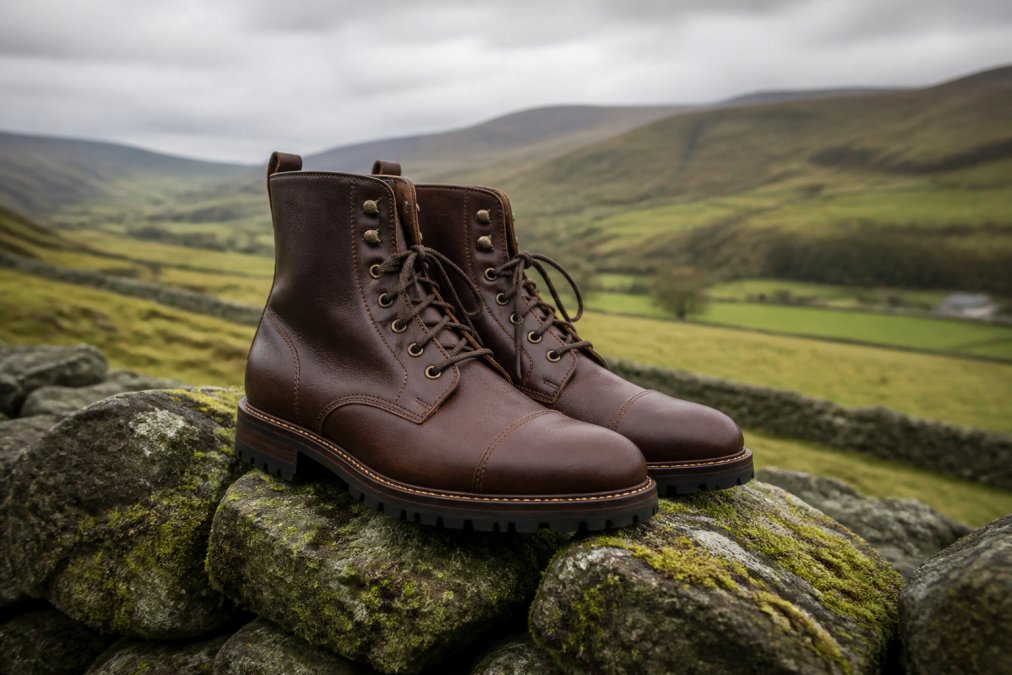
The Country Boot in Quality Brown Leather is the most versatile boot in this guide, pairing Goodyear welted construction with a Vibram Commando sole and a Sympatex lining. It handles mixed terrain, from gravel tracks to wet pasture, without demanding a change of footwear.
Premium brown leather and Avellino suede uppers sit over a cleated Vibram Commando sole, so traction holds on loose ground and wet stone. The Sympatex lining adds waterproof protection with breathability, and Goodyear welted construction means the boot can be resoled rather than replaced. Full-length insoles with a cork footbed provide insulation and cushioning, which matters on cold mornings.
Triple stitching reinforces the seams, and an elastic gusset at the leg keeps the fit secure. Pull-on straps on each side make the boot quick to get on and off.
At £215, it is the entry point into the range and the one we would recommend to anyone replacing a Blake-stitched boot for the first time.
Pros: Goodyear welted and fully resoleable; waterproof Sympatex lining; cork footbed; versatile brown leather; brush included. Cons: Not the longest shaft in the range, so deep mud can reach the top.
2. 11" Laced Country Boot in Greased Brown Leather: Best for Mud and Snow
The 11" Laced Country Boot in Greased Brown Leather is built for the worst conditions on the calendar: saturated mud, slush and snow. A thick greased hydrophobic leather upper and a storm-welted construction combine to keep water out where a Blake-stitched boot would soak through.
The Vibram rubber Commando sole provides grip on mud and snow, and the Sympatex lining adds a waterproof, breathable layer inside. Storm welting ensures waterproofing at the sole join, which is the weak point of any boot in standing water. A detachable gun-rest sits on the vamp for extra protection during field work.
A double-sided buckle allows fine adjustment of fit, treble stitching adds strength, and cork insulation in the midsole helps regulate temperature. The full leather-lined insole keeps the foot comfortable over long days.
At £270, this is the boot for anyone who spends winter outdoors rather than looking at it through a window.
Pros: Storm welted and waterproof; greased hydrophobic leather; Vibram Commando sole; detachable gun-rest; adjustable buckle. Cons: The greased finish needs regular conditioning to stay supple.
3. Dealer Boot Falcon in chestnut : Best for Smart-Casual Wear
The Dealer Boot in Falcon in chestnut is the odd one out in the best possible way: a pull-on boot with storm-welted construction and a Dainite button rubber sole, built for town as much as field. It is the answer for anyone who wants welted durability without a laced country boot on their foot.
Burnished chestnut leather gives it a smarter finish than the laced options, and the Dainite sole keeps the profile low while remaining hard-wearing. Full-length leather linings inside add a level of comfort that cheaper pull-on boots rarely match, and storm welting means the construction is still repairable.
This is the boot for the drive to the shoot, the pub afterwards, and the office on Monday. It is not designed for deep mud; the low profile and smooth sole are a deliberate trade.
At £144, it is the most affordable option here and the easiest to wear with anything.
Pros: Smart enough for town; storm welted and repairable; Dainite sole; full leather lining; lowest price in the range. Cons: Low profile and smooth sole limit it on steep, muddy ground.
4. 11" Laced Country Boot in Chestnut Grained Leather: Best for Adjustable Fit
The 11" Laced Country Boot in Chestnut Grained Leather is the boot to choose when fit is the deciding factor, thanks to a double-sided buckle and a lacing system that lets you tune the boot to your foot and calf. If your last pair of boots never quite fitted, start here.
The chestnut grained leather upper is hydrophobic, and the Sympatex lining provides waterproof, breathable protection. A Vibram rubber Commando sole delivers grip and traction in all weathers, and storm-welted construction adds waterproofing at the sole. The upper is reinforced with an extra-thick gun-rest on the vamp, stitched treble-strong for strength and longevity.
Cork insulation in the midsole helps regulate temperature and conforms to the contours of the foot over time, which is where much of the long-term comfort comes from. Two laces are included.
At £270, it suits anyone who wants a precise fit and a boot that will still be going in ten years.
Pros: Double-sided buckle for adjustable fit; storm welted; waterproof Sympatex lining; cork midsole; travel bag and brushes included. Cons: Grained leather shows scuffs more readily than smooth finishes.
5. Marsh Harrier Safari and Hiking Boot: Best for Long-Distance Walking
The Marsh Harrier Safari and Hiking Boot is the lightest and most walk-focused option in this guide, designed for long days on foot over harsh terrain. Its 9-inch height keeps it agile while still offering meaningful ankle support and protection.
Premium hydrophobic chestnut grain leather provides water resistance, and a Sympatex lining adds waterproofing and breathability. The Vibram Commando sole gives traction in mud and snow, and storm-welted construction ensures the boot can be resoled rather than retired. A reinforced, detachable gun-rest on the vamp, full leather lining and a half-bellows tongue all increase waterproofing and insulation.
This is the boot for walkers, hikers and safari-goers who cover distance rather than stand still.
At £225, it is the best value in the range for pure walking use.
Pros: Light and agile for distance; storm welted; hydrophobic leather; Vibram Commando sole; detachable gun-rest. Cons: Shorter shaft than the 11-inch boots, so less protection in deep cover.
6. Long Hunting & Shooting Boot: Best for Maximum Coverage
The Long Hunting & Shooting Boot is the most protective boot here: a 17-inch shaft that covers the calf entirely, built for hunting, shooting and general field use in tall, wet cover. Where shorter boots let water and debris in over the top, this one simply does not.
Goodyear welted construction with a repairable Vibram Commando outsole gives it the same rebuildable foundation as the rest of the range, and treble stitching adds strength and durability. The upper is soft but thick brown grain leather, and a double buckle at the top combines with a gusset and half-zip for easy entry and removal.
A full-length insole with cork infill underfoot provides insulation on cold days, and the Sympatex lining is waterproof and breathable.
At £290, it is the most expensive boot in the guide, and the one to choose if you regularly wade through wet bracken or wade deep cover.
Pros: 17-inch shaft for full calf coverage; Goodyear welted and repairable; half-zip and gusset for easy access; mink oil and brush included. Cons: The tallest and heaviest option, so slower to put on than a dealer boot.
7. Ladies' Laced Country Boot in Tan Grained Leather: Best for Female Wearers
The Ladies' Laced Country Boot in Tan Grained Leather is cut on a women's last from UK size 3 to 9, so the fit is proper rather than a scaled-down men's boot. It carries the same storm-welted construction and Vibram sole as the men's range.
The strong upper is crafted from light brown grained, hydrophobic leather, with a quality leather lining for protection against transitional weather. A Vibram rubber Commando sole provides traction in slippery and snowy conditions, and storm-welted construction ensures waterproofing and increased repairability. An extra-thick leather oval at the vamp carries a gun-rest, useful for motorcycle riders and anyone kneeling on rough ground.
A double-sided buckle ensures an adjustable fit, and every seam is treble stitched. Cork insulation in the midsole regulates temperature, and a full leather-lined insole completes the design. Two laces are included.
At £238, it is the pick for female wearers who want the same construction quality as the men's boots, in a last that actually fits.
Pros: Women's-specific last from UK 3 to 9; storm welted and repairable; hydrophobic leather; Vibram Commando sole; adjustable buckle. Cons: Fewer colourways than the men's range.
How to Choose Your Alternative: A Decision Framework
Choosing among the 7 alternatives to blake stitched leather boots is simpler than it looks if you work from conditions first and aesthetics second. Use the framework below, in order, and you will land on the right boot in under five minutes.
Step 1: Where will you actually wear them?
- Wet grass, mud and standing water → storm-welted boot with a Vibram Commando sole
- Mixed terrain and farm tracks → Goodyear welted all-rounder
- Town and light field use → Dealer boot with a Dainite sole
Step 2: How far will you walk in them?
- Long distances on foot → 9-inch Marsh Harrier
- Moderate days with stops → 11-inch laced country boot
- Mostly standing or short walks → Dealer boot or long hunting boot
Step 3: How much coverage do you need?
- Deep cover and tall grass → 17-inch hunting boot
- Standard field use → 11-inch boot
- Town and travel → Dealer boot
Step 4: How important is repairability? Every boot in this guide is welted and resoleable, which is the whole point of moving away from Blake stitching. Goodyear and storm welted boots can both be rebuilt by a cobbler several times over.
Step 5: Set your budget.
- £180 to £225 → Dealer Boot, Country Boot, Marsh Harrier
- £238 to £270 → Ladies' Osprey, 11-inch Osprey variants
- £290 → Long Hunting & Shooting Boot
The real challenge with moving away from Blake stitching is not choosing a construction method, it is finding welted boots that are actually built to be rebuilt rather than merely described that way. Field & Moor handcrafts its country, Chelsea and safari boots in family-owned artisan factories in Spain, using Goodyear and storm-welted construction, waterproof Sympatex linings and rugged Vibram soles, with British design by Hannah Stiles. Every boot in the range can be resoled, and the House of Cheviot socks made in the Scottish borders are the natural companion for long days out. Get started with Field & Moor and invest in footwear that lasts for years of adventure rather than a single season.
Frequently Asked Questions
Is Goodyear welt better than Blake stitch?
Neither is universally better; they suit different needs. Goodyear welt construction creates a water-resistant seal and allows the sole to be replaced multiple times, making it a long-term investment. Blake stitching produces a slimmer, more flexible profile but offers less water resistance and fewer resole options. For wet British weather and rugged terrain, Goodyear welt or storm welt is often the more practical choice.
What does Blake stitched mean in footwear construction?
Blake stitching is a method where the upper is sewn directly to the sole with a single stitch running through both layers. This creates a lightweight, flexible boot with a sleek profile. However, the stitching channel sits close to the ground, so water can penetrate more easily, and the sole can only be replaced a limited number of times before the upper is compromised.
Are Goodyear welted boots more waterproof than Blake stitched?
Yes, generally. Goodyear welted boots feature a welt strip that creates a raised seal between the upper and sole, and storm welted versions add a ridge that further blocks water. Blake stitched boots have stitching that goes straight through the sole, so water can wick through the thread. For wet conditions, a storm-welted boot with a waterproof lining offers the best protection.
Which boot construction offers the best value for money?
It depends on how you define value. Blake stitched boots cost less upfront but may need replacing sooner. Goodyear welted and storm-welted boots cost more initially but can be resoled repeatedly, spreading the cost over many years. If you want a boot that lasts a decade or more and can be repaired by a cobbler, a welted construction is the better long-term investment.