How to Choose Country Walking Socks: A 2026 Guide

Table of Contents
- Why the Right Walking Socks Matter for Country Pursuits
- Sock Materials and Fabric Blends: Merino, Synthetics, and Blends
- Merino Wool Walking Socks Benefits: Temperature Control and Comfort
- Understanding Sock Cushioning Levels: From Light to Extra Cushioned
- Choosing the Right Sock Height: Ankle, Crew, and Over-the-Calf
- The Importance of Fit and Sizing for Walking Socks
- Moisture-Wicking and Breathability: Keeping Feet Dry on the Trail
- How to Prevent Blisters When Hiking: Fit, Friction, and Fabric
- Sock Construction and Seam Design: Seamless Toes and Arch Support
- Seasonal Considerations: Summer vs Winter Walking Socks
- Sock-to-Boot Compatibility: Matching Socks to Your Footwear
- Foot Anatomy and Pressure Mapping: Where Comfort Is Won or Lost
- House of Cheviot Shooting Socks: Heritage Craft for Country Pursuits
- Sustainability and Ethical Sourcing in Walking Socks
- Troubleshooting Common Fit Issues: When Socks Just Won't Cooperate
- Caring for Your Walking Socks to Extend Their Life
- Frequently Asked Questions
Last Updated: September 17, 2026
Why the Right Walking Socks Matter for Country Pursuits
A long day on the moor, in the beating line, or walking the dog across wet pasture succeeds or fails at the ankle. Get the sock wrong and you will feel it within two hours: rubbing, heat, then a hotspot that becomes a blister. Get it right and you will forget your feet entirely. That is why knowing how to choose country walking socks matters more than the boots you pair them with.
Socks as a Performance Layer, Not an Afterthought
Boots get the attention and the budget. Socks get whatever is in the drawer. That is backwards. A boot is a rigid shell; the sock is the interface that decides whether your foot sits still or slides. Friction between foot and sock, or sock and boot, is what causes blisters, not distance alone.
Sock Materials and Fabric Blends: Merino, Synthetics, and Blends
Merino wool blended with synthetic fibres is the best all-round choice for country walking because it manages moisture, regulates temperature, and resists odour without feeling clammy. Pure synthetics dry faster but hold odour; pure cotton is the worst option because it soaks and stays wet.
- Merino wool: soft, breathable, temperature control, low odour
- Nylon: durability and abrasion resistance at heel and toe
- Lycra or elastane: stretch, shape retention, anatomical fit
- Acrylic: adds bulk and durability at lower cost
- Cotton: avoid for walking; retains moisture and causes friction
Merino Wool Walking Socks Benefits: Temperature Control and Comfort
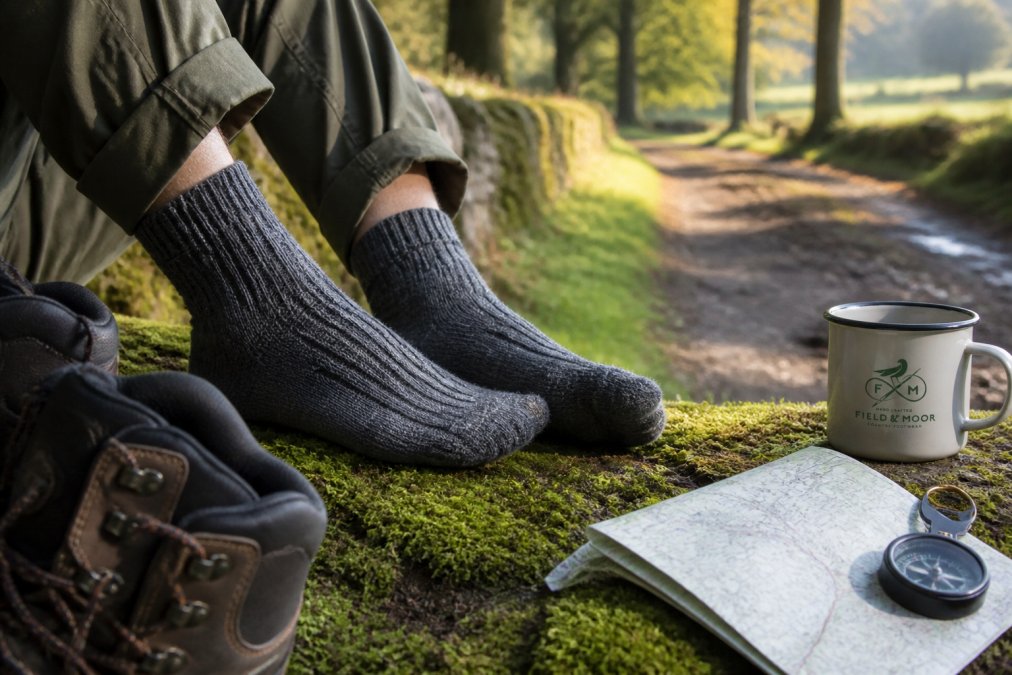
Merino wool walking socks benefits come down to one property: the fibre regulates temperature and moves moisture vapour away from skin, so feet stay warm in winter and cooler in summer. Merino fibres also have a natural crimp that traps air for insulation while remaining breathable.
How Merino Regulates Temperature and Manages Moisture
Merino works by absorbing moisture vapour into the core of the fibre, then releasing it as conditions change. This is thermal regulation in practice: the sock buffers your foot against temperature swings rather than simply insulating it.
Understanding Sock Cushioning Levels: From Light to Extra Cushioned
Cushioning runs from light through mid-weight to extra cushioned, and the right level depends on terrain, boot volume, and how much shock your feet absorb. Light cushioning suits fast walking on firm ground; extra cushioning suits rough ground, long days, and heavy loads.
| Cushioning Level | Padding Density | Best For | Trade-off |
|---|---|---|---|
| Light | Minimal, targeted | Fast walking, firm trails, warm weather | Less shock absorption |
| Mid-weight | Medium terry loops, heel and forefoot | General country walking, mixed terrain | Slightly warmer |
| Extra cushioned | High density, full footbed | Rough ground, long days, heavy packs | Takes up boot volume |
Choosing the Right Sock Height: Ankle, Crew, and Over-the-Calf
Sock height should match your boot height and the ground you walk on. Ankle length suits low shoes and summer; crew length is the workhorse for country walking; over-the-calf protects the calf and stays put in tall boots and wellingtons.
- Ankle: low shoes, dry summer trails, minimal coverage
- Crew: most country walking, sits above the boot collar
- Over-the-calf: tall boots, wellingtons, shooting, cold weather
The Importance of Fit and Sizing for Walking Socks
Fit matters more than any single feature on a sock label. A walking sock should sit close to the foot with no wrinkles, hold the heel in place, and leave room at the toe without excess fabric. Wrinkles cause friction; a loose heel lifts and rubs.
Should You Size Up or Down in Hiking Socks?
Size to your normal shoe size for a close fit, and size up only if you are between sizes or wearing a thick sock over a liner. Sizing down is almost never right: it reduces cushioning where you need it most and shortens the sock's life.
Moisture-Wicking and Breathability: Keeping Feet Dry on the Trail
Moisture-wicking fabric moves sweat away from skin to the outer surface of the sock, where it can evaporate through the boot's breathable lining. Breathability and wicking work together: wicking without ventilation just moves dampness around.
How to Prevent Blisters When Hiking: Fit, Friction, and Fabric
Blisters come from friction, moisture, and heat acting together on softened skin. The fix is not one product but three changes: a sock that fits without wrinkles, a fabric blend that manages moisture, and a boot that holds the heel secure.
Reducing Friction and Managing Hotspots
A hotspot is the warning stage: a warm, tender patch where friction is building. Stop and deal with it immediately. Adjust the sock, retie the boot, or add a thin liner before it becomes a blister.
- Check for wrinkles under the arch and at the heel
- Retie laces to lock the heel into the heel cup
- Swap to a dry pair if the sock is saturated
- Use a liner sock if you are prone to hotspots
Sock Construction and Seam Design: Seamless Toes and Arch Support
Construction decides how a sock feels after four hours, not four minutes. Look for a seamless or flat-linked toe, a defined heel pocket, graduated arch support, and a ribbed cuff that holds without pinching.
Seasonal Considerations: Summer vs Winter Walking Socks
Season is not just about warmth. It changes how much moisture your feet produce, how quickly skin softens, and how much insulation the sock needs to trap. The right sock for a July lowland walk is a different piece of kit from the right sock for a December day on the hill, even if both are merino blends.
Summer: Managing Heat, Sweat, and Friction
In warm conditions a foot can produce a significant amount of sweat over a long walk. That moisture softens the skin, and softened skin damages far more quickly under friction. The sock's job in summer is to move that moisture away from the skin and let it evaporate, while adding as little insulation as possible.
What to look for:
- Light cushioning under the heel and ball of the foot, where pressure peaks, but a thin instep so the boot still closes cleanly.
- Ventilation zones, often a mesh or ribbed panel across the instep, that let air move across the top of the foot.
- A higher merino content with a lighter knit, rather than a thick terry-loop footbed. Merino regulates temperature and manages moisture vapour; the lighter knit keeps the sock from feeling clammy.
- Crew height for most country walking, so the boot collar does not rub directly on skin, but ankle height is fine with low shoes on dry, firm ground.
Winter: Insulation, Dryness, and Boot Volume
Winter shifts the priority to keeping the foot warm and dry when boots may be wet for hours. The sock needs to trap insulating air, manage moisture from sweat and from any water that gets in, and fill the boot without crowding the toes.
What to look for:
- Mid to extra cushioning with a denser terry-loop footbed for insulation and shock absorption on rough, cold ground.
- A taller height, crew or over-the-calf, to protect the calf and stay put inside a tall boot or wellington.
- A denser merino blend, often with a slightly higher wool content, because the crimp in merino fibres traps air for insulation while still moving moisture vapour.
- A ribbed cuff that holds without pinching, which matters more when you are wearing the sock for hours in cold conditions.
Shoulder Season and the Two-Pair Approach
Spring and autumn are the hardest seasons to dress for because conditions change within a single walk. The practical answer is a mid-weight merino crew sock, which covers most of the year, plus one lighter pair for warm days and one heavier pair for cold ones. That three-pair rotation covers almost everything the British weather can throw at a country walk.
Lady Glen House of Cheviot Country and →
| Season | Priority | Sock Characteristics |
|---|---|---|
| Summer | Heat and moisture management | Light cushioning, ventilation zones, thinner knit, crew or ankle height |
| Winter | Insulation and dryness | Mid to extra cushioning, taller height, denser merino blend, ribbed cuff |
| Shoulder | Versatility | Mid-weight cushioning, crew height, breathable blend |
Matching Season to Boot, Not Just to Weather
Season and boot choice are linked. A roomy leather country boot that feels right in winter will feel sloppy in summer with a thin sock, and a close-fitting summer shoe will feel cramped with a thick winter sock. When you change season, check the sock-and-boot pairing as a system rather than changing one and hoping the other still works.
Sock-to-Boot Compatibility: Matching Socks to Your Footwear
Sock and boot must be chosen together, because sock thickness changes how a boot fits. Match a cushioned sock to a roomier boot and a thin sock to a closer-fitting one, and always test the combination before a long day out.
| Boot Type | Recommended Sock | Why |
|---|---|---|
| Leather country boot, roomy fit | Mid to extra cushioned crew | Fills volume, cushions underfoot |
| Close-fitting walking boot | Light to mid-weight crew | Avoids crowding the toe box |
| Tall shooting or field boot | Over-the-calf, mid cushioning | Stays up, protects calf |
| Wellington | Over-the-calf, mid cushioning | Prevents sock slipping down |
| Low walking shoe | Ankle or crew, light cushioning | Matches lower collar height |
Foot Anatomy and Pressure Mapping: Where Comfort Is Won or Lost
Pressure under the foot is not evenly distributed. The heel and the ball of the foot take the highest loads, the arch carries the least, and the toes take impact on descents. Sock design follows that map.
House of Cheviot Shooting Socks: Heritage Craft for Country Pursuits
House of Cheviot socks are designed, knitted, and hand finished in the Scottish Borders, and we stock a large range at competitive prices. For shooting, walking, and country wear, they combine a merino wool blend with zoned cushioning and a fit built for long days on the move.
Sustainability and Ethical Sourcing in Walking Socks
Durability is the most credible sustainability argument in socks. A pair that survives several seasons and holds its shape replaces three cheap pairs that pill, thin, and lose their cushioning. Look at wool sourcing, manufacturing location, and repairability.
Troubleshooting Common Fit Issues: When Socks Just Won't Cooperate
Most sock problems have a mechanical cause and a simple fix. Socks that slide down, bunch under the arch, or wear through at the heel are usually the wrong size, the wrong height, or paired with the wrong boot volume.
- Socks slide down: cuff too loose or sock too large; move to over-the-calf or a smaller size
- Bunching under the arch: sock too long or stretched; check sizing against foot length
- Heel wears through fast: heel lifting inside the boot; retie laces or reduce sock thickness
- Toes feel cramped: sock too thick for the boot; drop a cushioning level
- Feet cold despite thick socks: sock is damp; improve wicking with a merino blend
- Persistent hotspots: wrinkles or a poor heel lock; check fit before adding padding
Caring for Your Walking Socks to Extend Their Life
Most guides tell you to wash wool socks at 30 degrees and avoid the tumble dryer. That is correct but incomplete. The reason wool socks fail early is usually mechanical, not chemical: fibres break, loft collapses, and elasticity goes. Understanding why each care rule exists makes it easier to keep a good pair performing for years rather than months.
Why Wool Socks Wear Out: The Three Failure Modes
Wool socks rarely fail because the wool itself disintegrates. They fail in one of three ways:
- Fibre breakage from abrasion. Nylon is added at the heel and toe precisely because those are the high-wear zones. Once the nylon reinforcement thins, the wool fibres underneath abrade quickly.
- Loft collapse from heat and agitation. The crimp in merino fibres traps air for insulation and cushioning. Hot water and tumble drying relax that crimp, so the sock feels flat and stops cushioning pressure points.
- Elasticity loss from repeated stretching and heat. Lycra and elastane degrade with heat and with being left stretched. A sock that has lost its heel lock will slide and rub, which is a fit problem caused by care.
Washing: Temperature, Detergent, and Agitation
- Turn the sock inside out before washing. Most abrasion and sweat salts sit on the inside surface. Washing inside out cleans the part that touches your skin and protects the outer knit from rubbing against other items in the drum.
- Wash at 30 degrees on a wool or delicate cycle. Higher temperatures accelerate loft collapse and elasticity loss. A cool wash is enough to remove sweat and odour because merino naturally resists odour-causing bacteria.
- Use a wool-friendly detergent, not a biological one. Biological detergents contain enzymes that break down protein fibres, which is exactly what wool is. A pH-neutral wool wash preserves the fibre.
- Skip fabric softener entirely. Softener coats the fibres and reduces their ability to move moisture vapour, which is the main reason you bought a merino sock in the first place.
- Wash with similar colours and avoid heavy items. Zips, hooks, and velcro from other garments cause the abrasion that breaks fibres.
Drying: Why Flat Air Drying Matters
- Never tumble dry wool. Heat and tumbling are the fastest way to collapse loft and shrink the sock. Even a low-heat cycle causes cumulative damage.
- Lay flat to dry, reshaping the sock. Hanging a wet wool sock by the toe stretches it out of shape and puts strain on the cuff. Laying it flat and patting it back into shape preserves the anatomical fit.
- Dry away from direct heat. Radiators and airing cupboards that run hot will dry the sock but also relax the fibres. Room temperature is fine.
- Dry fully before storing. A sock put away damp can develop a musty smell and, over time, weaken the fibres.
Rotation, Storage, and On-Trail Care
The single biggest lifespan extender is rotation. A sock that is worn every day never fully dries, so the loft stays compressed and the fibres stay damp. Rotating two or three pairs on a multi-day trip lets each pair dry fully between wears, which restores loft and cushioning.
On the trail, a few habits help:
- Air socks overnight. Hang them outside the tent or on a line, even if they feel dry. Residual moisture in the footbed is what compresses the padding.
- Rinse mud and grit off before they dry. Grit embedded in the knit acts like sandpaper against the fibres on the next wear.
- Do not wring or twist a wet wool sock. Squeeze gently instead. Twisting stretches the knit out of shape.
- Store clean and dry, folded loosely. Do not store socks compressed in a tight bag for months, as this flattens the loft.
When to Retire a Pair
House of Cheviot socks are knitted and hand finished in the Scottish Borders, and we stock a large range at competitive prices. Treated with the care above, they are built to give several seasons of country walking rather than a single winter.
Frequently Asked Questions
What type of socks are best for traveling and walking?
Merino wool blend walking socks offer the best balance of comfort, temperature regulation, and moisture management for travel and country walks. Look for a cushioning level that matches your activity, a height that suits your boots, and a fit that stays snug without restricting circulation. Merino's natural properties keep feet warm in winter and cool in summer, making it a versatile choice for varied conditions.
What are the best socks for walking long distances?
For long distances, prioritise moisture-wicking fabrics like merino wool blends, moderate cushioning under the footbed, and a seamless toe to reduce friction. Arch support and a secure heel lock prevent slipping that leads to blisters. Socks with ventilation zones and wicking properties help manage sweat during sustained effort. Rotating two or three pairs on multi-day walks also extends performance.
Should I size up or down in hiking socks?
Choose your normal shoe size unless the sock is specifically labelled as thick or extra-cushioned, in which case you may need to size up to avoid compressing the cushioning. Socks that are too small restrict circulation and bunch; too large creates folds that rub. Check the manufacturer's size chart and measure your foot if you are between sizes. A proper fit should feel snug but not tight.
Are thick or thin socks better for walking?
Neither is universally better; it depends on your boots, the season, and the terrain. Thick cushioned socks suit cold weather and rough ground where padding reduces impact, while thinner socks work well in warm conditions or with close-fitting boots. Many walkers keep both weights and switch based on conditions. The key is matching sock thickness to boot volume so your foot stays stable.
What are the benefits of merino wool for walking socks?
Merino wool regulates temperature by trapping warmth in cold conditions and releasing heat when active, manages moisture by wicking sweat away from skin, and resists odour naturally. It is soft enough to wear against sensitive skin and provides breathability. Blended with nylon for durability and Lycra for elasticity, merino socks hold their shape and cushioning over many wears, making them a sound investment for regular walkers.
How do I prevent blisters when walking long distances?
Prevent blisters by wearing properly fitted moisture-wicking socks with a seamless toe, ensuring your boots are the right size, and keeping feet dry. Reduce friction by using a liner sock if needed and addressing hotspots immediately by stopping to adjust socks or apply tape. Cushioning and arch support help stabilise the foot. Gradually build up distance so your feet adapt to the load.
Do I need different socks for summer and winter walking?
Yes, seasonal socks make a noticeable difference. Summer calls for lighter, more breathable socks with ventilation zones to manage heat and sweat. Winter benefits from thicker, insulating merino blends with higher cushioning for warmth and impact absorption. Some walkers use a mid-weight sock year-round, but having a summer and winter pair ensures comfort across temperature extremes and varying terrain.
How do I care for my House of Cheviot socks to ensure longevity?
Turn House of Cheviot socks inside out and wash at 30 degrees on a wool-friendly cycle using a gentle detergent. Do not tumble dry, as high wool content can shrink; instead, lay them flat to air dry naturally. Avoid fabric softeners and bleach. Following these steps preserves the merino blend's wicking properties, elasticity, and cushioning, keeping your socks performing for many seasons of country walking.