
How to Break in Goodyear Welted Boots: 2026 Guide

Table of Contents
- Why Goodyear Welted Boots Feel Stiff at First
- Step 1: Check Sizing and Fit Before You Start
- Step 2: Build a Gradual Wear-In Schedule
- Step 3: Soften Stiff Leather Uppers Before Heavy Wear
- Step 4: Choose the Best Socks for Breaking in Boots
- Step 5: Preventing Blisters in New Boots
- How Long to Break in Leather Boots
- Troubleshooting Pressure Points and Heel Slip
- Looking After Goodyear Welted Boots After Break-In
- Frequently Asked Questions
Last Updated: September 18, 2026
Why Goodyear Welted Boots Feel Stiff at First
Goodyear welted boots feel stiff at first because the leather upper, cork filler and thick sole need time to mould to your feet. This construction is built to last for years, so it starts firm on purpose. At Field & Moor, our leather uppers are made from thick hides that stay soft, which helps break in Goodyear boots with far less misery than most people expect.
That stiffness is not a fault. It is the price of a boot that can be resoled again and again instead of thrown away.
The first week is the hardest. After that, the leather starts to give.
What the Welt and Cork Filler Do Underfoot
A Goodyear welt is a strip of leather stitched to the upper and the insole, then attached to the sole. It creates a water-resistant seal and lets a cobbler replace the sole later without damaging the boot.
Under your foot sits a cork filler. This layer sits between the insole and the outsole. As you walk, the cork warms and shifts, slowly taking the shape of your foot.
That is why a new boot feels hard and a worn boot feels custom. The SATRA footwear testing and technology guidance explains how sole and upper materials behave under repeated flexing. The cork does the moulding work. You just have to walk.
Step 1: Check Sizing and Fit Before You Start
Sizing is the one thing you cannot fix later. A boot that is too small will never break in comfortably, no matter how patient you are.
Start by measuring your feet at the end of the day, when they are at their largest. Stand up. Feet spread when you put weight on them.
Check these points before you wear them outdoors:
- Toe box: you need about a thumb's width ahead of your longest toe
- Heel: a small amount of slip is normal at first, roughly 3-5 mm
- Width: no pinching across the widest part of your foot
- Arch: the footbed should support you without digging in
If you have wide feet or high arches, look for boots built on a roomier last. Field & Moor's Ladies Chelsea Boot in mid brown country leather is made on an athletic last with a feminine fit and runs true to normal sizing, with full inside length measurements listed for every size.

Step 2: Build a Gradual Wear-In Schedule
A gradual wear-in schedule is the single most effective way to break in Goodyear welted boots without pain. Wear them for short blocks at first, then add time each day.
Here is a schedule that works for most people:
| Day | Wear Time | Where | What to Watch |
|---|---|---|---|
| 1-2 | 30-45 minutes | Indoors, carpet | Hot spots, heel slip |
| 3-4 | 1-2 hours | Indoors, around the house | Pressure points |
| 5-7 | 2-3 hours | Short walks outside | Rubbing at the heel |
| Week 2 | 3-5 hours | Normal daily wear | Overall comfort |
| Week 3 | Full days | All-day wear | Fit and flex |
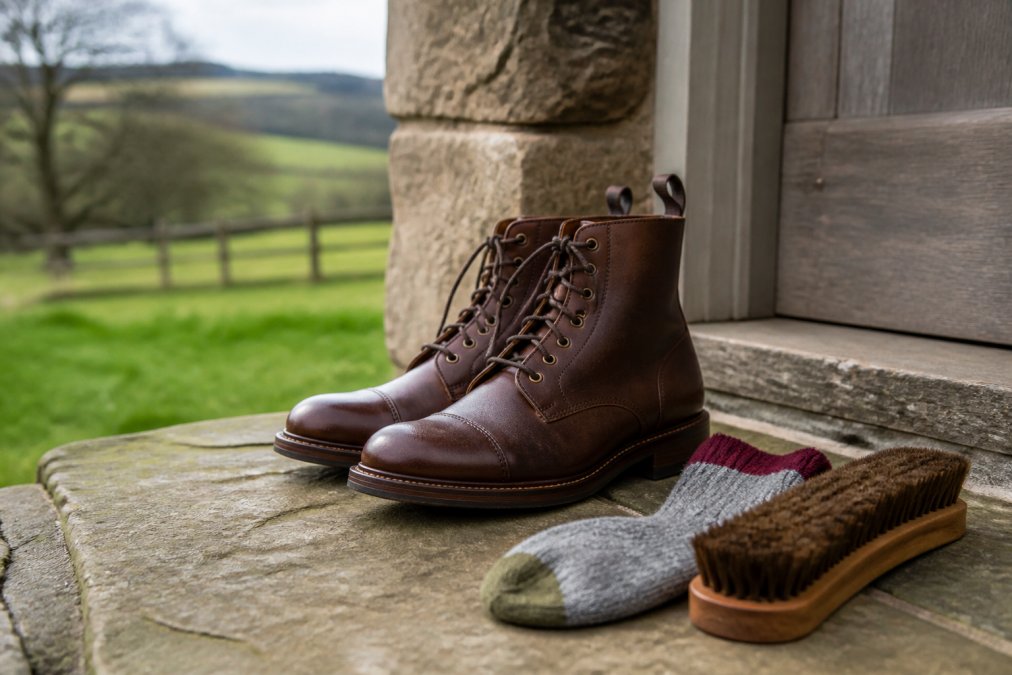
Wearing boots around the house is not wasted time. It is the cheapest way to soften leather without risking a blister on a long walk.
Keep the laces snug but not tight. You want the upper to flex, not clamp.
Step 3: Soften Stiff Leather Uppers Before Heavy Wear
Softening stiff leather boots starts with matching the product to the leather type, then applying it with a light hand. Too much conditioner can clog the leather and weaken the stitching. Too little, or the wrong product, and the upper stays board-stiff at the flex point.
The mechanism is simple. Leather is a network of collagen fibres held together by oils and fats. When those oils dry out, the fibres lock against each other and the upper feels hard. Conditioner replaces the lost oils, letting the fibres slide and re-form around your foot. That is why a dry boot breaks in badly and cracks early.
Work in thin layers. Let each one soak in before adding more.
- Use a dedicated leather conditioner or cream, not oil or grease
- Apply with a soft brush or cloth in small circles
- Focus on stiff areas: the vamp, the flex point and around the eyelets
- Leave for 20-30 minutes, then buff off any excess
- Repeat once a week during the break-in period
The vamp is the front section of the boot that creases as you walk. The flex point is where the sole bends at the ball of your foot. These two areas do most of the work.
Match the Method to the Leather
Not all leathers break in the same way. Treating a waxed flesh boot like a suede boot is how people ruin good uppers.
| Leather type | What it needs | What to avoid |
|---|---|---|
| Smooth full-grain | Cream conditioner, thin layers | Heavy wax that blocks breathability |
| Oiled or waxed flesh | Occasional neutral cream; brush to redistribute oils | Over-conditioning, which makes it greasy |
| Suede and nubuck | Suede brush and protector spray only | Creams and oils, which flatten the nap |
| Shell cordovan | Tiny amounts of cordovan cream, lots of brushing | Water and excess product |
A common pattern is that oiled leathers need less conditioner than people think. The oils are already in the hide. Brushing brings them to the surface. Smooth full-grain, by contrast, drinks up a light cream and softens quickly.
A good kit makes this simple. The Field and Moor Leather aftercare Boot cleaning kit at £26.25 includes Collonil delicate cream to soften and revive leather, Collonil Leather gel to condition and waterproof it, plus horsehair brushes and a polishing cloth.

Anatomy Changes the Plan
Your foot shape decides which parts of the upper work hardest. A generic routine misses this.
- High instep: the vamp and tongue area take the pressure. Condition here first and lace loosely over the instep to avoid cutting off circulation.
- Flat feet: the upper collapses inward at the arch. A slightly firmer conditioner on the quarter panels helps hold shape.
- Wide forefoot: the leather stretches across the ball. Keep this area supple so it gives without splitting.
- Narrow heel: the heel counter does the gripping. Condition the inside of the counter lightly to speed moulding.
If you are unsure which category you fall into, stand on a piece of paper, trace your foot and compare the outline to the boot's insole shape. The gaps tell you where pressure will build.
Step 4: Choose the Best Socks for Breaking in Boots
The best socks for breaking in boots are thick, seamless and made from natural fibres. They cushion pressure points and wick sweat away from the skin.
Thin cotton socks are the wrong choice. They bunch, rub and leave you raw.
Look for:
Field and Moor Leather aftercare Boot →
- Merino wool or wool blends for warmth and moisture control
- Cushioned heel and toe panels
- A seamless toe to reduce friction
- A snug fit with no wrinkles
House Of Cheviot socks, knitted and finished by hand in the Scottish borders, are made for long days in the field and work well during break-in. Wool also helps regulate temperature, so your feet stay dry in a boot that does not yet breathe perfectly.
Change socks if they get damp. Wet socks cause more blisters than tight boots.
Step 5: Preventing Blisters in New Boots
Preventing blisters in new boots comes down to three things: short wear sessions, dry feet and covered hot spots. Catch a hot spot early and you avoid a blister entirely.
The moment you feel rubbing, stop. Do not push through it.
- Apply a blister plaster or moleskin at the first sign of heat
- Keep toenails trimmed straight across
- Use a thin liner sock under a thicker wool sock for long walks
- Let boots dry fully between wears
- Rotate two pairs if you can
Most blisters form at the heel counter and the little toe. The heel counter is the stiff cup at the back of the boot that holds your heel in place. It softens with wear, but it is unforgiving in week one. Tension across the instep often exacerbates this friction, making the practice of preventing shoe damage through proper lacing techniques essential for a more comfortable break-in period.
If a blister does form, treat it and rest the boot for a day or two. Pushing on makes it worse.
How Long to Break in Leather Boots
Most leather boots take two to four weeks of regular wear to break in fully. Thick, stiff leather can take six weeks. Soft, supple leather can feel comfortable within days.
Several things change the timeline:
- Leather type: soft grain leather breaks in faster than stiff, oiled hides
- Sole flexibility: a rubber sole flexes sooner than a rigid leather one
- Your wear schedule: daily short sessions beat one long outing
- Fit: a correct fit halves the time
- Foot shape: high arches and wide feet often need longer
There is no fixed number. Judge by feel, not by the calendar. When the boot stops fighting your foot, it is done.
Troubleshooting Pressure Points and Heel Slip
Pressure points and heel slip are the two most common break-in complaints, and both usually have a fix that does not involve new boots. The hard part is knowing when discomfort is normal and when it means the boot is wrong for your foot.
Use this pain map to tell the difference.
| Where it hurts | Normal break-in? | Likely cause | What to do |
|---|---|---|---|
| Heel back, first week | Yes | New heel counter moulding | Tighten top eyelets, heel lock lacing |
| Heel back, after two weeks | No | Boot too long or too wide | Check heel slip; consider half size down |
| Little toe | Sometimes | Boot too narrow | Loosen lacing over the ball; try a wider last |
| Big toe tip | No | Boot too short | Size up; leather does not stretch lengthwise |
| Top of foot | Sometimes | Lacing too tight | Skip an eyelet pair or use a different lacing pattern |
| Arch | Sometimes | Footbed not yet moulded | Shorter sessions; check arch support |
| Ball of foot | No | Flex point in wrong place | Boot last does not match your foot length |
| Shin or ankle bone | No | Collar too high or too stiff | Different sock height; check boot height |
Heel slip is normal in the first week. The heel counter has not yet moulded to your ankle. If it persists past two weeks, your lacing is probably too loose. Tighten the top eyelets and try a heel lock lacing pattern.
Pressure points are sharper and more localised. They feel like a spot digging in, not a general rub. A pressure point that fades as the leather warms is normal. One that gets sharper the longer you wear is not.
The rule of thumb: normal break-in discomfort is diffuse, fades within an hour of removing the boots, and improves week on week. A fit problem is sharp, leaves a red mark that lasts, and does not improve after three weeks of regular wear.
If a pressure point will not shift after three weeks, the boot may be the wrong shape for your foot. That is a sizing issue, not a break-in issue. No amount of conditioner or patience will turn a narrow last into a wide one.
Looking After Goodyear Welted Boots After Break-In
Post-break-in care is what keeps a moulded boot comfortable for years. Once the leather has taken your shape, you want to protect that shape, not lose it.
Follow a simple routine:
- Brush off dirt after every wear
- Condition every four to six weeks, or more in wet weather
- Use shoe trees to hold the shape and soak up moisture
- Let boots dry at room temperature, never on a radiator
- Check the welt stitching and sole for wear once a season
Shoe trees are the most underrated tool here. Cedar trees pull moisture out of the lining and stop the leather curling at the toe.
The best part of Goodyear welted construction is that the boot can be resoled. When the sole wears through, a cobbler stitches on a new one. The upper, already moulded to your foot, carries on. That is why a well-kept pair can outlast several cheap pairs.
For boots worn in wet grass and mud, keep the leather fed and the welt clean. Dirt trapped in the welt stitching speeds up rot.
Breaking in a good pair of boots is a test of patience, but it pays back for years. The trick is a correct fit, a gradual wear schedule and leather that is soft enough to work with you. Field & Moor builds boots with thick but soft leather uppers, Goodyear and storm-welted construction, waterproof Sympatex linings and rugged Vibram soles, so the break-in is shorter and the wear is longer. Pair them with House Of Cheviot socks for comfort from day one. Get started with Field & Moor and step into boots built to mould to your feet and last for years.
Frequently Asked Questions
How long does it take to break in Goodyear welted boots?
Most people need two to four weeks of regular wear, spread across roughly 20 to 40 hours. Soft, thick leather uppers can mould within a week or so, while stiff grain leather may take longer. The key is a gradual wear schedule: short indoor sessions first, then longer outdoor walks, rather than one long day that leaves you sore.
Should I wear thick socks to break in new leather boots?
Yes. The best socks for breaking in boots are thick, breathable wool or wool-blend pairs that fill small gaps and cushion pressure points. They also manage moisture, which is what causes blisters. Avoid thin cotton socks during the first fortnight, and match sock thickness to how the boots fit so you are not stretching the leather unevenly.
Can I use leather conditioner to soften stiff leather boots?
A small amount of conditioner can help, applied sparingly to the flex point and any firm panels. Too much softens the leather unevenly and can darken it. Field & Moor uppers use thick but soft leather, so most pairs need little more than warmth, wear and a light condition every few weeks. Always test on a hidden area first.
How do I know when my boots are properly broken in?
The leather has moulded to your foot, the sole flexes at the ball without resistance, heel slip has stopped, and you can wear them all day with no pressure points or blisters. If they still pinch after a month of regular wear, the issue is usually sizing or lacing tension rather than the break-in itself, so adjust those before assuming the boots are faulty.