
Luxury Hiking Boots: Field & Moor Review (2026)

Table of Contents
- Luxury Hiking Boots: What You Actually Get for the Money
- Field & Moor Range at a Glance: Prices and Key Specs
- Marsh Harrier Men's: The Tall Boot for Rough Ground
- Marsh Harrier Ladies: Same Build, Shorter Last
- Harrier: The New Leather and Suede Combination
- Hiking Boot Fit and Sizing: Getting It Right First Time
- Waterproof Hiking Boots: How Sympatex and Storm Welting Perform
- Walking Boots for Rugged Terrain: Grip, Support, and Stability
- Hiking Boot Care: Making Handcrafted Leather Last
- Verdict: Which Field & Moor Boot Suits You
- Frequently Asked Questions
Last Updated: October 12, 2026
Luxury Hiking Boots: What You Actually Get for the Money
Spending £200 or more on a pair of luxury hiking boots is a decision most people make once a decade, so it pays to understand exactly where the money goes. At Field & Moor, we build our boots in family-owned artisan factories in Spain, using Goodyear and storm-welted construction, thick hydrophobic leathers, Sympatex waterproof linings and Vibram soles. That combination is what separates a boot you resole from one you replace.
Below, we break down our full range: prices, materials, sizing, waterproofing, grip and long-term care. If you want the short version, the Marsh Harrier is our flagship for rough ground, and the Harrier is our most versatile all-rounder.

Field & Moor Range at a Glance: Prices and Key Specs
Four models make up the current line, spanning men's and ladies' lasts, leather-only uppers and leather-suede combinations. Each is handcrafted in Spain and finished with a waterproof, breathable Sympatex lining.
| Model | Price | Upper | Sole | Best For |
|---|---|---|---|---|
| Marsh Harrier Men's (Tall) | £225.00 | Chestnut grain leather | Vibram Commando | Rough ground, fieldsports |
| Marsh Harrier Ladies (Tall) | £198.00 | Chestnut grain leather | Vibram Commando | Rough ground, wet weather |
| Harrier Men's | £225.00 | Chestnut leather and suede | Vibram | All-round country and town |
| Harrier Ladies | £210.00 | Tan leather and Felefrio suede | Vibram | All-round country and town |
The discontinued Hen Harrier Ladies in tan Dallas leather remains available at £112.00 for anyone who wants a lighter, athletic-lasted boot.

Marsh Harrier Men's: The Tall Boot for Rough Ground
The Marsh Harrier Men's is the boot we recommend first for anyone spending long days on wet, uneven ground. Its tall cut gives more ankle coverage than a standard walking boot, and the hydrophobic chestnut grain leather upper sheds water rather than soaking it.

What sets it apart is the detail work. A detachable reinforced gun-rest on the vamp protects the boot during field use, the half bellow tongue keeps water and debris out, and the full leather lining insulates against temperature swings.
- Vibram Commando sole for traction in mud and snow
- Storm-welted construction for longevity
- Sympatex waterproof and breathable lining
- Comes with a horse hair brush for after-wear care
At £225.00, it is a serious investment, but the storm welt means the sole can be replaced rather than the whole boot discarded.
Marsh Harrier Ladies: Same Build, Shorter Last
The Marsh Harrier Ladies shares the men's boot's core construction, just on a shorter, narrower last. Same hydrophobic chestnut grain leather, same Sympatex lining, same Vibram Commando sole, same storm welt.
The ladies' version adds cork in the footbed, which regulates temperature and cradles the foot for a more natural gait over long distances. It ships with an extra pair of laces and a boot brush, and it comes in at £198.00, slightly below the men's model.
For sizing, the wooden last measures 24.4 cm at UK 3 and 29.1 cm at UK 9, so you can match against a boot you already own.
Harrier: The New Leather and Suede Combination
The Harrier is our newest addition and the one we reach for when a boot needs to work across a shoot on Saturday and a town lunch on Monday. It pairs thick chestnut grain leather with chestnut suede on the men's version, and tan grain leather with Felefrio suede on the ladies'.
Both feature a full bellows tongue, Sympatex waterproof lining and a rugged Vibram sole. Goodyear welting and treble stitching add strength, while the full leather insole and cork infill keep the foot comfortable over long days.
- Men's Harrier: £225.00, detachable gun rests included
- Ladies' Harrier: £210.00, extra laces and horse hair brushes included
- Ski hooks and D rings hold the heel securely
That heel fitment matters more than most buyers realise. A locked-in heel prevents the rubbing that causes blisters on long walks.
Hiking Boot Fit and Sizing: Getting It Right First Time
Hiking boot fit and sizing comes down to one measurement: the internal length of the last the boot is built around. We publish this for every model so you can compare against a boot you already trust. But with a luxury boot, fit is not just about length, it is about protecting a significant investment, and the details that matter at £200+ are different from those at £90.
Our lasts run from UK 3 at 24.4 cm up to UK 15 at 33.8 cm on the Marsh Harrier Men's. The Harrier follows the same scale from UK 6 upward. The Hen Harrier Ladies runs UK 3 to UK 8. These are internal measurements, so they account for the thickness of the leather lining and insole in a way that a foot trace does not.
Why luxury fit is different
A mass-produced boot is often built on a generic last and padded to hide fit issues. A handcrafted boot like the Marsh Harrier or Harrier is built on a wooden last with a full leather insole and cork infill, which means it will mould to your foot over time, but only if the initial fit is correct. Too long and the heel will slip, causing blisters on descents. Too short and your toes will jam on steep ground. Neither is fixable by break-in.
Sock choice changes everything
A common mistake is measuring for boots while wearing thin cotton socks, then walking in thick wool socks. The difference can be half a size or more. For a boot like the Marsh Harrier, which is designed for cold, wet conditions, you will likely wear a thicker sock. Measure with the sock you intend to walk in. House of Cheviot socks, knitted by hand in the Scottish borders, are a good benchmark for the thickness a country boot is built around.
Break-in and return considerations
Goodyear-welted and storm-welted boots have a break-in period, typically a few short walks before the leather softens and the cork footbed takes your shape. The Marsh Harrier Ladies, with its cork footbed, often feels comfortable sooner than a fully rigid leather insole. But because these are expensive boots, you should check the return policy before wearing them outdoors. Most retailers will not accept returns on footwear that has been worn outside, so the smart approach is to try them on indoors, on carpet, and walk around for an hour before committing.
Width and volume
Our lasts are a standard width, but the full leather lining and cork infill mean the boot will accommodate a slightly higher instep over time. If you have wide feet or high arches, measure your existing boots first. A boot that is too long will slip at the heel; one that is too short will pinch the toes on descents. Getting this right is the difference between a boot you wear daily and one that sits in the cupboard.
Waterproof Hiking Boots: How Sympatex and Storm Welting Perform
Waterproof hiking boots rely on two things working together: the membrane inside and the construction of the upper. Ours use a Sympatex lining for waterproofing and breathability, paired with either storm welting or Goodyear welting depending on the model.
Storm welting reduces water penetration at the sole join, which is where most boots fail first. On the Marsh Harrier, the half bellow tongue and full leather lining add further protection. The Harrier uses a full bellows tongue instead.
Chestnut Grain leather 9 " Safari, Hiking and Walking Boot - Men’s - Marsh →
Sympatex is a non-porous membrane, so it keeps water out while allowing vapour to escape. In practice, that means your feet stay dry on a wet moor but do not overheat on a long climb.
Walking Boots for Rugged Terrain: Grip, Support, and Stability
Walking boots for rugged terrain need three things: grip, ankle support and stability underfoot. Every boot in our range pairs a Vibram sole unit with a reinforced heel counter and secure lacing.
The Marsh Harrier's Vibram Commando sole is built for mud and snow, with deep lugs that clear as you walk. The Harrier's Vibram unit is tuned for mixed terrain, offering grip on wet rock and loose gravel alike. The discontinued Hen Harrier uses a Ripple Vibram sole, engineered for shock absorption and lightness over long distances.
Ankle support comes from the tall cut on the Marsh Harrier and the ski hooks and D rings on the Harrier, which hold the heel firmly in place. That combination reduces roll on uneven ground and keeps your foot from sliding forward on descents.
Hiking Boot Care: Making Handcrafted Leather Last
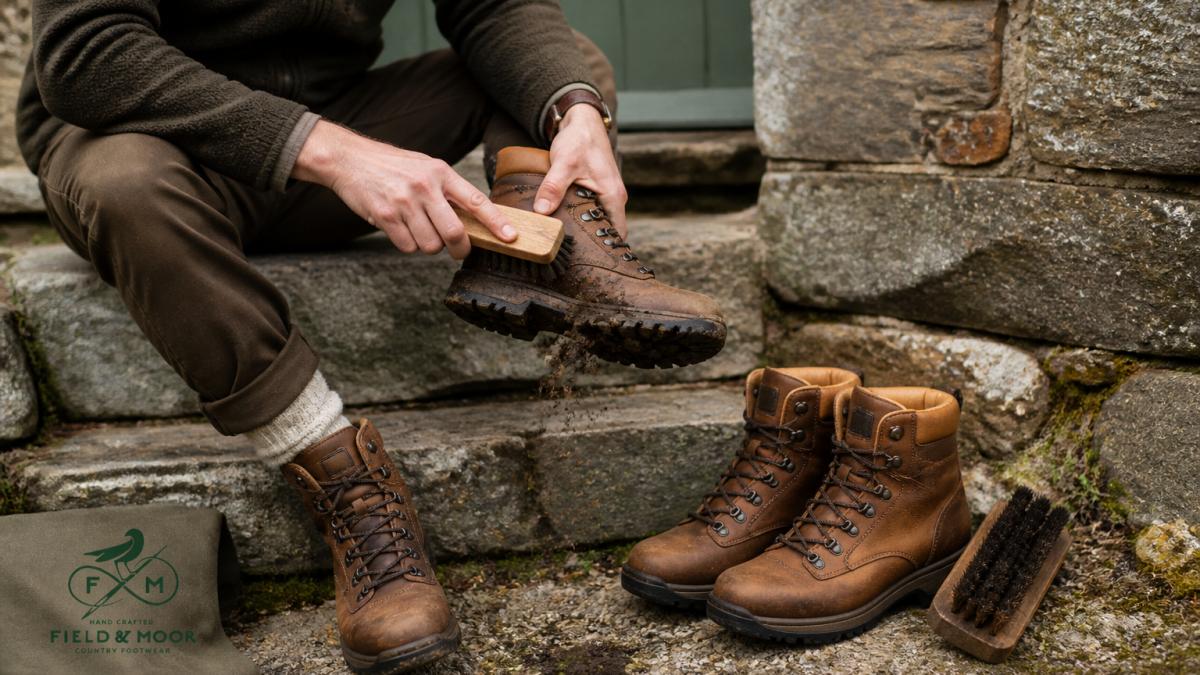
Hiking boot care is what turns a £225.00 purchase into a decade of wear. Every Field & Moor boot ships with a horse hair brush, and using it after each outing is the single most important habit you can build. But luxury boots need more than a quick brush; the materials and construction that justify the price also demand specific maintenance to deliver the cost-per-wear advantage.
The routine for grain leather
Brush off dried mud before it works into the stitching. Wipe the leather with a damp cloth. Let the boots dry naturally, away from direct heat, then apply a leather conditioner to keep the grain supple. For the Marsh Harrier's hydrophobic chestnut grain leather, a neutral conditioner is best; coloured waxes can darken the finish unevenly. Apply conditioner sparingly; too much can clog the leather's pores and reduce breathability.
Suede and combination uppers
The Harrier pairs grain leather with suede panels, and suede needs different treatment. Use the horse hair brush dry to lift the nap and remove dirt. Avoid heavy waxes or oils, which mat the suede and attract more dirt. If the suede gets wet, let it dry naturally and brush it back to life. A suede protector spray can help, but reapply it seasonally rather than weekly.
Membrane care
The Sympatex lining is a non-porous membrane that keeps water out while allowing vapour to escape. It does not need conditioning, but it does need to stay clean. Dirt and sweat salts can clog the membrane over time, reducing breathability. Rinse the inside of the boot with lukewarm water occasionally and let it dry thoroughly. Never use heat, and never machine wash.
Welting and resoling
Because our boots are Goodyear or storm-welted, the sole can be replaced when it wears through. That repairability is the core of the value case. A £225.00 boot resoled twice over ten years costs far less per wear than a £90.00 boot replaced every two. A common pattern is that the first resole is needed after three to five years of regular use, depending on terrain and how much you walk on abrasive surfaces like rock or tarmac. A good cobbler can replace the Vibram sole and re-stitch the welt, restoring the boot's performance without replacing the upper.
Cost per wear: the luxury argument
If you walk twice a week for ten years, that is roughly 1,040 outings. At £225.00, that is about 22p per wear before resoling. Add two resoles at, say, £60 each, and the total is £345.00, still under 34p per wear. A £90.00 boot replaced every two years costs £450.00 over the same period, and it never fits as well or performs as reliably. That is the luxury case in numbers.
Verdict: Which Field & Moor Boot Suits You
If you spend your weekends on wet moorland, in mud or on snow, the Marsh Harrier is the boot to buy. The tall cut, hydrophobic grain leather and Vibram Commando sole are built for exactly that ground. Men's at £225.00, ladies' at £198.00.
If you want one boot for the shoot, the dog walk and the drive into town, the Harrier is the better call. The leather and suede combination softens the look without giving up the Sympatex lining or Vibram grip. Men's at £225.00, ladies' at £210.00.
Either way, buy for the last measurement, not the size on your old boots, and treat the leather well. That is how a pair of luxury hiking boots earns its keep.
Choosing the right boot for British weather and mixed terrain is easier when the construction does the work for you. Field & Moor builds every pair with Goodyear and storm-welted construction, a waterproof Sympatex lining and rugged Vibram soles, handcrafted in family-owned artisan factories in Spain. Explore the Marsh Harrier and Harrier range, and pair them with House of Cheviot socks knitted by hand in the Scottish borders. Get started with Field & Moor and invest in boots built to be resoled, not replaced.
Frequently Asked Questions
What makes hiking boots luxurious?
Luxury hiking boots combine handcrafted construction with premium materials. Field & Moor boots use thick hydrophobic leather uppers, full leather linings, Goodyear or storm-welted construction, and Vibram soles. The difference shows in the details: treble stitching, cork footbeds that regulate temperature, and soles that can be repaired rather than replaced. These boots are built to be maintained and resoled, not discarded after a season.
How should hiking boots fit?
Your heel should sit firmly with minimal lift, and your toes need roughly a thumb's width of space at the front. Field & Moor publishes the internal last measurements for every size, so you can compare against a boot that already fits you. For example, the men's Marsh Harrier in UK 9 measures 29.1 cm internally. Wide feet and high arches often suit this generous last better than narrow technical boots.
Are waterproof hiking boots breathable?
Yes, when the lining is designed for it. The Sympatex membrane in Field & Moor's Marsh Harrier and Harrier boots keeps water out while allowing moisture vapour to escape. Full leather linings and cork footbeds also help regulate temperature. No waterproof boot is as breathable as an unlined leather boot, but for wet British conditions the trade-off favours staying dry.
How do you care for leather hiking boots?
Brush off mud while it is still damp, using the horse hair brush supplied with Field & Moor boots. Let them dry at room temperature, never on a radiator. Clean the leather periodically, then apply a conditioner or wax to feed it and maintain water resistance. Store them with the shape held. Goodyear-welted boots can be resoled when the Vibram unit wears down, which extends their working life well beyond glued alternatives.
Can luxury hiking boots be worn for everyday use?
The Harrier and Marsh Harrier styles work for both country pursuits and town wear. The leather and suede combinations look smart enough with trousers, while the Vibram soles and waterproof linings handle fieldsports and dog walking. One pair covers a Saturday shoot and a weekday in town without looking out of place in either setting.