
7 Essential Items for Deer Stalking in Scotland

Table of Contents
- Why a Focused Deer Stalking Kit List Matters
- 1. Best Boots for Deer Stalking: The Foundation of Every Day on the Hill
- 2. Deer Stalking Clothing: Layering for Wet, Cold and Changing Weather
- 3. Socks and Gloves That Keep Hands and Feet Working
- 4. Optics: Binoculars, Rifle Scope and Rangefinder
- 5. Rifle, Ammunition and Pre-Stalk Checks
- 6. Knife, Recovery Kit and Field Dressing Essentials
- 7. Deer Stalking Safety Essentials: Legal Requirements and Permissions
- Your Complete Deer Stalking Kit List: What to Pack vs What the Guide Provides
- Frequently Asked Questions
Last Updated: October 20, 2026
Why a Focused Deer Stalking Kit List Matters
Deer stalking in Scotland punishes poor preparation faster than almost any other country pursuit. A short walk from the vehicle can turn into three hours of crawling through wet heather, and the wrong boot or a fogged scope ends the day before it starts. This guide from Field & Moor breaks the kit down to seven essentials, ranked by what actually fails first on the hill.
The principle behind the list is simple: deer stalking is the practice of approaching wild deer on foot to within safe shooting range, using cover, wind and terrain to stay undetected. Everything you carry either supports that approach or gets in the way. Kit that rubs, rattles or soaks through costs you the stalk, not just comfort.
Below, we cover what to buy, what to check before you leave, and what your guide will already have in the truck. First, though, the part most first-timers get wrong: buying the rifle before the boots.
1. Best Boots for Deer Stalking: The Foundation of Every Day on the Hill
The best boots for deer stalking are waterproof, ankle-supporting and built for wet ground, because Scottish stalking means bog, heather and steep grass rather than paths. Get this wrong and nothing else in your kit matters.
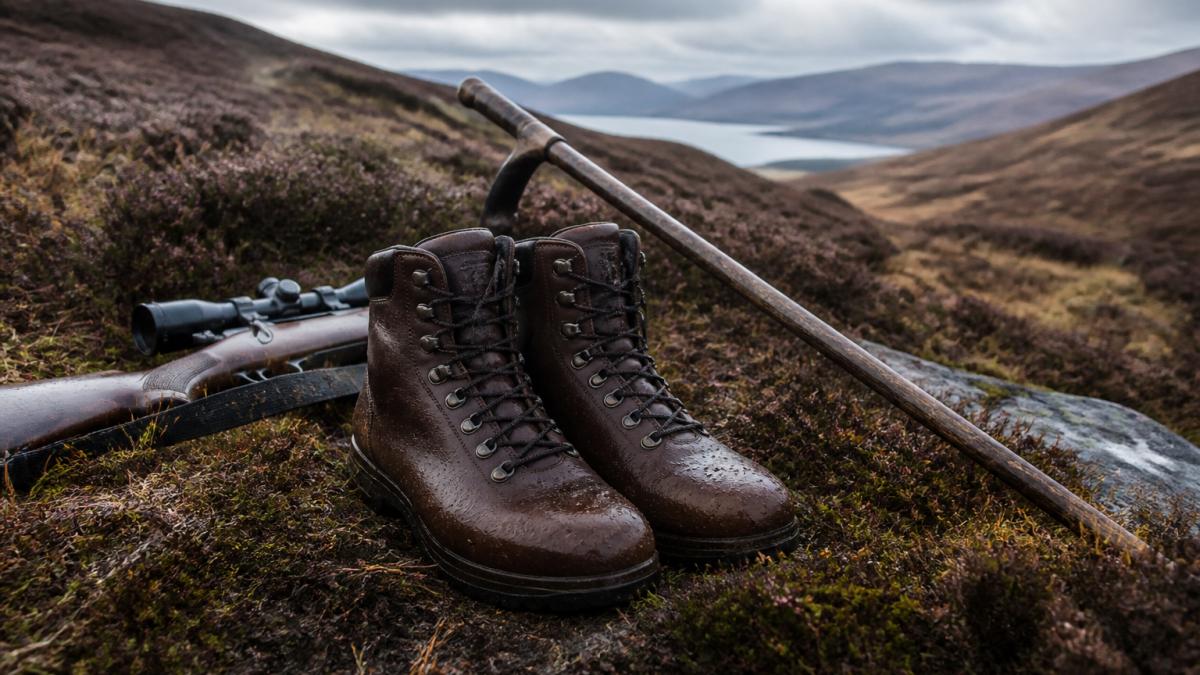
Look for four things: a waterproof and breathable membrane, a deep lugged sole for mud, a stiffer midsole for side slopes, and construction that can be repaired rather than replaced. A stalking boot also needs a protected vamp, since you will be kneeling and crawling far more than walking upright.
Our own pick is the Osprey laced country boot at £270.00. The greased hydrophobic leather upper, Sympatex lining and Vibram Commando sole are built for exactly this ground, and the detachable gun-rest on the vamp protects the boot when you are shooting from low positions. Storm-welted construction means it can be resoled instead of binned.

A common mistake is buying boots a full size up to fit thick socks. Fit to your normal sock thickness and check the internal last measurement before ordering.
2. Deer Stalking Clothing: Layering for Wet, Cold and Changing Weather
Deer stalking clothing works as a layering system, not a single jacket. Scottish weather shifts from still and mild to horizontal rain inside an hour, and you will overheat on the climb then freeze the moment you stop to glass.
Build it in three parts:
- Base layer: merino or synthetic, never cotton, which holds water against the skin.
- Mid layer: fleece or light insulation you can strip off before a climb.
- Outer layer: quiet, waterproof and breathable, with a hood that does not flap in wind.
Camo patterns are optional. Movement and wind discipline matter far more than pattern, and a steady, dull-coloured outer layer beats a busy one that rustles. Avoid anything crisp or shiny; deer pick up both.
Weatherproofing is the gap most kit lists skip. Reproof your outer shell before the season, check taped seams, and carry a lightweight waterproof bag for your pack so your spare layers stay dry even if the pack soaks.
3. Socks and Gloves That Keep Hands and Feet Working
Socks and gloves are the cheapest items on this list and the ones most likely to ruin a day. Cold, wet hands fumble a safety catch; damp feet blister on the walk back.
For socks, choose a merino blend with a reinforced heel and a knee-length cuff that stays up inside the boot. House of Cheviot socks are knitted and finished in the Scottish Borders, and the Harris in forest green at £34.50 uses an 85% merino wool blend with nylon and Lycra for durability. Take two pairs: one to wear, one dry pair in the pack.

Gloves need to do two different jobs. Thin, close-fitting gloves let you feel a trigger and work a bolt; thicker insulated gloves keep you warm while glassing. Carry both. A thin pair of latex gloves in a pocket is worth its weight for gralloching later.
4. Optics: Binoculars, Rifle Scope and Rangefinder
Optics are how you find deer before they find you. Binoculars do the searching, the rifle scope does the aiming, and a rangefinder confirms the distance you will shoot at.
Binoculars in the 8x42 range suit most woodland and open hill stalking: bright enough at dawn and dusk, light enough to carry all day. Higher magnification sounds better but shakes in cold hands and narrows your field of view when a deer breaks cover close by.
Your rifle scope should be zeroed and its turrets set before you travel, not adjusted on the estate. A rangefinder removes the guesswork on distance, which matters more on open ground than in woodland where ranges are short. Reliable timekeeping remains just as critical as precise optics when managing your pace across the hills, making the selection of robust watches for hunting an essential consideration for any serious stalker.
Keep lenses clean and dry. A microfibre cloth and a lens pen in a chest pocket prevent the fogged, smeared view that costs you the only chance of the day.
5. Rifle, Ammunition and Pre-Stalk Checks
The rifle and ammunition are the items you must confirm with your guide before booking, because requirements vary by estate, by ground and by species. Never assume your setup suits the terrain you are travelling to.
Start with the legal position. In Scotland, the Deer (Firearms etc.) (Scotland) Orders set out the minimum calibres and muzzle energies permitted for each species, and your firearm certificate must list a rifle that meets those thresholds for the deer you intend to take. A common pattern is a .243 Winchester or larger for roe and a .270 or 6.5mm for red deer on open hill, but the estate's own policy often narrows that further. Confirm the calibre and bullet weight your guide expects before you travel, not on the morning.
11 " Laced Country Boot - Greased brown Leather - Men’s - Osprey →
Ammunition choice matters as much as calibre. Most Scottish stalking is done at ranges under 150 metres, so a heavier, controlled-expansion bullet that holds together on a shoulder shot is more useful than a flat-shooting varmint round. Carry only what you need for the day in a secure case, know your estate's limit, and keep the rest locked away. Expanding ammunition must be used for deer, and non-lead alternatives are increasingly requested by estates managing carcases for the food chain, ask which is preferred.
Pre-stalk checks we would run every time:
- Confirm the rifle is suitable for the species and ground with your guide in advance, including any estate-specific calibre or bullet rule.
- Check your zero on a range before travelling, and again if the rifle has been knocked in transit or has sat in a cold vehicle.
- Confirm the condition of the rifle, bolt and moderator, and clean and dry everything after a wet day.
- Practise shooting from sticks and from prone, since most hill shots are taken from support and the angle changes on sloping ground.
- Check that your firearm certificate and any visitor permit are current and carried, and that your ammunition is stored and transported lawfully.
Zeroing is not a formality. A rifle that has flown, driven over rough tracks or sat in a cold vehicle can shift, and a stalk ruined by a poor shot is worse than a stalk not taken. If you are travelling with your own rifle, check the Home Office guidance on firearm certificates and confirm with your guide what documentation the estate requires on arrival.
6. Knife, Recovery Kit and Field Dressing Essentials
Field dressing and carcass handling are where first-timers are least prepared and most grateful for the right kit. Your guide will lead the gralloch, but you should carry your own basics and understand the sequence so you are useful rather than in the way.
A practical field-dressing kit is small: a sharp fixed-blade knife with a sheath, a small sharpening stone or steel, latex or nitrile gloves, a cloth or wipes, and a strong cord for tying off. Add a compact recovery kit, a drag strap or sled, strong cord, and a head torch for the walk out after dark. On open hill, extraction can be the longest part of the day, and a deer that falls in a bog or on a steep face changes the plan entirely.
The gralloch itself follows a consistent pattern. Your guide will open the abdomen, remove the pluck and gralloch, and inspect the carcase for signs of disease before it is lardered. Your job is to hold a torch, pass kit, keep the site clean and follow instructions. A blunt knife is the most common field-dressing mistake: it turns a straightforward gralloch into a slow, unsafe job, so sharpen before you travel and carry a stone.
Lardering, the inspection and preparation of the carcase for the food chain, is usually done by the guide or estate larder. Ask in advance what they provide for extraction and lardering, so you are not carrying a sled you will never use or missing a strap you need. On some estates a quad bike or Argo is available; on others the deer is dragged or carried out, and that changes what you should bring.
Ask your guide in advance what they provide for extraction and lardering, and confirm whether you are expected to carry the carcase out or whether transport is arranged. That single question decides whether a drag strap is essential or dead weight.
7. Deer Stalking Safety Essentials: Legal Requirements and Permissions
Deer stalking safety essentials start with the law, not the kit bag. In Scotland, deer management is governed by the Deer (Scotland) Act 1996 and the Deer (Firearms etc.) (Scotland) Orders, which set out lawful seasons, permitted firearms and ammunition, and the conditions under which deer may be taken. Always confirm current requirements with the relevant Scottish authority and with your guide before you travel.
What this means in practice:
- Permission: you need the landowner's or estate's permission to stalk, and written permission where required. Never assume access.
- Firearms: your firearm certificate must be valid and your rifle and ammunition must comply with the legal requirements for the species and season.
- Seasons: red deer, roe deer and sika deer have different seasons and different rules for stags and bucks versus hinds and does. Off season means off, regardless of what you see.
- Safety: treat every rifle as loaded, identify your target and what lies beyond it, and follow your guide's safety brief without exception.
The Scottish Government guidance on deer management and NatureScot deer management information set out the legal framework and current seasons. Read them before you book, and check the Home Office guidance on firearm certificates if you are travelling with your own rifle.
Your Complete Deer Stalking Kit List: What to Pack vs What the Guide Provides
Most estates and guides provide the rifle, ammunition, sticks, drag equipment and lardering tools, plus transport on the ground. Confirm the split in writing before you travel, because it varies widely.
Here is how we would divide a typical kit list:
| Item | You Bring | Guide Usually Provides | Priority |
|---|---|---|---|
| Boots | Yes | No | Essential |
| Layering and waterproofs | Yes | No | Essential |
| Socks and gloves | Yes | No | Essential |
| Binoculars and rangefinder | Yes | Sometimes | Essential |
| Rifle and ammunition | Confirm first | Often | Essential |
| Knife and latex gloves | Yes | Sometimes | Essential |
| Recovery and extraction kit | Confirm first | Usually | Confirm |
| Safety and legal documents | Yes | No | Essential |
Your seven essentials, in priority order: boots, layering, socks and gloves, optics, rifle and pre-stalk checks, knife and recovery kit, and safety and legal compliance. Everything else is optional.
Frequently Asked Questions
What should I wear for deer stalking in Scotland?
Start with a waterproof and breathable outer layer in muted greens or browns, then add insulating mid-layers you can remove as you warm up. Avoid noisy fabrics and bright colours. Good boots and wool socks matter as much as the jacket, because wet feet end a day early. Check whether your guide expects you to wear a shooting suit or practical hill clothing, and confirm any colour requirements before you travel.
What equipment do you need for deer stalking?
A deer stalking kit list should cover boots, clothing, socks and gloves, binoculars, a rifle with scope and ammunition, a knife, and a small recovery kit. Add a rangefinder if you are shooting at longer ranges. Many guides supply the rifle and handle carcass extraction, so ask before buying gear you may not need. Focus your budget on footwear and optics, which affect every stalk.
What boots are best for deer stalking?
Look for waterproof, breathable boots with a grippy sole and enough support for uneven ground. Leather boots with a Sympatex lining and a Vibram Commando sole, such as the Field & Moor Osprey at £270, handle mud, heather and wet rock well. Fit matters more than brand: try boots with the socks you will wear and allow room for swelling feet on long days.
Do you need waterproof clothing for deer stalking?
Yes. Scottish weather changes quickly, and a waterproof outer layer keeps you comfortable during long periods of glassing and waiting. Breathable fabrics prevent overheating on steep climbs. Pair the jacket with waterproof trousers and avoid cotton next to the skin. Even on a dry forecast, carry a packable shell, because a shower can arrive within minutes on open hill.
What safety equipment should a deer stalker carry?
Carry a first aid kit, a charged phone or radio, a map and compass, and a headtorch for late returns. Know the legal requirements for your outing, including permission to be on the land and any firearm licensing conditions. Tell someone your route and expected return time. If you are new to stalking, book with a guide who can brief you on safety and firearm handling before you set out.
A well-planned kit removes the excuses and leaves you free to concentrate on the stalk itself. Field & Moor builds footwear for exactly that ground: the Osprey laced country boot pairs a waterproof Sympatex lining and Vibram Commando sole with storm-welted construction that can be repaired for years of use, while House of Cheviot socks knitted in the Scottish Borders keep feet dry and warm through a full day out. Get started with Field & Moor and walk onto the hill properly equipped.