
Leather vs Rubber Boots for Shooting: 2026 Comparison

Table of Contents
- Leather vs Rubber Boots for Shooting: The Quick Comparison
- Waterproofing and Wet Weather Performance
- Ankle Support and Stability on Rough Terrain
- Breathability, Insulation and Comfort for Long Days
- Durability, Repairability and Resoling
- How to Ensure Proper Fit for Lace Up Boots
- How to Break in Leather Shooting Boots
- Leather Boot Care and Maintenance
- Which Boot for Which Terrain: A Field Guide
- Frequently Asked Questions
Last Updated: September 20, 2026
Leather vs Rubber Boots for Shooting: The Quick Comparison
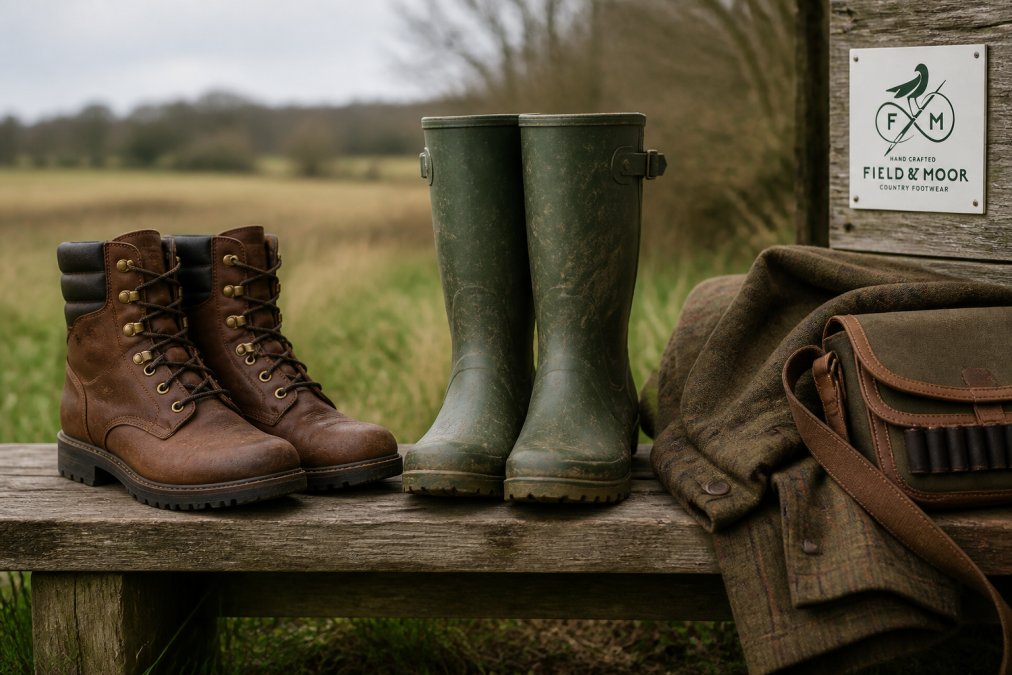
The leather vs rubber boots for shooting debate comes down to two different tools for two different jobs. Leather boots win on ankle support, breathability and repairability across rough terrain, while rubber wellingtons win on total waterproofing in standing water and deep mud. At Field & Moor, we build handcrafted leather country boots for exactly this reason: most shooting days involve walking, not wading.

Rubber has one genuine advantage. It cannot leak. A rubber wellington is a single moulded shell, so there is no stitching, no welt and no membrane to fail. If your day involves standing in a flooded dyke bottom or crossing saturated bog, that matters more than anything else on this page.
Leather is a different proposition. A well-made leather shooting boot breathes, holds your ankle, and can be resoled rather than replaced. The trade-off is that it needs care to stay waterproof, and cheap leather boots rarely survive a hard season.
Below, we break down waterproofing, ankle support, breathability, durability and terrain so you can pick the right pair for your shoot. The quick comparison table covers the essentials first.
| Factor | Leather Shooting Boots | Rubber Wellingtons |
|---|---|---|
| Waterproofing | Membrane plus treated leather | Fully waterproof shell |
| Ankle support | High, laced or structured | Low to moderate |
| Breathability | Good with a membrane lining | Poor, feet sweat |
| Repairability | Resolable, rebuildable | Not repairable |
| Best terrain | Rough, hilly, mixed ground | Wet, flat, standing water |
| Longevity | Years with care | One to three seasons |
Waterproofing and Wet Weather Performance
Leather boots stay dry through a combination of a waterproof membrane and a treated upper, not through the leather alone. Field & Moor boots use a Sympatex lining that is both waterproof and breathable, which is the same principle most serious leather shooting boots rely on.

The weakness is the seams and the welt. Water sits on stitching and works its way in over a long, wet day. That is why a waterproofing treatment on the leather matters, and why you should reapply it through the season rather than once a year.
Rubber boots have no seams to fail. A wellington is waterproof by construction, full stop. The catch is condensation: your feet produce moisture, and a rubber shell traps it. After four hours of walking, many shooters find their socks are damp from sweat even though nothing got in from outside.
For wet weather performance, the honest answer is that rubber wins on a static, soaked day and leather wins on a moving one. If you are walking between drives in steady rain, a breathable leather boot with a membrane keeps your feet drier overall because it lets vapour out.
Ankle Support and Stability on Rough Terrain
Ankle support is where leather shooting boots separate themselves from wellingtons. A structured leather upper, especially a laced or high-cut design, holds the ankle and reduces the roll that causes sprains on tussocky or stony ground.
Rubber wellingtons are soft and flexible, which is comfortable on flat ground and a liability on a slope. The shaft bends, the ankle moves freely, and on wet grass or loose shale that freedom becomes instability.
Field conditions rarely offer flat, even ground. A walked-up day over moorland or through root crops puts your ankles under constant load, and that is where a stiff heel counter and a supportive upper earn their keep. Boots with a contoured fit and a secure lacing system keep the foot locked in place, which reduces foot fatigue over a long day.
If your shooting is mostly standing on a peg with short walks, ankle support is a smaller concern. If you cover miles over uneven ground, it is close to the top of the list.
Breathability, Insulation and Comfort for Long Days
Breathability is the single biggest reason shooters move from rubber to leather, but most guides stop at 'leather breathes, rubber sweats' and never explain the mechanism or what to do about it. The mechanism matters because it dictates your sock system.
A rubber wellington is a sealed shell. Your foot produces moisture vapour continuously, roughly a quarter of a litre of sweat over a full walking day, and a rubber boot traps all of it against your skin. The sock becomes saturated, conductivity rises, and your feet go cold even though the boot itself is warm. That is why shooters in wellingtons often report cold feet on mild days: the problem is moisture, not insulation.
A leather boot with a breathable membrane works differently. Vapour passes through the membrane and out through the leather, so the moisture load in the sock stays lower. The membrane is a barrier to liquid water but not to vapour, which is why a good leather boot can be both waterproof and breathable at the same time. The catch is that breathability only works if the vapour has somewhere to go, a boot laced tight over a saturated cotton sock will still feel clammy.
How boot material dictates your sock system
This is the part almost no comparison covers. The boot you choose determines the sock thickness and fibre you need, not the other way round.
With rubber wellingtons: the boot cannot vent, so the sock has to do all the moisture management. That means a thin moisture-wicking liner against the skin under a wool outer sock. The liner moves sweat away from the foot; the wool absorbs and buffers it. A single thick cotton sock in a wellington is the worst combination available, cotton holds water against the skin and loses all insulation value when wet.
With breathable leather boots: the boot vents some vapour, so you can run a slightly thicker single wool or wool-blend sock without overheating. A liner sock is still useful on long walked-up days, but it is less critical than in rubber.
With insulated leather boots (winter): the insulation layer sits between your foot and the membrane, so the sock should be thinner than you would wear in an unlined boot of the same warmth. Over-socking an insulated boot compresses the insulation and reduces its loft, which makes your feet colder, not warmer.
Seasonal sock layering
| Season | Boot | Sock system |
|---|---|---|
| Mild, walked-up days | Breathable leather | Thin wool or wool-blend, single layer |
| Cold, driven days | Insulated leather | Thin liner under mid-weight wool |
| Wet, static days | Rubber wellington | Thin wicking liner under thick wool |
| Deep winter, static | Insulated rubber | Liner under heavy wool, plus a spare pair to change at lunch |
A common pattern among experienced shooters is to carry a spare pair of socks and change them at lunch on a wet day. It costs nothing, takes two minutes, and resets the moisture load in the boot for the afternoon.
Comfort over a long day
Comfort is not one feature, it is several working together:
- A moisture-wicking sock that moves sweat away from the skin
- A breathable membrane lining that lets vapour out
- A cushioned footbed that absorbs shock on hard ground
- A fit that holds the heel without pinching the toes
- A sole stiff enough to stop stone bruising on rough ground
Sock choice is the cheapest upgrade available and the one most shooters get wrong. A wool or wool-blend shooting sock regulates temperature and cushions the foot far better than a cotton everyday sock, which holds moisture against the skin and loses insulation when damp.
Durability, Repairability and Resoling
Durability is the strongest argument for leather, and repairability is the reason. A Goodyear-welted leather boot can be resoled and rebuilt, so the upper can outlast several soles. Rubber wellingtons cannot be repaired at all once they split or perish.
This is the part most comparisons skip. A rubber boot is a consumable. When the sole wears through or the rubber cracks at the flex point, the boot is finished and goes in the bin. A welted leather boot goes back to a cobbler, gets a new sole, and returns for another few seasons.
Field & Moor boots use Goodyear and storm-welted construction for exactly this reason. The welt is stitched, not glued, so the sole can be replaced without destroying the upper. Full-grain leather uppers, triple stitching and reinforced eyelets all add to the working life of the boot. Investing in such robust materials ensures that the full grain leather benefits endure through years of heavy use in the field, providing a level of durability that synthetic alternatives struggle to match.
Country Boot in Chestnut Brown Leather →
Sustainability follows from repairability. A boot you resole three times uses far less material than three pairs of wellingtons. If you shoot regularly, the cost per season of a repairable leather boot is often lower than replacing rubber every couple of years.
How to Ensure Proper Fit for Lace Up Boots
Getting the fit right is the difference between a boot you wear for a decade and one that gathers dust. How to ensure proper fit for lace up boots comes down to measuring your feet properly, allowing for socks, and checking heel hold before you commit.
Start with your actual foot length, not your shoe size. Field & Moor lists the internal length of the last for each size, which is far more useful than a generic UK size. For example, a UK 9 measures 29.1 cm inside, and a UK 10 measures 29.7 cm. Measure your foot against a wall, add a small allowance for a thick sock, and match it to the internal length.
Then work through the checks:
- Measure both feet, and fit to the larger one
- Wear your shooting socks when you try the boots on
- Check heel hold: your heel should not lift when you walk
- Check toe room: about a thumb's width in front of the longest toe
- Check width across the ball of the foot for pinching
- Lace up fully and walk on a slope if you can
Wide feet and high arches are the most common fitting complaint. A laced boot with a bellows tongue and adjustable lacing gives you far more room to work with than a pull-on wellington, because you can loosen the forefoot while keeping the ankle locked.
How to Break in Leather Shooting Boots
How to break in leather shooting boots is mostly about patience and short sessions, not endurance. Leather softens and moulds to your foot through flexing and warmth, and rushing that process is what causes blisters.
The good news is that break-in depends heavily on the leather. Field & Moor uses premium leathers from local Spanish tanneries chosen specifically to be easy to break in, which shortens the process considerably compared with stiff, heavily finished hides. A softer, well-tanned leather moulds quickly; a hard, dry one fights you for weeks.
A sensible break-in routine:
- Wear them indoors for an hour a day for the first few days
- Move to short walks on pavement, building up gradually
- Add your shooting socks once the leather starts to soften
- Keep the lacing snug but not tight across the instep
- Treat the leather before your first full day out
Expect some stiffness in the first week. If you are getting hot spots, stop and let the boot cool rather than pushing through. The leather adapts to your foot, but it needs recovery time between sessions.
Leather Boot Care and Maintenance
Leather boot care and maintenance is what keeps a waterproof boot waterproof. Mud and grit dry out leather, strip its natural oils, and eventually crack it at the flex points, so a simple routine through the season protects your investment.
The routine is not complicated:
- Brush off mud while it is still damp, using a horsehair brush
- Let boots dry naturally at room temperature, never near a heat source
- Clean the leather with a damp cloth once it is dry
- Apply a waterproofing treatment to the upper, working it into the seams
- Condition the leather to stop it drying out
- Check the welt and stitching for damage before storing
Twice a season is a reasonable baseline for a boot in regular use, and more often if you shoot in wet conditions. Field & Moor boots ship with a horsehair brush for exactly this purpose, because after-wear care is what prolongs the life of the leather.
Store boots somewhere dry and airy, not in a sealed bag in a cold shed. Damp storage is what grows mould and rots stitching.
Which Boot for Which Terrain: A Field Guide
Terrain should decide the boot, and most guides stop at 'rubber for wet, leather for rough'. That is true but too blunt to be useful. The surfaces you actually walk on, peat, heather, mud, stubble, rocky inclines, each put different demands on a boot, and the right choice changes with them.
Surface-by-surface breakdown
Peat bog and saturated moss: the ground is soft, holds water and gives no purchase. Rubber wellingtons win here because the boot is fully sealed and the deep tread clears peat. Leather will eventually wick water through the welt on a long static day in standing peat. If you are walking across peat rather than standing in it, a leather boot with a deep Vibram-style lug pattern and a gusseted tongue keeps more water out than most shooters expect, because the foot is moving and the leather is shedding rather than soaking.
Heather and tussock: this is the classic walked-up surface. The ground is uneven, the tussocks roll underfoot, and ankle support matters more than waterproofing. Leather wins clearly. A structured leather upper with a stiff heel counter holds the ankle against the roll that causes sprains. Rubber wellingtons flex too freely here and offer almost no lateral support.
Deep mud with long static waits: rubber wins. Standing in mud for hours is the one scenario where a sealed shell beats a breathable boot, because there is no walking to generate the airflow that makes a membrane work. A leather boot standing in mud will eventually draw water through the seams.
Stubble and dry arable fields: leather wins on comfort.
Quick reference
| Terrain | Best choice | Why |
|---|---|---|
| Peat bog, standing | Rubber wellington | Sealed shell, no wicking through welt |
| Peat bog, walking | Leather with membrane | Foot movement sheds water, better support |
| Heather and tussock | Leather shooting boot | Ankle support on rolling ground |
| Deep mud, static | Rubber wellington | Total waterproofing over hours |
| Stubble and dry fields | Leather shooting boot | Breathability and comfort |
| Rocky inclines | Leather shooting boot | Stiffer sole, better grip, ankle hold |
| Wet grass, short day | Either | Rubber drier, leather more comfortable |
| Wet grass, long walk | Leather shooting boot | Breathability wins over the day |
The weight-to-fatigue factor
One thing the table cannot show is weight. A rubber wellington is typically heavier than a comparable leather shooting boot, and that weight sits at the end of a long lever, your leg. Over a full walked-up day covering several miles, the extra weight per step adds up to noticeable fatigue in the calves and hips. On a static driven day, weight matters far less because you are not lifting the boot thousands of times.
The pragmatic answer
Most shooters end up owning both and picking per day. That is not a cop-out, it is the correct answer for anyone who shoots a mix of driven and walked-up days. If you must own one pair, a leather boot with a rugged lugged sole and a waterproof membrane covers the widest range of ground, it handles rough terrain, keeps feet dry in rain, and looks presentable enough for the drive home and a pub lunch.
Frequently Asked Questions
Are rubber boots better for wet conditions than leather?
Rubber boots are fully impermeable, so they handle standing water, bogs and heavy rain without any treatment. Leather boots rely on a waterproof membrane and a treated upper to keep water out. A quality leather boot with a Sympatex lining and a properly maintained finish will stay dry through a full day of wet weather, and it breathes far better than rubber, so your feet stay drier from sweat as well as rain.
Do leather boots require a break-in period?
Yes, but it does not have to be brutal. Premium full-grain leather from good tanneries softens faster than stiff corrected-grain uppers. Wear new boots indoors for short periods first, then build up to longer walks over a week or two. A leather conditioner applied before first wear speeds up the process. Avoid wearing them for a full shoot day straight out of the box.
Which boot material offers better ankle support for uneven terrain?
Leather boots generally win here. A lace-up or structured leather boot with a contoured last and a stiffened heel counter holds the ankle firmly, which matters on tussocky moorland, steep banks and rutted tracks. Rubber wellingtons are usually softer and offer less lateral support. If you cover rough ground regularly, a leather boot with a Vibram sole and proper lacing gives noticeably more stability.
How do I maintain leather shooting boots for longevity?
Brush off mud while it is still damp, never let it dry hard on the leather. Clean with a damp cloth and mild leather cleaner, then apply a conditioner or wax to keep the leather supple. Re-proof the membrane area periodically if the boot has a waterproof lining. Store boots with cedar trees or stuffed with newspaper away from direct heat. Goodyear-welted boots can also be resoled, which extends their working life considerably.