Are Wool Shooting Socks Worth It? Merino Guide

Table of Contents
- Are Wool Shooting Socks Worth It? The Honest Verdict
- Merino Wool Blend Socks Benefits for Long Days in the Field
- House of Cheviot Shooting Socks Review
- Merino Wool vs Synthetic Socks: How They Compare
- Wearing Wool Shooting Socks with Breeks and Garter Ties
- Durability and Cost Per Wear of Wool Shooting Socks
- How to Wash Wool Shooting Socks Without Shrinking Them
- Layering Wool Socks for Cold Weather and Foot Comfort
- Conclusion: When Wool Shooting Socks Are Worth the Money
- Frequently Asked Questions
Last Updated: October 3, 2026
Are Wool Shooting Socks Worth It? The Honest Verdict
Wool shooting socks are worth it if you spend long days in the field, because merino wool keeps feet warm when it is cold, cool when it is warm, and drier than cotton or basic synthetics in both conditions. At Field & Moor, we sell House of Cheviot shooting, hunting and country socks knitted from a merino wool blend, and we have watched enough customers come back for a second and third pair to know the answer is not marketing spin.
The case for wool rests on a simple fact: wool handles moisture differently from every other fibre. Wool fibres can absorb a significant amount of water vapour before they ever feel damp against the skin, which is why a wool sock stays comfortable through a long walk, a wet drive, and the standing around that follows.
Below, we break down the temperature regulation, the moisture management, the durability, and the cost per wear, so you can decide whether a wool sock earns its place in your kit bag or whether a synthetic pair does the job for less.
Merino Wool Blend Socks Benefits for Long Days in the Field
Merino wool blend socks benefit anyone who spends hours on their feet in changeable weather, because the fibre manages temperature and moisture at the same time. Merino is finer than most traditional wools, which means it sits softly against the skin rather than prickling, and it works with nylon and Lycra to hold its shape through repeated wear and washing.
The blend matters as much as the wool. Our House of Cheviot socks use 85% merino wool and acrylic, with 10% nylon reinforcement and 5% Lycra. The nylon adds abrasion resistance where a sock wears fastest, at the heel and toe.
That combination is what separates a proper field sock from a fashion sock. You get the natural properties of wool plus the structural memory of a technical knit.
Temperature Regulation and Insulation
Merino wool regulates temperature by trapping air in the crimp of the fibre while still letting excess heat and moisture escape. In practice, this means the same sock can keep your feet warm on a cold morning at the peg and stop them overheating on the walk back to the vehicle.
This is the property synthetics struggle to match. A merino wool blend sock is genuinely a year-round piece of kit, which is why we describe the Ben Trek as an all-year product rather than a winter sock.

For anyone standing at a peg in January, the insulation is the headline benefit. For anyone walking a drive in September, the breathability is. Wool delivers both from the same pair.
Moisture-Wicking, Breathability and Odour Resistance
Wool wicks moisture away from the skin and holds it in the fibre rather than letting it pool, which is the single biggest reason wool socks reduce blister risk on long days. The ventilated ribs knitted into socks like the Ben Trek add airflow, and the soft cuff holds gently without pinching.
Wool is also naturally anti-microbial, so it resists the odour build-up that plagues synthetic socks after a full day in boots. You can wear a wool pair two days running on a trip and not think twice about it, which is not something most people would say about a polyester sock.
House of Cheviot Shooting Socks Review
House of Cheviot shooting socks are made in the Scottish borders, designed, knitted and finished by hand in the workshop, and they are the socks we choose to stock at Field & Moor. The range covers ladies' country and hiking socks, men's technical country socks, and trekking socks, all built on the same merino wool blend formula.
What sets the range apart is consistency. Every pair uses the same 85% merino wool and acrylic blend with 10% nylon and 5% Lycra, so once you know your size in one style, you know it across the range. The colours are chosen to work with country attire rather than compete with it, which matters when your socks are visible above a boot.
Lady Glen Country and Hiking Socks
The Lady Glen is a ladies' country and hiking sock with a cushioned foot, available in Dark Olive with an orange accent and in Navy with bluebell tones. Both are knitted and hand finished in Scotland and priced at £16.50.

The cushioned foot is the detail that earns its place on a long day. It adds comfort under the heel and ball without adding bulk through the instep, so the sock still fits inside a close-fitting boot. The two-tone colourway looks deliberate with tweed and breeks rather than generic.
Turn the sock inside out and wash it on a wool-friendly cycle at 30 degrees, then lay it flat to air dry. Tumble drying is not recommended, because the high wool content will shrink.
Glen and Ben Trek Technical Socks
The Glen in Charcoal is a men's country and technical sock with a charcoal grey body and navy trim collar, priced at £15.00. It is the smartest of the range, and it reads well with breeks and a jacket when you want the sock to look considered rather than purely functional. House of Cheviot socks at Field & Moor
The Ben Trek is the technical option for men, in charcoal or in a shorter denim colourway, both priced at £16.50. It has a cushioned foot designed to reduce fatigue, a soft cuff for a gentle hold, ventilated ribs for breathability, and Lycra support at the ankle and instep.
If you want one pair that covers shooting, walking and everything between, the Ben Trek is our pick. If you want the pair that looks sharpest with breeks, the Glen wins.
Merino Wool vs Synthetic Socks: How They Compare
Merino wool beats synthetics on temperature range, odour resistance and long-term comfort, while synthetics win on drying speed and initial cost. The right answer depends on how you use the sock, not on which fibre is objectively better.
Here is how the two compare across the factors that matter in the field:
| Factor | Merino Wool Blend | Synthetic | Better Choice |
|---|---|---|---|
| Temperature range | Warm and cool in one pair | Usually single-season | Wool |
| Moisture handling | Absorbs vapour, feels dry | Wicks fast, feels clammy | Wool for comfort |
| Odour resistance | Naturally anti-microbial | Holds odour | Wool |
| Drying speed | Slower | Faster | Synthetic |
| Shape retention | Lycra holds fit | Varies by knit | Even |
| Cost per wear | Falls with every wear | Low upfront, shorter life | Wool over time |
The honest limitation of wool is drying time. If you are washing a pair overnight on a trip, a synthetic sock will be dry by morning and a wool sock may not. Pack two pairs of wool instead of one, and the problem disappears.
Where synthetics genuinely win is in a hot, wet, high-sweat environment where the sock will be soaked through and needs to dry fast. For a day at the peg in mixed weather, wool is the more comfortable choice.
Wearing Wool Shooting Socks with Breeks and Garter Ties
Wool shooting socks are worn with breeks by turning the sock over at the calf and holding it in place with garter ties, which keeps the sock neat above the boot and stops it slipping down during a walk. The turn-over top is not decoration.
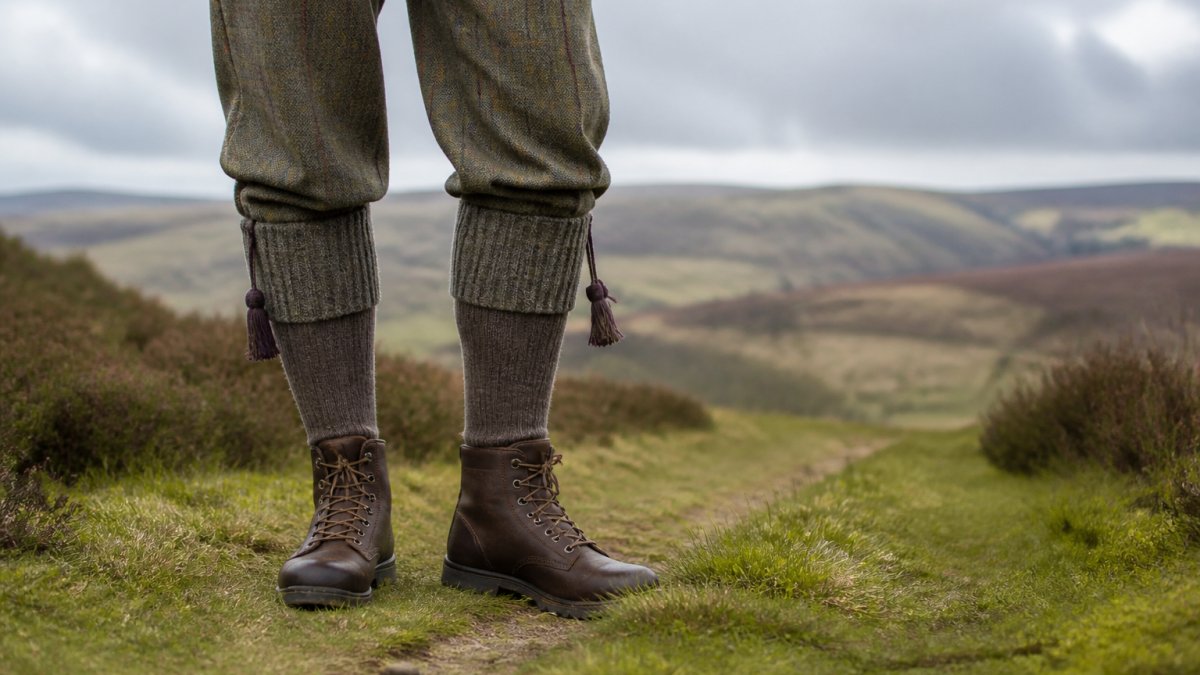
A few details make the difference between looking right and looking like you borrowed the kit:
Lady Glen House of Cheviot Country and hiking socks - Dark Olive →
- Turn the sock over so the fold sits just below the knee, not halfway down the shin.
- Tie the garter below the fold, snug but not tight enough to leave a mark.
- Match the sock colour to the breeks or the jacket, not to the boots.
- Choose a calf-length sock so no bare skin shows between sock and breeks when you sit or crouch.
The two-tone colourways in the House of Cheviot range are designed for exactly this. A charcoal sock with a navy collar or an olive sock with an orange accent gives the eye something to catch without shouting.
Durability and Cost Per Wear of Wool Shooting Socks
Wool shooting socks cost more per pair upfront and less per wear over time, because a well-made pair lasts for years rather than a season. This is the calculation most buyers skip, and it is the one that changes the answer. Investing in high-quality fibers extends beyond footwear, as maintaining a consistent standard of warmth across your entire kit remains essential, a principle explored further in our wool apparel guide.
The reason a quality pair outlasts a cheap one is structural, not sentimental. Three things do the work:
- Fibre length and crimp. Longer wool fibres spun into a tight yarn resist pilling and thinning far better than short-staple wool or loose acrylic. The crimp also gives the yarn natural elasticity, so it springs back into shape rather than sagging.
- Reinforcement placement. Nylon at the heel and toe, around 10% in a well-built field sock, protects the two points that fail first. A sock without it will blow through at the heel within a season of hard use.
- Knit density and finishing. A denser knit holds its structure through repeated washing. Hand finishing catches the dropped stitches and loose ends that machine finishing misses, and those are the faults that turn into holes.
The cost-per-wear calculation, done properly
Take a pair at £16.50. If you wear it 30 times a year for three years, that is 90 wears, which works out at under 20 pence per wear. A cheaper synthetic pair at a third of the price that lasts one season and gets worn 20 times costs more per wear, and it will have lost its shape long before the wool pair has.
The pattern most buyers notice is that the second and third seasons are effectively free. Once a wool sock has survived its first year without thinning at the heel, it tends to keep going, because the reinforcement has already proved itself and the fibre has settled into its final shape. A cheap sock rarely reaches that point.
Why foot health is part of the durability case
Durability is not only about the sock surviving, it is about your feet surviving the day. A sock that has thinned at the heel stops cushioning, and a sock that has stretched out of shape starts moving against the skin. Both are direct contributors to blisters and foot fatigue.
A cushioned merino wool blend sock reduces pressure under the heel and ball, and Lycra support at the ankle and instep stops the sock sliding against the foot. That is the mechanism behind blister prevention: less friction, less moisture, less movement. Most practitioners find that walkers and shooters who switch to a properly fitted wool sock report fewer hot spots after a long day, simply because the sock is doing the job a worn-out synthetic no longer can.
The sustainability angle buyers increasingly weigh
Wool is a natural fibre that regrows annually, and a sock that lasts three years instead of one keeps a meaningful amount of textile out of landfill. A pair that is hand finished in the Scottish borders and repaired rather than replaced fits the same logic as a good pair of boots.
Sourcing standards matter here too. Mulesing-free wool is the benchmark modern buyers look for, and it is worth asking any supplier directly whether their merino is certified mulesing-free and traceable to the farm.
Treat a wool sock well and it rewards you. Wash it at 30 degrees, avoid the tumble dryer, and it will hold its fit far longer than anything knitted from polyester.
How to Wash Wool Shooting Socks Without Shrinking Them
Wool shooting socks shrink when they are exposed to heat and agitation, so the rule is simple: cool water, gentle cycle, no tumble dryer. Follow that and a merino wool blend sock will keep its size and shape for years.
The full method, step by step:
- Turn the socks inside out. This protects the outer face from friction.
- Use a wool-friendly detergent, not a biological powder.
- Wash at 30 degrees or below on a gentle spin, or hand wash.
- Skip the fabric conditioner. It coats the fibre and reduces breathability.
- Do not tumble dry. Ever.
- Lay flat to air dry naturally, away from direct heat.
The high wool content is exactly why the tumble dryer is off limits. Heat plus tumbling is what causes shrinkage, and no care label can override physics.
Layering Wool Socks for Cold Weather and Foot Comfort
Layering wool socks for cold weather works best as a system: a thin liner sock against the skin and a cushioned wool sock over it, with the boot sized to fit both. The liner moves moisture away from the skin, and the outer wool sock provides insulation and cushioning.
This is where the medical and comfort case for wool gets interesting. Blisters and foot fatigue both come down to friction and moisture, and wool addresses both. A cushioned foot reduces pressure under the heel and ball. Moisture management keeps the skin dry. Lycra support at the ankle and instep stops the sock moving against the foot, which is what causes boot rub in the first place.
Matching the layering system to the boot
The system only works if the boot can accommodate it. Match the layers to the boot type, not the other way round:
- Close-fitting leather country boots. One cushioned merino wool blend sock, no liner. These boots are cut snug and a second layer will restrict circulation.
- Rubber wellingtons. A liner plus a mid-weight wool sock. Wellingtons have no breathability, so the liner is doing most of the moisture work and the wool sock provides the insulation.
- Insulated field boots. A thin liner plus a light wool sock. The boot already insulates, so a heavy sock on top will overheat the foot and cause sweating, which defeats the purpose.
- Extreme cold, static peg work. A liner, a mid-weight wool sock, and a boot with room to spare. Standing still is the hardest condition for feet, because there is no walking movement to pump blood around. A liner plus wool is the combination that keeps feet functional through a long, cold sit.
The layering rules that matter
- Liner layer: thin, close-fitting, moisture-moving. It should sit smooth against the skin with no folds.
- Insulation layer: cushioned merino wool blend sock, turned over at the calf and held with garter ties.
- Fit check: the boot must accommodate both without pinching. If your boots are already snug with one pair, do not force a second pair in. Restricted circulation undoes every benefit of layering.
Why wool is the right outer layer
A liner alone will not keep you warm, and a wool sock alone will eventually saturate if you sweat heavily. Together they solve each other's weakness. The liner handles the moisture spike; the wool handles the insulation and the cushioning. That is why the layering system is the standard recommendation for anyone standing at a peg in January or walking a long drive in driving rain.
There is also a sustainability angle that buyers increasingly weigh. Wool is a natural fibre that regrows annually, and a sock that lasts three years instead of one keeps a lot of textile out of landfill. A pair that is hand finished in the Scottish borders and repaired rather than replaced fits the same logic as a good pair of boots.
Conclusion: When Wool Shooting Socks Are Worth the Money
Wool shooting socks are worth the money when you value comfort across a full day in changeable conditions, and they are not worth it if you only need a sock for occasional short walks in mild weather. The value case rests on cost per wear, temperature range and durability, and on those three measures a merino wool blend wins.
The one thing to get right is fit. A wool sock that is too thick for the boot will make your feet colder, and a garter tied too tightly will do the same. Match the sock to the boot, tie the garter snug rather than tight, and wash at 30 degrees without a tumble dry.
Long days in the field ask a lot of your feet, and the kit closest to the skin does more work than most people realise. Field & Moor stocks House of Cheviot shooting, hunting and country socks in a merino wool blend, hand finished in the Scottish borders, alongside our handcrafted country, Chelsea and safari boots with Goodyear and storm-welted construction, waterproof Sympatex linings and rugged Vibram soles.
Frequently Asked Questions
Why are wool socks better for shooting and outdoor activities?
Wool regulates temperature, so feet stay warm in winter and cool in summer. Merino wool also wicks moisture away from the skin, which reduces dampness, softening and blister risk during long days standing at peg or walking a drive. It is naturally odour-resistant too, so socks stay fresher across a full day in the field.
Do merino wool shooting socks keep your feet warm when wet?
Merino wool retains insulating properties even when damp, unlike cotton which loses warmth once wet. A wool blend sock with nylon reinforcement and Lycra, like the House of Cheviot range, holds its shape and cushioning so feet stay comfortable through wet grass and rain. Pair them with waterproof boots for the best protection.
How do you care for high-quality wool shooting socks?
Turn them inside out and wash at 30 degrees or below on a wool-friendly cycle using a wool detergent and a gentle spin. Never tumble dry, as the high wool content can shrink; instead lay them flat to air dry naturally. Follow this routine and a quality pair will keep its shape and cushioning for years.
Are merino wool blends better than pure wool for shooting?
Blends often work better for active use. A mix such as 85% merino wool with 10% nylon and 5% Lycra adds durability, shape retention and a secure fit while keeping the warmth and breathability of wool. Pure wool is warm but can wear faster at heel and toe, so a blend suits regular shooting and walking.
What makes House of Cheviot socks a preferred choice for fieldsports?
House of Cheviot socks are knitted and hand finished in the Scottish borders using a merino wool blend with a cushioned foot for comfort. The range covers calf-length country socks, shorter trekking styles and technical designs, all built for breathability and all-day wear. That combination of heritage craft and practical performance suits country pursuits well.