
How to Tell If Boots Are Goodyear Welted: 2026 Guide

Table of Contents
- Why Goodyear Welted Construction Matters for Boot Buyers
- How to Identify Welted Boots: A Step-by-Step Inspection Checklist
- What a Goodyear Welt Actually Looks Like on a Boot
- Welted Boots vs Cemented Boots: Spotting the Difference
- Storm Welt vs Goodyear Welt: What Changes and What Stays the Same
- Hidden, Split, and Imitation Welts: When Visual Inspection Fails
- Can Goodyear Welted Boots Be Resoled? What That Means for Longevity
- How to Verify Construction When the Sole Edge Is Covered
- Conclusion: Building a Reliable Inspection Routine
- Frequently Asked Questions
Last Updated: October 9, 2026
Why Goodyear Welted Construction Matters for Boot Buyers
A Goodyear welt is a strip of leather stitched to the upper and insole, then stitched again to the outsole, creating a shoe that can be repaired rather than replaced. This construction method is what separates a boot you keep for a decade from one you bin after two winters. At Field & Moor, we build every pair this way, so we have a clear view of what the stitching should look like and where cheap imitations give themselves away.
The core benefit is simple: a Goodyear welted boot can be resoled. When the sole wears through, a cobbler cuts the stitches, lifts off the old sole, and attaches a new one. The upper survives. That is the whole point.
Most boots sold on the high street are cemented, meaning the sole is glued on. They work fine until the glue fails or the sole wears down, and then they are finished. If you are spending real money, you want to know which one you are buying before you hand over your card.
Below, we will show you exactly how to tell if boots are goodyear welted using a three-step inspection you can do in the shop.
How to Identify Welted Boots: A Step-by-Step Inspection Checklist
Learning how to identify welted boots takes about two minutes once you know where to look. The inspection focuses on three areas: the sole edge, the welt strip, and the inside of the boot. But boots add their own complications: a tall shaft, a lugged sole, or a thick midsole can hide the very features you are looking for. This checklist is built for boots specifically, so you can work through it in the shop without guesswork.
Here is the full sequence:
- Start at the sole edge. Look for a line of stitching running around the perimeter, set in a groove.
- Find the welt strip. Run your thumb along the side of the boot just above the sole. A raised ridge means a welt is present.
- Check the inside for a rib or seam. Lift the sock lining and look for a rib or visible seam running around the insole.
- Confirm the stitching is structural, not decorative. Real welt stitching continues around the full perimeter and sits in a groove; decorative stitching sits on the surface and often stops short.
- Feel for a raised seam where the welt meets the outsole. This is the welt-to-outsole join, and it should feel like a distinct ridge.
- Consider the boot's specific features. A lugged sole may obscure the welt edge; a thick midsole can hide the stitch line; a tall shaft makes the inside seam harder to see. In these cases, rely on the welt ridge and the inside seam.
A genuine welted boot will pass all six. A cemented boot will fail at least three.
Step 1: Examine the Sole Edge for Stitching
The fastest test is the sole edge. On a Goodyear welted boot, you will see a line of stitching running around the outside of the sole, roughly 5mm to 10mm in from the edge. This is the welt-to-outsole seam, and it is the single most reliable visual clue.
Look closely at the thread. It should sit in a shallow groove, not on top of the surface. On a cemented boot, the sole edge is usually smooth, or it has a moulded fake stitch pattern pressed into the rubber. On a boot with a lugged sole, the stitching may be partially hidden by the lugs, so check between the lugs for a continuous line.
Step 2: Locate the Welt Strip
The welt strip is a narrow ribbon of leather that sits between the upper and the outsole. Run your thumb along the side of the boot just above the sole. On a welted boot, you will feel a distinct ridge.
That ridge is the welt. It is usually 5mm to 8mm wide on a country boot. If the upper meets the sole with no intermediate strip, you are looking at a cemented or vulcanised build. On a boot with a thick midsole, the welt may be less pronounced, but you should still feel a change in texture where the leather welt meets the rubber sole.
Step 3: Check the Inside for a Rib or Seam
Turn the boot over and look inside. A Goodyear welted boot has a rib or a visible seam running around the insole, where the welt stitching passes through. You may need to lift the sock lining slightly to see it.
On some boots, the insole is covered by a full leather insole with cork underfoot, so the seam sits underneath. In that case, feel for a raised ridge with your fingers. A tall boot shaft can make it awkward to reach the insole, but a small torch and a little patience will reveal the seam.
Boot-Specific Inspection Details
Boots differ from shoes in ways that affect inspection. The shaft can block light and make the interior hard to see, so use a torch. Lugged soles can hide the welt stitching, so check between the lugs. Thick midsoles, common on country boots, can obscure the welt edge, so rely on the welt ridge and the inside seam. Finally, the weight and flex point are useful secondary clues: a welted boot is heavier than a cemented one of the same size, and it flexes at the ball of the foot, not through the arch.
If you are looking at a pair of Field & Moor boots, such as the Osprey, Marsh Harrier, Harrier, Eagle, or Golden Eagle, you will find these features by design. Each is built with Goodyear or storm-welted construction, a full leather insole, cork underfoot, and a Vibram sole, so comfort and resoleability are built in.
What a Goodyear Welt Actually Looks Like on a Boot
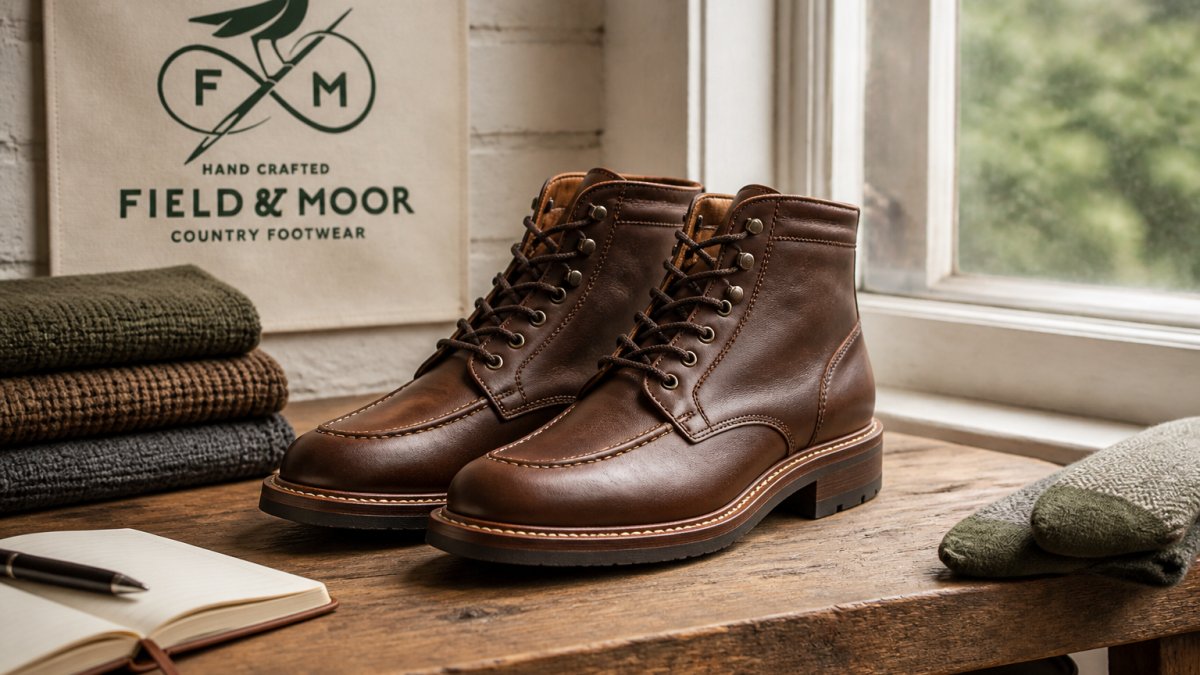
A Goodyear welted boot shows two parallel lines of stitching on the outside: one joining the upper to the welt, and one joining the welt to the outsole. Both are structural. Neither is decoration.
Once you have seen a real one, you will never confuse it with a glued sole again.
Welt Stitching vs Decorative Stitching
Decorative stitching is the most common trick used to make a cemented boot look welted. It sits on top of the upper or along a fake welt strip, and it does nothing.
Here is how to tell them apart:
| Feature | Structural Welt Stitching | Decorative Stitching |
|---|---|---|
| Position | In a groove on the sole edge | On the surface of the upper |
| Depth | Passes through welt and outsole | Sits on top of the leather |
| Spacing | Even, 6-10 stitches per inch | Often uneven or oversized |
| Function | Holds the sole on | Cosmetic only |
| Repairable | Yes, cobbler can replace sole | No, sole is glued |
If the stitching does not continue around the full perimeter, it is decorative.
How the Welt Connects Upper, Welt, and Outsole
The welt is the bridge. The upper is pulled over the last and stitched to the welt. The welt is then stitched to the outsole. A cork or leather filler sits between the insole and the outsole to level the base.
This three-part join is why the boot can be taken apart and rebuilt. A cobbler unpicks the welt-to-outsole seam, removes the sole, and stitches a new one to the same welt. The upper never has to be touched.
Welted Boots vs Cemented Boots: Spotting the Difference
The difference between welted boots and cemented boots comes down to how the sole is attached. Welted boots are stitched; cemented boots are glued. Everything else follows from that.
Cemented construction is not automatically bad. It is lighter, cheaper, and often more flexible out of the box. But it cannot be resoled in the traditional sense, and the bond weakens with heat and water over time.
Welted construction costs more because it takes longer to make. In return, you get a boot that a cobbler can rebuild several times over. Our Merlin Chelsea boot in mid brown country leather, for example, is built this way for exactly that reason.
Safari Green suede Chelsea Boot →

Storm Welt vs Goodyear Welt: What Changes and What Stays the Same
A storm welt is a Goodyear welt with a raised lip that folds up against the upper. The construction underneath is identical. The only change is the extra ridge, which sheds water away from the seam.
For anyone walking wet ground, that ridge matters. It keeps water from sitting in the stitch line, which is where rot and seepage start.
What stays the same:
- The welt strip is still stitched to the upper and insole
- The outsole is still stitched to the welt
- The boot can still be resoled
- The inside still shows a rib or seam
If you inspect a storm-welted boot using the three steps above, you will find the same evidence. The welt strip is simply taller and turned up at the edge. Our storm-welted country boots use this build for that reason.
Hidden, Split, and Imitation Welts: When Visual Inspection Fails
Not every welt is visible from the outside. A hidden welt, sometimes called a blind welt, has the stitching tucked under the sole edge so nothing shows. A split welt runs only partway around the sole. An imitation welt is moulded rubber pretending to be leather. Each can fool a quick glance, but each has tells if you know where to look.
Hidden Welts
A hidden welt is still a Goodyear welt, but the stitching is concealed under a folded leather edge or a rubber rand. You will not see the welt-to-outsole seam from the side. Instead, check the inside: the rib or seam on the insole will still be present. Also feel for the welt ridge just above the sole; even if the stitches are hidden, the welt strip itself creates a slight bulge. Hidden welts are common on dress boots and some country boots where a clean side profile is preferred.
Split Welts
A split welt does not run the full perimeter. It may start at the ball of the foot and stop before the heel, or it may be present only on the sides. This is sometimes done for flexibility or to reduce weight. To identify a split welt, run your thumb along the entire side of the boot. If the ridge disappears at any point, it is a split welt. A split welt can still be resoled, but the repair may be more complex because the welt does not encircle the whole boot.
Imitation Welts
An imitation welt is the most common deception. It is a moulded rubber strip with fake stitch marks, glued to the sole edge to mimic a welt. It looks convincing in photos. To tell it apart, run your fingernail along the "stitching." Real stitching sits in a groove and has a slightly irregular, thread-like texture. Moulded fake stitching is smooth and uniform, and it often lacks the depth of a real groove. Also check the inside: an imitation welt will not have a rib or seam on the insole, because there is no structural stitching.
What to Do When You Cannot See Stitching
When the sole edge is covered by a rubber rand, a moulded midsole, or a thick lug pattern, visual inspection has limits. You need a second method. Try these in order:
- Check the inside seam. Lift the sock lining and look for the rib. This is the hardest feature to fake.
- Ask for the construction spec. A maker who builds welted boots will say so plainly in the product copy.
- Look for a resole policy. A brand that offers resoling is telling you the construction supports it.
- Feel the flex point. A welted boot flexes at the ball of the foot, not through the middle of the arch.
- Check the weight. Welted boots are heavier than cemented ones of the same size.
If a retailer cannot answer the construction question, treat that as your answer.
At Field & Moor, we avoid these ambiguities by building every pair with a genuine Goodyear or storm welt. Our Osprey, Marsh Harrier, Harrier, Eagle, and Golden Eagle styles all feature a full leather insole, cork underfoot, and a Vibram sole, so you can verify the construction by the inside seam and the welt ridge. Comfort and resoleability are the two features we refuse to compromise on, because they are what make a boot worth keeping.
Can Goodyear Welted Boots Be Resoled? What That Means for Longevity
Yes. Goodyear welted boots can be resoled, usually several times over the life of the upper. A cobbler removes the worn outsole, stitches on a new one, and the boot goes back into service.
This is the practical payoff of everything above. A cemented boot has one life. A welted boot has as many lives as the leather upper can support.
For a boot worn on wet ground, in mud, and on hard tracks, that difference is not academic. Soles wear out long before uppers do. Resoling turns a replacement purchase into a repair bill.
The construction also supports comfort over time. A full leather insole with cork underfoot moulds to the shape of your foot, and that footbed survives the resole because it is not glued to the sole being replaced.
How to Verify Construction When the Sole Edge Is Covered
When the sole edge is covered by a rubber rand, a moulded midsole, or a thick lug pattern, visual inspection has limits. You need a second method.
Try these in order:
- Check the inside seam. Lift the sock lining and look for the rib. This is the hardest feature to fake.
- Ask for the construction spec. A maker who builds welted boots will say so plainly in the product copy.
- Look for a resole policy. A brand that offers resoling is telling you the construction supports it.
- Feel the flex point. A welted boot flexes at the ball of the foot, not through the middle of the arch.
- Check the weight. Welted boots are heavier than cemented ones of the same size.
If a retailer cannot answer the construction question, treat that as your answer.
Conclusion: Building a Reliable Inspection Routine
The three-step check takes two minutes: sole edge, welt strip, inside seam. Do it every time you pick up a boot, and you will never pay welted prices for a glued sole again.
At Field & Moor, every pair is built with Goodyear or storm-welted construction, so the stitching you are looking for is there by design. Our Osprey, Marsh Harrier, Harrier, Eagle, and Golden Eagle styles all share that build, along with full leather insoles, cork underfoot, and Vibram soles. Comfort and resoleability are the two features we refuse to compromise on, because they are what make a boot worth keeping.
If you want a pair you can have repaired rather than replaced, browse the Field & Moor collection and look for the welt.
Frequently Asked Questions
Can you tell if a boot is Goodyear welted just by looking at the sole?
In most cases, yes. Look for a visible row of stitching running around the sole edge, joining the welt strip to the outsole. You should also see a narrow leather band (the welt) between the upper and the sole. However, some boots hide this stitching under a sole edge dressing or use a hidden channel. If the sole edge looks smooth with no stitches and no welt band, it is likely cemented rather than Goodyear welted.
Do all boots with visible stitching around the sole have a Goodyear welt?
No. Visible stitching can also indicate a Blake stitch, a stitchdown construction, or even decorative stitching added to mimic a welt. The key difference is the welt strip itself: a genuine Goodyear welt has a separate leather band stitched to both the upper and the outsole. If you can lift or see a distinct strip between the upper and sole, it is likely welted. If the stitching goes directly through the upper into the sole with no welt strip, it is not Goodyear welted.
Can Goodyear welted boots be resoled, and how does that affect comfort?
Yes, Goodyear welted boots can be resoled because the construction uses a stitched welt rather than glue alone. A cobbler removes the outsole stitching, attaches a new sole, and re-stitches through the existing welt. This extends the boot's life significantly. On comfort, a cork layer under the footbed moulds to your foot over time, and the stitched construction allows some flexibility. Many wearers find well-made welted boots comfortable after a short break-in period, though initial stiffness varies by leather and last shape.
What is the difference between a storm welt and a Goodyear welt?
A storm welt is a variation of Goodyear welt construction. The welt strip has a raised lip that turns upward against the upper, creating a tighter seal against water and debris. Standard Goodyear welts sit flatter. Both are stitched and resoleable, but storm welts offer better water resistance, which suits wet or muddy conditions. If you are inspecting a boot, look for a slightly taller, folded welt edge rather than a flat strip.