
Fully Waterproof and Breathable Luxury Boots for All-Weather Comfort

Table of Contents
- Why Waterproof Breathable Boots Matter for All-Weather Comfort
- Sympatex vs Gore-Tex for Footwear: Which Membrane Works Best?
- Benefits of Goodyear Welted Waterproof Boots
- Key Features That Define Fully Waterproof and Breathable Luxury Boots
- How to Choose the Right Waterproof Boot for Your Climate and Terrain
- Field & Moor Boots Reviewed: Models for Every Pursuit
- How to Care for Waterproof Leather Boots
- Sustainability and Long-Term Performance in Luxury Footwear
- Conclusion: Investing in All-Weather Comfort
- Frequently Asked Questions
Last Updated: September 13, 2026
Why Waterproof Breathable Boots Matter for All-Weather Comfort
Fully waterproof and breathable footwear solves a problem that has frustrated walkers for generations: keeping water out while letting perspiration escape. At Field & Moor, we build every pair around that single principle, because a boot that only blocks rain will leave your feet as wet from the inside as a leaky boot would from the outside. This guide from Field & Moor explains how waterproof breathable boots work, which construction methods last, and how to match a pair to your climate and terrain.
The core mechanism is simple to describe and difficult to execute. A waterproof membrane sits between the leather upper and the lining, with pores small enough to stop liquid water but large enough to let water vapour pass. Perspiration leaves as vapour; rain and puddles stay out. Without that membrane, a leather boot becomes a sealed container, and your feet soak themselves within an hour of hard walking.
That distinction matters more than most buyers realise. A waterproof boot and a breathable boot are not the same purchase, and the best pairs are engineered to be both at once. The British Standards Institution guidance on footwear testing sets out how water resistance and vapour permeability are measured separately, which is why two boots can both claim waterproofing while performing very differently over a long day.
Below, we break down membrane technology, welted construction, and the features that separate a boot that lasts a decade from one that fails in a season.
Sympatex vs Gore-Tex for Footwear: Which Membrane Works Best?
Both membranes keep water out and let vapour pass, but they achieve it by different physical mechanisms, and that difference shows up in feel, longevity, and environmental profile. Understanding the mechanism is what separates a buyer who chooses on brand name from one who chooses on fit for purpose.
Gore-Tex is a microporous expanded PTFE (ePTFE) membrane. Its structure contains billions of pores per square centimetre, each roughly 20,000 times smaller than a water droplet but around 700 times larger than a water vapour molecule. Liquid water cannot pass; perspiration vapour can. The ePTFE is typically laminated to a thin polyurethane layer to protect it from oils and body fats, because raw PTFE is oleophobic but can be compromised by prolonged contact with contaminants.
Sympatex works differently. It is a non-porous, hydrophilic polyester membrane. Rather than passing vapour through physical holes, it transports moisture by a chemical process: water vapour is absorbed into the membrane's hydrophilic polymer chains on the warm, humid side, diffuses across, and is released on the cooler, drier outer side. Because there are no pores, there is nothing to clog, and the membrane cannot be breached by contamination in the same way a microporous film can.
Here is how the two compare on the criteria that affect daily wear:
| Feature | Sympatex | Gore-Tex |
|---|---|---|
| Base material | Hydrophilic polyester, PTFE-free | Expanded PTFE with PU laminate |
| Transport mechanism | Chemical diffusion (non-porous) | Physical vapour passage (microporous) |
| Breathability | Strong vapour permeability, consistent when dirty | Strong when clean; can decline if pores clog |
| Feel underfoot | Softer, more flexible, quieter | Slightly stiffer, can rustle |
| Sustainability profile | Recyclable, no fluoropolymers | PTFE-based, subject to PFAS scrutiny |
| Common use | Country, field and luxury leather boots | Hiking, technical and mountaineering footwear |
| Care requirements | No pore maintenance needed | Keep clean to preserve pore function |
The practical implication for a thick leather country boot is significant. A non-porous membrane like Sympatex pairs more predictably with a heavy upper because it does not depend on keeping microscopic pores clear of leather oils, dust, and conditioner residue. A microporous membrane performs best when the boot is kept scrupulously clean, which is not always realistic in field conditions.

Breathability figures are measured under standard test conditions, and the British Standards Institution guidance on footwear testing sets out how water resistance and vapour permeability are assessed separately. This is why two boots can both claim waterproofing while performing very differently over a long day: the test conditions rarely match a wet November walk with a heavy pack.
The membrane is only one part of the system. A hydrophobic coating on the leather, a gusseted tongue, and seam-sealed construction all determine whether the boot stays dry in practice. A premium membrane behind untreated leather is a wasted investment.
For luxury footwear specifically, the choice often comes down to hand-feel as much as performance. A PTFE membrane can introduce a faint stiffness and a subtle rustle that is noticeable in a refined boot. A hydrophilic polyester membrane sits flatter against the lining and preserves the supple drape that buyers expect from a high-end leather upper.
Benefits of Goodyear Welted Waterproof Boots
Goodyear welting is a construction method in which the upper is stitched to a welt, which is then stitched to the sole, creating a durable, repairable bond. The benefit for waterproof boots is twofold: the stitched construction resists water penetration better than cemented soles, and the boot can be resoled rather than replaced when the sole wears through.
That repairability is the real argument for welted construction. A cemented boot is glued together and generally cannot be rebuilt once the sole fails. A Goodyear welted boot goes back to a cobbler, gets a new sole, and returns to service. Over ten years, that difference in footwear longevity is substantial, and it is the reason welted boots hold their value.
Storm welting takes the principle further. A storm welt adds a raised lip where the upper meets the sole, which sheds water away from the seam and reduces penetration in wet grass and standing water. For anyone walking in boggy ground, the storm welt is worth the small extra weight.
Key Features That Define Fully Waterproof and Breathable Luxury Boots
A fully waterproof and breathable luxury boot combines five elements: a hydrophobic leather upper, a waterproof breathable membrane, sealed seam construction, a gusseted tongue, and a sole unit that grips in wet conditions. Remove any one of these and the boot's all-weather performance drops sharply.
The upper is where most cheap boots fail. Thick, full-grain leather treated with a durable water repellent sheds rain and resists abrasion. A 2.2mm full-grain upper, like the one used across our Hawk range, offers a level of abrasion resistance that thinner corrected-grain leathers cannot match. The thicker hide also holds its shape better over years of wear, which matters for arch support and foot comfort.
Inside, a moisture-wicking lining moves perspiration away from the skin toward the membrane. Cork insulation in the midsole regulates temperature, keeping feet warm in cold weather and cooler in summer. A full-length leather insole adds structure and moulds to the foot over time.
Construction, Materials and Traction
Traction is the feature buyers underestimate most. A boot that keeps water out but slides on wet grass is a hazard on a shoot day. Vibram commando soles use aggressive cleats to bite into mud, snow, and loose gravel, and the rubber compound stays flexible in cold weather so grip does not disappear when temperatures drop.
Ergonomic fit and arch support complete the picture. A boot that fits properly reduces fatigue, and a cork footbed that conforms to the foot provides impact absorption over long distances. The gusseted tongue blocks water at the most vulnerable point, where the lacing gap meets the upper. These structural refinements ensure that your footwear remains reliable in shifting conditions, serving as a foundational element of quality outdoor gear that supports every step of your journey.
How to Choose the Right Waterproof Boot for Your Climate and Terrain
Most buying guides treat 'wet' as a single condition. It is not. A boot chosen for a mild, humid autumn in the lowlands is a different proposition from one chosen for a cold, snowy winter on high ground, and the breathability requirement changes with the climate as much as the waterproofing does. Climate-specific footwear matching is the single most useful decision you can make before buying, and it is the angle most guides skip entirely.
Humid and wet climates: breathability is the priority
In mild, damp conditions, the outside air is often nearly as humid as the inside of the boot. Vapour transport slows because there is little humidity gradient to drive it. This is where a non-porous hydrophilic membrane earns its keep: it keeps moving moisture even when the external air is saturated, and it does not depend on pores staying clear.
For this climate, prioritise:
- A membrane with strong vapour permeability and no pore-clogging risk
- A moisture-wicking lining that moves sweat away from the skin quickly
- A leather upper that breathes as well as it repels, such as a lightly treated full-grain rather than a heavily waxed hide
- A sole unit that sheds mud rather than trapping it, so the boot does not stay wet for hours after the walk
Cold and snowy climates: insulation and moisture management together
Cold air holds less moisture, so the humidity gradient is stronger and breathability is less of a bottleneck. The problem shifts to condensation: warm, moist air from the foot meets a cold membrane and can condense inside the boot if the insulation and lining cannot manage it. Cork insulation in the midsole and a full leather insole matter more here than membrane brand, because they regulate temperature and reduce the temperature differential that causes condensation.
For this climate, prioritise:
- Cork or similar natural insulation in the midsole and footbed
- A full leather insole that wicks and insulates
- A taller boot height to keep snow out at the ankle
- A rubber compound that stays flexible below freezing, so grip does not disappear when temperatures drop
- A storm welt to shed meltwater away from the sole seam
Terrain matching: the questions that actually change the boot
Work through these before you commit:
- How wet is your ground? Standing water and bog demand a storm welt and a high boot height. Damp grass does not.
- How cold does it get? Below freezing, insulation and insole material matter more than membrane choice.
- What is the terrain like? Mud and snow call for aggressive cleats; hard tracks favour a slightly less aggressive sole for comfort over distance.
- How long are your days out? Long days need a thick insole and proper arch support to reduce fatigue.
- Will you wear them in town? A refined leather finish and a slimmer profile let a country boot transition to smart-casual wear, which is where luxury construction pays off.
The luxury dimension
A boot that performs in all weather but looks out of place indoors is only half a purchase. The luxury angle is that the same technical system, a hydrophobic upper, a breathable membrane, a storm welt, and a Vibram sole, can be built into a boot with a refined last and a finish that polishes up. That is the gap most performance guides ignore: you do not have to choose between a boot that handles a wet Saturday in the field and one that looks right at lunch afterwards.
For most field use, a 10 to 11 inch boot with a storm welt, a Sympatex lining, and a Vibram commando sole covers the widest range of conditions. If you cross wetlands or river shallows, a taller boot with a half bellow tongue adds protection at the ankle and lacing. If your winters are severe, add cork insulation and a full leather insole to the specification. Match the boot to the climate you actually walk in, not the most extreme conditions you can imagine, and it will last longer and perform better.
Field & Moor Boots Reviewed: Models for Every Pursuit
Every boot in our range shares the same foundation: handcrafted construction in family-owned artisan factories in Spain, a waterproof and breathable Sympatex lining, and a Vibram sole unit. What changes across the range is boot height, welt type, leather finish, and the specific pursuits each model suits best.
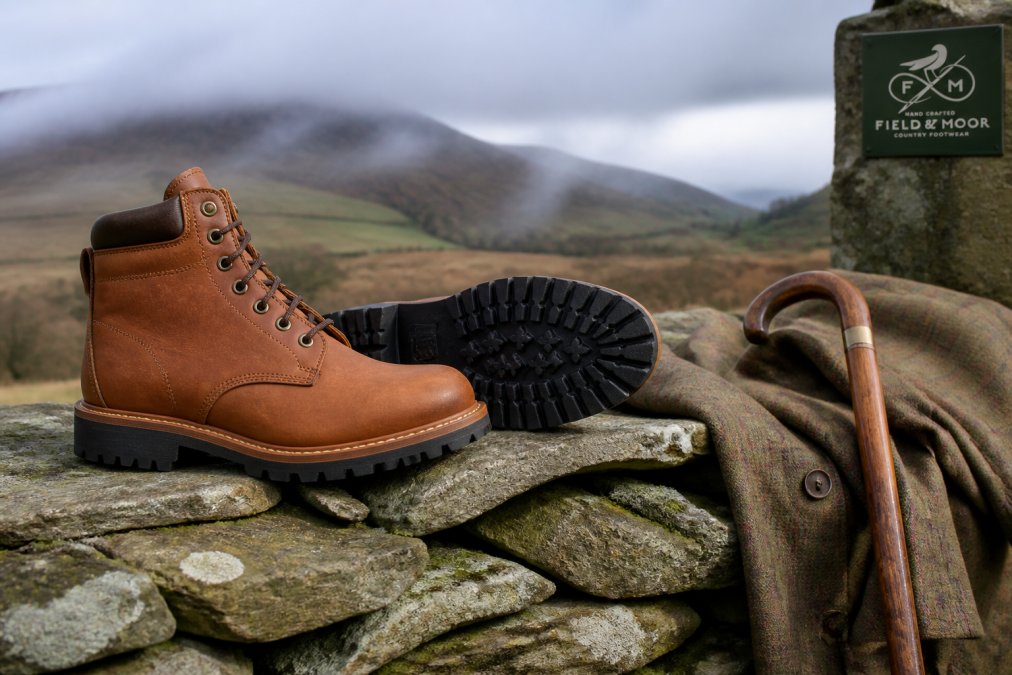
Hawk Country Boot: Goodyear Welted Classic
The Hawk Country Boot in tan leather is our 10 inch classic, priced at £224.00, and the model we recommend to anyone buying their first serious pair. A smooth premium leather upper sits over a Sympatex waterproof and breathable lining, and the Vibram commando sole provides rugged traction across wet ground. Goodyear welting makes the boot fully repairable, and triple stitching with reinforced eyelets on the straps adds strength where it matters.
Full-length leather insoles and a cork footbed insulate against cold ground, and the bellows tongue makes entry easy without compromising the seal. If you want the same build in a darker finish, the chestnut brown Hawk uses a thick 2.2mm full-grain upper at £196.00 while stocks last.

Osprey Laced Country Boot: Rugged Storm-Welted Performance
The Osprey is built for harder use. At 11 inches and £270.00, the greased brown Osprey pairs a hydrophobic greased leather upper with storm-welted construction, which adds waterproofing and repairability at the sole seam. A detachable gun-rest on the vamp protects the leather where a shotgun or rifle rubs, and a double-sided buckle gives an adjustable fit.

Cork insulation in the midsole regulates temperature, and the full leather-lined insole keeps feet comfortable over long days. The same boot is available in chestnut grained leather and light brown grained leather, both at £270.00, and in a ladies' tan grained version at £238.00.
Marsh Harrier: Safari and Hiking Versatility
The Marsh Harrier is a 9 inch boot designed for harsh conditions and long distances, priced at £225.00 in men's chestnut grain and ladies' chestnut grain. A hydrophobic chestnut grain leather upper combines with a Sympatex lining and a Vibram commando sole for all-terrain versatility, and storm-welted construction reduces water penetration.
The reinforced gun-rest on the vamp and half bellow tongue add extra waterproofing, while the full leather lining with cork in the footbed regulates temperature and cradles the foot. For safaris where wetlands or river crossings are common, the ladies' Marsh Harrier safari boot is the same build with safari-specific detailing.
How to Care for Waterproof Leather Boots
Caring for waterproof leather boots comes down to three habits: clean them after every wet outing, re-proof the leather regularly, and never dry them near direct heat. Neglect any of these and the leather stiffens, cracks, and loses the water-resistant finish that supports the membrane underneath.
A practical routine looks like this:
- Brush off mud and grit with a horse-hair brush while the leather is still damp
- Wipe the upper with a damp cloth and let the boot air-dry at room temperature
- Apply a leather conditioner or waterproofing wax two to four times a season
- Re-proof more often if you walk in wet grass or snow regularly
- Store boots with cedar or boot trees to hold their shape
- Never dry near a radiator, stove, or direct sun; heat cracks the leather and can damage the membrane
The UK government guidance on leather and footwear care is limited, so the most reliable reference remains the manufacturer's own instructions. What most guides miss is that the membrane needs no maintenance at all; it is the leather above it that determines whether water ever reaches the membrane in the first place. Treat the leather, and the waterproofing system keeps working.
Sustainability and Long-Term Performance in Luxury Footwear
Longevity is the most credible form of sustainability in footwear. A boot that lasts fifteen years and can be resoled twice uses far fewer resources than four pairs of cemented boots bought and discarded over the same period. This is where welted construction earns its place in an environmental argument, not just a durability one.
The materials matter too. Sympatex is a polyester-based membrane with no fluoropolymers, which gives it a lower environmental footprint than PTFE-based alternatives. Leather, when sourced from tanneries with proper traceability, is a by-product of the food industry and biodegrades at end of life. Vibram soles can be replaced rather than discarded with the boot.
The European Environment Agency reporting on textile and footwear waste has documented the scale of footwear disposal across Europe, and repairable construction is one of the few levers a buyer controls directly. Choosing a welted boot is a decision you make once and benefit from for years.
Climate-specific matching also plays a role. A boot suited to wet lowland ground will outlast a boot forced into conditions it was not built for, so buying the right model for your terrain extends its working life.
Conclusion: Investing in All-Weather Comfort
The gap between a boot that keeps you dry and one that leaves you soaked is rarely about the price tag. It comes down to whether the construction, membrane, and leather work together as a system, and whether the boot can be repaired when it eventually wears.
Field & Moor builds every pair around that system: Sympatex waterproof and breathable linings, Goodyear and storm-welted construction for repairability, hydrophobic leather uppers, and Vibram commando soles for grip in mud and snow. Handcrafted in family-owned artisan factories in Spain to a British design, our boots are made to be worn hard and resoled rather than replaced.
If you want footwear that handles a wet Saturday in the field and still looks right in town, start with the Hawk or the Osprey. Get started with Field & Moor and invest in boots built to last for years of adventure.
Frequently Asked Questions
Is there such a thing as breathable waterproof shoes?
Yes. A waterproof breathable boot uses a membrane like Sympatex that blocks liquid water from entering while allowing water vapour from sweat to escape. This keeps feet dry from both rain and perspiration. Look for a breathability rating and seam-sealed construction. Field & Moor boots combine a Sympatex lining with hydrophobic leather uppers, so they handle wet weather and long days without overheating.
How does Sympatex technology compare to other waterproof membranes?
Sympatex is a non-porous, hydrophilic membrane that transports moisture vapour through a chemical process rather than physical pores. It is 100% waterproof and windproof, and it contains no PTFE. Unlike some porous membranes, it does not clog with dirt or body oils over time. In practice, Sympatex offers reliable all-weather performance and is used across Field & Moor's country, safari and hiking boots.
How do I maintain the waterproof integrity of premium leather boots?
Clean mud off with a damp cloth and a horsehair brush after every wear. Let boots dry naturally, away from direct heat. Reapply a leather conditioner or waterproofing wax every few weeks, focusing on seams and flex points. For Goodyear welted boots, avoid saturating the welt with water. Store with cedar shoe trees to hold shape.
What are the most comfortable waterproof boots for all-day wear?
Comfort comes from fit, cushioning and moisture management. Look for an ergonomic fit, a cork footbed that moulds to your foot, arch support and a moisture-wicking lining. Field & Moor's Osprey and Marsh Harrier boots feature full-length leather insoles, cork insulation in the midsole and Vibram Commando soles for impact absorption. The adjustable double-sided buckle on Osprey models helps accommodate wide feet and high arches.
Why is breathability essential in luxury waterproof footwear?
Without breathability, sweat vapour condenses inside the boot, leaving feet damp and cold even if no rain gets in. That moisture softens the skin and causes blisters. A breathable membrane like Sympatex allows vapour permeability so feet stay dry from the inside. This matters for luxury footwear because the leather and construction should perform as well as they look, whether you are on a shoot or walking through town.