
Vibram vs Leather Soles for Wet Terrain Performance

Last Updated: November 7, 2026
Quick Summary
For wet terrain, vibram vs leather is not close: Vibram rubber soles grip through cleated tread while leather soles absorb water, soften and slide. Choose Vibram rubber for mud, rain and wet rock, and reserve leather soles for dry, formal town wear.
- Rubber does not absorb water, while leather softens, swells and loses grip when wet.
- A waterproof upper on a leather sole still leaves you with a slippery sole.
- Deep, widely spaced lugs shed mud; closely spaced lugs clog and then slide.
- The Osprey laced country boot uses a Vibram Commando sole built for mud and snow.
- Never dry leather soles on a radiator, as heat speeds cracking.
Table of Contents
- Vibram vs Leather Soles: The Core Trade-Off
- Best Boot Soles for Wet Weather: A Side-by-Side Comparison
- Leather Sole Grip in Rain: What to Expect
- Vibram Sole Grip on Wet Rock and Slippery Surfaces
- Water Absorption and Waterproofness: Leather vs Rubber
- Durability, Wear Resistance and Resoling
- How to Care for Leather-Soled Boots
- Comfort, Flexibility and Formal Appearance
- Choosing Your Wet-Terrain Boots at Field & Moor
- Frequently Asked Questions
Vibram vs Leather Soles: The Core Trade-Off
The vibram sole vs leather sole for wet terrain performance question comes down to one hard truth: rubber grips, leather glides. A Vibram rubber sole bites into wet grass, mud and rock through a cleated tread pattern, while a leather sole offers a smooth, formal finish that turns treacherous the moment rain hits it. This guide from Field & Moor sets out exactly where each sole type wins, where it fails, and how to choose for the ground you actually walk on.
Here is the part most buyers get wrong. They assume "waterproof boot" means "safe boot." It does not. A boot can keep water out and still send you sliding down a wet slope, because waterproofness and slip resistance are two different jobs done by two different parts of the shoe. The upper and lining keep water out; the outsole and its tread pattern keep you upright.
But a leather sole still has its place, and pretending otherwise would be dishonest. Below, we break down grip, water absorption, durability, comfort and care so you can match the sole to the terrain rather than the marketing.
Best Boot Soles for Wet Weather: A Side-by-Side Comparison
For wet weather, a rubber sole with a deep, cleated tread pattern is the better choice in almost every outdoor scenario. Leather soles absorb water, harden as they dry and lose what little surface grip they had. The comparison below sets the two materials against each other on the factors that matter most.
Comparison Table: Vibram vs Leather Soles
| Factor | Vibram Rubber Sole | Leather Sole |
|---|---|---|
| Wet-weather grip | High, cleated tread bites soft ground | Low, smooth surface slips |
| Water absorption | None, rubber is non-porous | Absorbs water, softens and swells |
| Slip resistance on wet rock | Good with lug pattern | Poor |
| Durability and abrasion | High wear resistance | Wears faster when wet |
| Flexibility | Moderate, depends on compound | Stiff, breaks in over time |
| Formal appearance | Casual, rugged | Smart, traditional |
| Resoling | Possible on welted boots | Possible but less practical |
| Best for | Mud, grass, rock, rain | Dry town wear, formal occasions |
Pros and Cons of Each Sole Type
Vibram rubber soles
- Pros: reliable traction on wet pavement, mud and rough terrain; no water absorption; strong abrasion resistance; lug pattern sheds mud.
- Cons: heavier underfoot; a rugged look that can feel out of place with formal dress; tread wears down over years of hard use.
Leather soles
- Pros: clean, formal appearance; traditional craftsmanship; comfortable once broken in on dry ground.
- Cons: dangerous on wet surfaces; absorbs water and loses shape; needs regular conditioning; poor slip resistance in rain.
If your week involves wet fields, stalking or shooting, the choice is not close. If your boots live in town and only meet rain on the walk to the car, a leather sole can still earn its keep.
Leather Sole Grip in Rain: What to Expect
Leather sole grip in rain is poor, and that is the honest answer. A smooth leather outsole has very little surface contact with wet ground, and once the leather absorbs water it becomes slick rather than tacky. On wet pavement, polished stone or a wooden bridge, a leather sole offers minimal slip resistance. The mechanism is straightforward: leather is porous, so water softens the fibres and fills the surface, and a softened, water-laden sole has neither the hardness nor the texture to key into a wet surface.
The problem compounds as the leather wears. A new leather sole has some texture; a worn one is glassy. Add rain and you have a genuinely hazardous combination, particularly on smooth or hard surfaces like concrete steps and tiled floors.
Treatments and overlays: what they can and cannot do
Sole conditioning and protective treatments can slow water absorption and keep the leather supple, which reduces cracking and extends life. They do not turn a leather sole into a wet-grip sole. A conditioned leather sole is still smooth and still porous, and it will still slide on a wet tiled floor.
Watch out: wearing a plain leather-soled boot for a full day of rain is how people end up with soaked feet and a fall. Treat leather soles as dry-ground footwear, and if you need wet-weather safety, look for a boot with a rubber outsole.
Vibram Sole Grip on Wet Rock and Slippery Surfaces
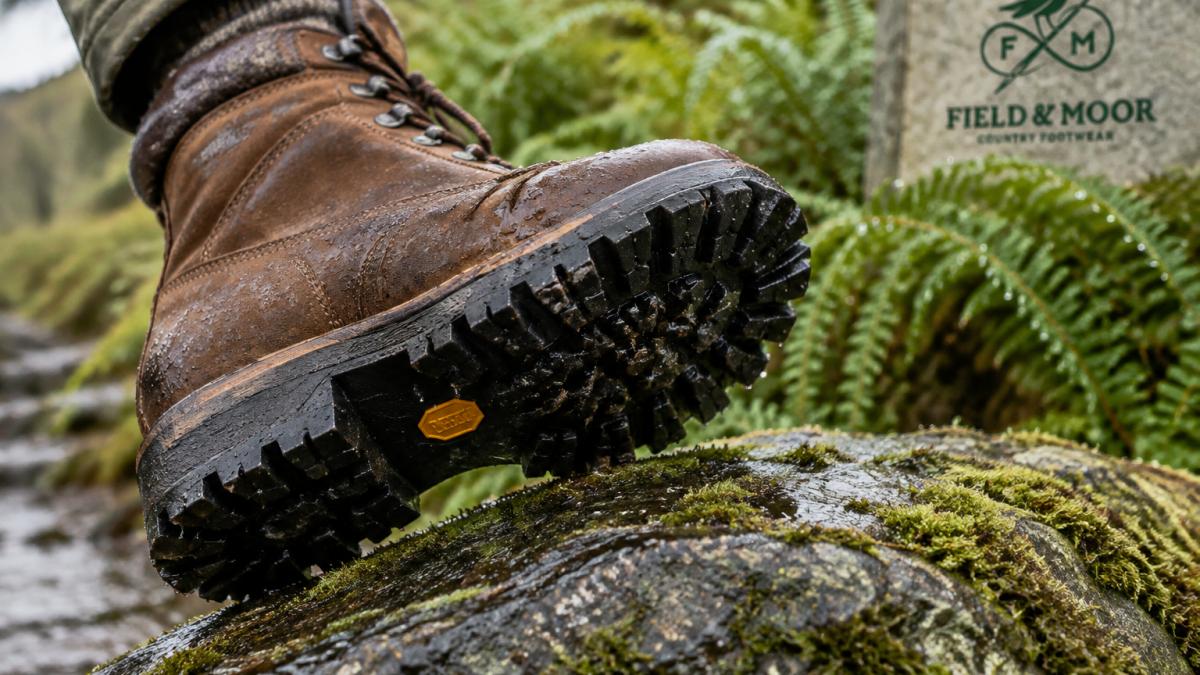
Vibram sole grip on wet rock is where rubber earns its reputation, but the reputation is often oversold as a single property. Vibram is not one sole. It is a family of rubber compounds and tread designs, and wet-rock performance can vary between them. A soft, high-friction compound with deep, well-spaced lugs will bite into wet rock; a hard, shallow-tread compound built for abrasion resistance can skate across the same surface. The variables that matter are compound hardness, lug depth, lug spacing and tread pattern, and they trade off against each other.
Wet performance by surface type
Wet grip is not one number. It changes with what is underfoot, and the same sole can perform well on one surface and poorly on another.
- Wet pavement and concrete: Hard, abrasive and relatively uniform. A medium-compound lugged sole performs well here; the main risk is worn lugs that have rounded off, which reduce the edges that push water aside.
- Polished floors and smooth stone: The hardest case for any sole. Smooth, non-porous surfaces offer little for a lug to key into, so compound softness and a fine, siped tread matter more than lug depth. A hard commando lug can be less secure here than a softer, flatter rubber sole.
- Mud and wet grass: Deep, widely spaced lugs shed mud and bite into soft ground. Closely spaced lugs clog and then slide. This is the surface where a cleated Vibram sole is furthest ahead of leather.
- Wet rock: Grip depends on compound softness and tread contact. Soft rubber conforms to small irregularities and pushes water out of the contact patch; hard rubber does not. Wet rock also rewards edge geometry, because the lug edges scrape water away as the foot rolls.
- Loose gravel and scree: Lug depth and pattern matter more than compound, because the sole is gripping loose material rather than the surface beneath it.
How to identify the right Vibram type
Vibram names its compounds and tread patterns, and the name on the sole is the fastest way to know what you are buying. A commando-style lug pattern is built for mud, snow and soft ground. A flatter, siped pattern is built for hard surfaces and mixed town use. A softer high-friction compound grips wet rock better but wears faster; a harder compound lasts longer but sacrifices some bite. That is the grip-durability trade-off every bootmaker balances, and it is why two boots with a Vibram sole can behave very differently in the rain.
The Osprey laced country boot uses a Vibram Commando sole built for mud and snow, with a hydrophobic greased leather upper and a Sympatex waterproof lining. If your walking is mostly hard, wet town surfaces rather than soft ground, a flatter, softer compound is the better match, and it is worth checking the specific Vibram name on the sole before you buy.
Water Absorption and Waterproofness: Leather vs Rubber
Rubber does not absorb water. Leather does. That single fact drives most of the wet-weather difference between the two sole types. A rubber outsole stays consistent in the rain, while a leather sole takes on moisture, softens, swells and loses both shape and grip.
Waterproofness, though, is about more than the sole. A boot stays dry because of its construction and lining. Goodyear-welted and storm-welted builds create a sealed barrier between upper and sole, and a waterproof breathable lining such as Sympatex manages moisture from the inside. For a deeper material comparison, our guide on leather versus rubber boots for shooting covers the full picture.
The key insight: a waterproof upper on a leather sole still leaves you with a slippery sole. Waterproofing protects your feet from water; the outsole protects you from falling. You need both.
Durability, Wear Resistance and Resoling
Rubber wins on wear resistance and abrasion. A Vibram rubber tread stands up to rough terrain, grit and constant flexing far better than leather, which scuffs, cuts and wears thin when wet. Leather soles are repairable, but a sole that has absorbed water repeatedly is harder to bring back.
Resoling is where welted construction matters. Goodyear-welted and storm-welted boots can be resoled, extending their life for years. Whether that means repairing or replacing worn soles is a decision worth weighing carefully, and our guide on whether to repair or replace leather boot soles walks through it.
The practical takeaway for wet terrain: a rubber sole delivers longer service life with less maintenance. Leather asks more of you and gives less back in the wet.
How to Care for Leather-Soled Boots
Care for leather-soled boots by keeping them dry, conditioned and away from direct heat. Wipe off dirt after each wear, let them air-dry naturally, and condition the leather regularly to stop it drying out and cracking. Never dry leather soles on a radiator, as heat draws out oils and speeds cracking.
For the soles specifically:
- Brush off mud before it dries and hardens into the leather.
- Let wet boots dry at room temperature, stuffed with newspaper to hold their shape.
- Condition the upper and sole edges to keep the leather supple.
- Store on shoe trees to preserve shape and slow wear.
If you want to go further and protect leather against the wet, our complete guide on how to waterproof leather country boots sets out the full process step by step. It is the difference between a sole that lasts years and one that fails in a season.
Comfort, Flexibility and Formal Appearance
Comfort splits along use case. Leather soles are stiff at first and break in over time, moulding to your foot on dry ground. Rubber soles offer more immediate cushioning and stability, which matters on long days over rough terrain. For flexibility, a thin leather sole bends more freely once worn in; a thick lugged rubber sole is stiffer but more supportive.
Formal appearance is leather's home turf. A leather sole gives a boot or shoe a clean, traditional profile that suits smart-casual and formal wear. Rubber, even a refined commando sole, reads as outdoor footwear.
The Hawk country boot combines a premium leather upper with a Vibram Commando sole, Goodyear welting and a cork footbed for insulation.
Choosing Your Wet-Terrain Boots at Field & Moor
Choose a Vibram rubber sole for wet terrain and a leather sole for dry, formal wear. That is the short version. If your boots will meet mud, rain, wet rock or long days outdoors, rubber with a cleated tread is the safer, longer-lasting choice.
Field & Moor's country boots are built on Vibram soles with waterproof Sympatex linings and Goodyear or storm-welted construction. If you want a ready-made option for wet country ground, the Osprey laced country boot in greased brown leather is built for rigorous outdoor use, while the country boot in quality brown leather pairs a Vibram Commando sole with a cork footbed for comfort on long days.


The right sole is the one matched to the ground under your feet. If wet fields, rain and rough terrain are part of your week, choose rubber with a proper lug pattern and a waterproof build. Field & Moor handcrafts country boots with Vibram Commando soles, Sympatex waterproof linings and welted construction built to be resoled and last for years. Get started with Field & Moor and step out in boots made for the wet.
Frequently Asked Questions
Are Vibram soles better than leather soles on wet ground?
For wet ground, Vibram rubber soles generally outperform leather. The cleated tread pattern and rubber compound channel water away and bite into soft surfaces like mud and wet grass, while leather soles become slick when wet. That said, not all Vibram soles are equal: compound hardness and lug depth vary, so a deep Commando-style tread suits rough terrain far better than a shallow urban pattern. For fieldsports and upland walking in the rain, a Vibram sole is the safer choice.
Are leather-soled boots slippery in the rain?
Yes, leather sole grip in rain drops sharply. Smooth leather has little tread to displace water, so on wet pavement, polished stone or concrete it can slide. The risk rises on smooth hard surfaces rather than rough ground. You can improve grip with a rubber topy or by choosing a boot with a rubber outsole from the start. If you wear leather-soled dress shoes in wet weather, take shorter, slower steps and avoid wet metal or marble.
Can leather-soled boots be worn on muddy terrain?
They can be worn, but they are a poor match for mud. Leather soles offer no lug pattern to shed mud, so you lose traction and the sole absorbs water, which speeds up wear. For occasional light mud on a path to town, leather is fine. For sustained muddy fields, wet grass or boggy ground during fieldsports, a Vibram rubber sole with a cleated tread is the practical choice. Reserve leather soles for dry, formal or indoor settings.
Can you resole leather boots with Vibram soles?
Yes. Goodyear-welted and storm-welted boots can be resoled, and a cobbler can fit a Vibram rubber sole unit in place of a worn leather one. This is one reason welted construction matters: the upper is stitched, not glued, so it can be rebuilt.
How do you improve the grip of leather-soled boots?
The most effective fix is a rubber topy or half-sole fitted by a cobbler, which adds tread without changing the boot's profile. Keeping leather conditioned but not over-oiled helps, since excess oil softens the sole and reduces bite. Roughening a worn, glazed leather sole with fine grit can restore some friction. For regular wet-weather use, though, the better answer is a boot built with a Vibram rubber sole from the outset.
