
Benefits of Storm Welted Boots for Hiking

Table of Contents
- Why Storm Welted Boots Make a Difference on the Trail
- Storm Welt vs Goodyear Welt: What Actually Changes
- Are Storm-Welted Boots Waterproof? Separating Fact From Marketing
- Durability and Lifespan: What You Get for the Money
- Can Goodyear Welted Boots Be Resoled? Repairability Explained
- How to Care for Welted Boots Through Mud, Rain and Grit
- Comfort, Weight and Break-In: The Honest Trade-Offs
- Matching Storm-Welted Boots to Terrain and Trip Type
- Choosing a Pair: A Quick Comparison of Storm-Welted Options
- Conclusion
- Frequently Asked Questions
Last Updated: October 17, 2026
Why Storm Welted Boots Make a Difference on the Trail
Storm welted boots are leather hiking boots built with a raised welt ridge that sheds water away from the upper-to-sole seam. That single construction detail separates them from ordinary welted footwear, and it matters most on wet ground. This guide from Field & Moor explains what that ridge does, where it falls short, and when it is genuinely worth paying for.
Welted boots have a loyal following among walkers for one reason: they can be repaired. A stitched sole can be replaced, so the upper keeps going long after the outsole wears through. Storm welting takes that repairable base and closes one of its weak points.
A common mistake is assuming "welted" means "waterproof". It does not. The welt is one part of a system, and the rest of that system decides whether your feet stay dry.
Below, we break down how storm welt construction works, how it compares with standard Goodyear welting, and which terrain suits it best.
Storm Welt vs Goodyear Welt: What Actually Changes
The difference between a storm welt and a standard Goodyear welt is a raised leather ridge stitched along the top of the welt. Both constructions stitch the upper to a welt, then stitch the welt to the sole. The storm version adds that extra upstanding lip where the upper meets the welt.
That lip does two things. It creates a physical barrier that pushes running water away from the seam, and it adds a second line of defence against grit working into the stitching.
The Added Ridge That Sheds Water
Picture water running down a leather upper in steady rain. On a standard welt, it reaches the seam and sits there. On a storm welt, the ridge interrupts that flow and sends it outward, away from the stitch line. It is a small piece of geometry doing useful work.
Where Standard Goodyear Welt Falls Short Outdoors
Standard Goodyear welting is excellent for town shoes and dry-weather boots. On boggy ground and long wet grass, water finds the seam. That is why traditional hiking boots and field boots so often use the storm version. Our own welted range, including the Osprey and Marsh Harrier, uses this construction, and these boots are Goodyear welted.

Are Storm-Welted Boots Waterproof? Separating Fact From Marketing
Storm-welted boots are not automatically waterproof. The welt reduces water entry at one seam, but full waterproofing depends on the leather, the lining, the tongue and how the boot is maintained. Any brand claiming the welt alone keeps feet dry is overselling it.
A boot stays dry when four things work together:
- The leather upper. Tightly grained, treated leather resists soaking. Our boots use thick hydrophobic leather for this reason.
- The lining. A membrane such as Sympatex adds a waterproof, breathable barrier behind the leather.
- The tongue. A half bellows tongue stops water entering over the top of the foot.
- The welt and sole unit. The storm welt and a sealed sole unit close the bottom of the boot.
Construction, Lining and Leather Working Together
Think of waterproofing as a chain. The storm welt is one link. A breathable membrane is another. If the leather is saturated and never cared for, or the tongue gapes open in long grass, water gets in regardless of the welt.
Water Resistance vs Waterproofing: A Crucial Distinction
Water resistance means the boot hinders water ingress but is not impervious. Waterproof means no water passes through under normal use. Storm welting primarily enhances water resistance at the seam. Full waterproofing requires a membrane lining and proper construction throughout. A boot may be water-resistant yet fail in prolonged wet conditions if the membrane is compromised or the leather is saturated.
The Role of Maintenance in Waterproofing
Even the best materials degrade without care. Dirt and grit left in the welt stitching abrade the thread, creating pathways for water. Conditioners and waxes keep leather supple and hydrophobic, but over-application can clog membranes and reduce breathability. A balanced routine, clean, dry, feed, maintains both water resistance and breathability.
Practical Limits in Wet Conditions
No boot stays waterproof forever. Prolonged exposure to deep mud or standing water can overwhelm any construction. The storm welt excels at shedding running water from the upper, but if water enters over the top or through a saturated tongue, the welt is irrelevant. For sustained wet conditions, pair storm-welted boots with gaiters and treat the leather regularly.
Durability and Lifespan: What You Get for the Money
Durability is where welted construction earns its keep. A stitched welt holds the upper and sole together mechanically, and the thick leather uppers used in this type of boot resist abrasion far better than fabric hiking shoes. With care, a well-made pair can last many seasons.
The real advantage is not that the boot never wears out. It is that the parts which wear fastest, the outsole and the welt stitching, can be renewed. A bonded or moulded sole usually means the boot is finished when the sole goes.
Weight and stiffness are the trade-offs. Leather boots are heavier than fabric shoes, and a stiff sole unit takes time to flex. For long-distance walking on mixed ground, that weight is the price of support and repairability. This inherent durability is the primary reason why handmade leather shoes remain a superior investment for those who prioritize longevity over the fleeting convenience of synthetic materials.
| Factor | Storm-welted leather boots | Fabric hiking shoes |
|---|---|---|
| Water resistance | High, with membrane and care | Varies, often lower |
| Abrasion resistance | High | Moderate |
| Repairability | Resoleable | Usually not |
| Weight | Heavier | Lighter |
| Break-in | Needed | Minimal |
| Ankle support | Strong | Lighter |
| Lifespan with care | Many seasons | Fewer seasons |
Can Goodyear Welted Boots Be Resoled? Repairability Explained
Goodyear welted boots can be resoled, and so can storm-welted boots, because both use a stitched welt rather than glue alone. A cobbler cuts the old stitching, removes the worn sole, and stitches a new sole to the existing welt. The upper is untouched.
This is the strongest argument for buying welted footwear. You pay more up front, then spread that cost over repeated resoles instead of replacing the whole boot. Over several years, the lifecycle cost often works out lower than buying cheaper boots again and again.
Two practical points. First, not every cobbler handles welted work, so find one before you need one. Second, resoling only makes sense if the upper and lining are still sound, which is why leather care matters as much as the sole.
Chestnut Grain leather 9 " Hiking and Walking Boot - Ladies - Marsh Harrier →
How to Care for Welted Boots Through Mud, Rain and Grit
Caring for welted boots comes down to a simple routine: clean, dry slowly, feed the leather, and keep grit out of the stitching. Do that and the leather stays supple and the seams stay tight.
- Clean after every wet outing. Remove mud with a brush and cool water. Grit left in the welt stitching abrades the thread.
- Dry at room temperature. Never place leather boots on a radiator or beside a fire. Fast heat cracks leather and shrinks stitching.
- Feed the leather regularly. A conditioner or wax keeps the upper supple and helps it shed water.
- Check the welt seam. Look for loose stitches or a lifted ridge, and deal with it early.
- Store with shape. Use boot trees or stuff the boot to hold its form and manage moisture.
A horsehair brush, like the one supplied with our boots, is the right tool for routine cleaning. It lifts dried mud without scratching the grain.
Comfort, Weight and Break-In: The Honest Trade-Offs
Comfort on welted boots is earned, not given. Expect a break-in period. Thick leather and a stiff sole unit need time to mould to your foot, and the first few walks should be short ones.
Fit is the deciding factor. Too tight and no amount of breaking in will help. Too loose and you get heel slip and blisters. Measure your foot, check the maker's sizing guidance, and account for the socks you will actually wear.
Our boots include cork in the footbed and midsole, which warms and conforms to the foot with wear. That helps comfort over long days, but it does not replace correct sizing.
Breathability is the other honest trade-off. Leather with a membrane lining manages moisture well, but a heavy boot runs warmer than a light fabric shoe. On hot days, choose a thinner sock and manage expectations.
Practical Break-In Guidance
Start with short walks (20-30 minutes) and gradually increase distance over two to three weeks. Wear the socks you plan to hike in. Condition the leather before first use to soften it slightly and protect against water. Pay attention to pressure points; if they persist, consider a different size or model.
Fit and Sizing Advice
Measure your feet at the end of the day when they are largest. Use a Brannock device if possible. Allow a thumb's width at the toe for downhill walking. Heel should be snug but not tight. Try boots on with your hiking socks. Our sizing follows standard UK sizing; check the size guide for each model.
Managing Weight and Fatigue
Storm-welted leather boots are heavier than fabric alternatives. For long hikes, this weight can cause fatigue. Choose a boot with a well-cushioned midsole and consider aftermarket insoles for extra support. Build up distance gradually to condition your legs to the weight.
Matching Storm-Welted Boots to Terrain and Trip Type
Match the boot to the ground you actually walk on, not the ground you imagine. Storm-welted leather boots suit wet grass, mud, moorland, rocky trails and long days in changeable weather. They are overkill for a dry summer path and a pavement stroll.
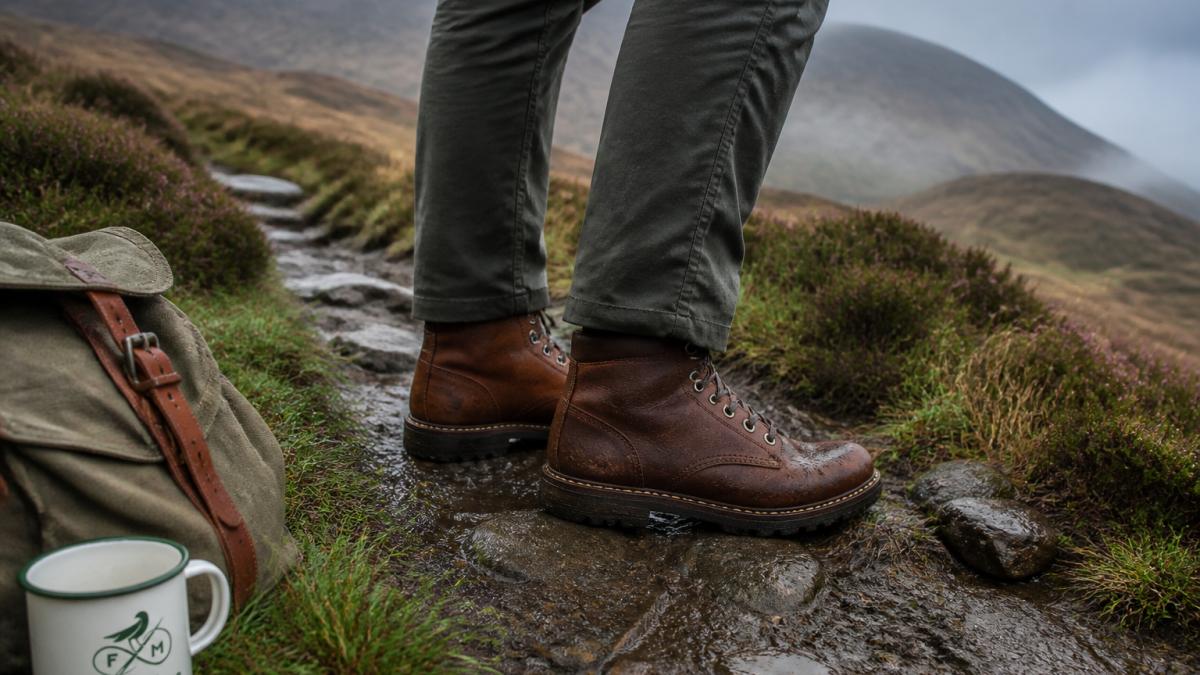
Use this as a rough guide:
- Wet lowland, fields and moor: storm welt, membrane lining, grippy commando sole.
- Rocky and uneven ground: stiffer sole, strong ankle support, secure lacing.
- Long-distance mixed trails: prioritise fit and break-in over features.
- Dry summer paths: a lighter shoe may serve you better.
- Town and country crossover: a welted country boot covers both without looking out of place.
Choosing a Pair: A Quick Comparison of Storm-Welted Options
Choosing a pair comes down to fit, use and budget. All our welted boots use storm-welted construction, and are Goodyear welted, so the differences are in height, leather and detailing.

| Boot | Price | Best for | Key features |
|---|---|---|---|
| Marsh Harrier 9" Hiking and Walking Boot (Ladies) | £225.00 | Wet lowland walks and fieldsports | Hydrophobic chestnut grain leather, Sympatex lining, Vibram Commando sole, storm welt, gun-rest vamp |
| Marsh Harrier 9" Safari, Hiking and Walking Boot (Men's) | £225.00 | Harsh conditions and off-road days | Hydrophobic leather, Sympatex lining, Vibram Commando sole, storm-welted, detachable gun-rest |
| Osprey 11" Laced Country Boot (Chestnut grained) | £270.00 | Upland days and country wear | Sympatex lining, Vibram Commando sole, storm-welted, treble-stitched gun-rest, cork midsole |
| Osprey 11" Laced Country Boot (Light Brown grained) | £270.00 | Transitional weather and upland paths | Leather lining, Vibram Commando sole, lightweight storm welt, double-sided buckle |
| Osprey 11" Laced Country Boot (Greased brown) | £270.00 | Difficult terrain and mud | Greased hydrophobic leather, Sympatex lining, Vibram Commando sole, storm-welted, detachable gun-rest |
Our pick for most walkers is the Marsh Harrier at £225.00. It gives you the full storm-welted build, a waterproof and breathable Sympatex lining and a Vibram Commando sole at the lowest price in the range. Step up to the Osprey if you want the taller 11-inch shaft and the extra-thick gun-rest protection.

The honest limitation: these are substantial leather boots. If you want a featherweight summer shoe, they are not it.
Conclusion
The benefits of storm welted boots for hiking come down to one idea: a repairable boot with a seam that resists water. That combination is hard to beat on wet, rough ground, and it is why we build our welted range this way.
If you want a pair that handles mud, rain and long days, then gets resoled instead of replaced, explore the Field & Moor collection. Our boots combine storm-welted construction, Sympatex waterproof linings and Vibram Commando soles, handcrafted in family-owned workshops in Spain. Get started with Field & Moor and invest in footwear built to last for years of adventure.
Frequently Asked Questions
What does storm-welted mean in a hiking boot?
A storm welt is a strip of leather stitched between the upper and the sole with an extra raised ridge that sits proud of the boot's edge. That ridge throws rainwater away from the seam rather than letting it run straight down into the stitching. On a hiking boot it adds a small amount of weight and bulk in exchange for better protection where water usually gets in first. Field & Moor's Osprey and Marsh Harrier boots both use this construction.
Are storm-welted boots fully waterproof?
The welt alone does not make a boot waterproof. It reduces water entry at the sole seam, but a boot still needs a treated leather upper, a waterproof lining and a sealed tongue to keep feet dry. Field & Moor boots pair storm-welted construction with hydrophobic leather and a Sympatex waterproof and breathable lining, so the welt is one part of the system rather than the whole answer. No leather boot stays dry indefinitely in standing water.
Do storm-welted boots need breaking in?
Yes, but usually less than people expect from traditional welted footwear. Thick leather uppers soften and mould to the foot over the first few weeks. Wear them around the house and on short walks before a long day out, and keep them laced firmly but not tight. Cork in the footbed, as used in Field & Moor boots, warms and conforms to the shape of your foot, which shortens the settling-in period.
Can storm-welted and Goodyear welted boots be resoled?
Yes. Both constructions stitch the sole to the upper rather than gluing it, so a cobbler can cut the old stitching, lift the sole and attach a new one. That is the main reason a welted boot costs more up front but works out cheaper over a decade of walking. Field & Moor's Osprey, Marsh Harrier, Golden Eagle, Eagle and Harrier boots are Goodyear welted, which means the sole can be replaced rather than the whole boot.