
Leather vs Canvas Boots for Safari: Which Material Wins

Last Updated: November 1, 2026
Quick Summary
Leather vs canvas boots for safari is settled by protection: leather resists thorns, holds ankle shape and can be re-soled, while canvas breathes and dries fast but tears and rarely repairs. Choose leather for bush walks and rough terrain, canvas only for vehicle-based dry-heat trips. Suede is the overlooked middle ground, lighter than full-grain leather yet far tougher than canvas.
- Leather boots typically weigh 1.4-1.8 kg per pair, canvas 0.8-1.2 kg.
- Canvas often dries within a few hours; leather takes 12-24 hours in humid conditions.
- If you walk more than two hours daily in the bush, leather's protection outweighs the weight penalty.
- Suede dries faster than full-grain leather but slower than canvas and needs a suede brush, not conditioner.
- Never dry leather on a radiator or fire, as heat cracks the grain.
Table of Contents
- Leather vs Canvas Safari Boots: The Core Differences
- Leather vs Canvas Boots for Safari: Side-by-Side Comparison
- Protection from Rocks, Sand, Twigs and Thorns
- Breathability and Comfort in Hot Weather
- Best Safari Boots for Bush Walks
- Safari Footwear for Game Drives and Forest Walks
- Suede Safari Boots: The Overlooked Alternative to Canvas
- Drying Time, Care and Repair in the Field
- Fit, Break-In and Blister Prevention
- Choosing Your Safari Boots from Field & Moor
- Frequently Asked Questions
Leather vs Canvas Safari Boots: The Core Differences
Leather vs canvas boots for safari comes down to one question: do you want footwear that protects you from the bush, or footwear that feels light until the first thorn? Leather uppers resist thorns, hold their shape, and can be repaired for years. Canvas boots breathe well and dry fast, but they bruise easily and offer little structure on uneven ground. At Field & Moor, we build boots for people who spend long days on their feet, and suede is a material worth considering alongside leather for safari itineraries.
Below, we break down exactly where each material earns its place, which conditions favour canvas, and how to choose a pair that survives more than one trip.
How Leather Uppers Perform in the Bush
Leather is a durable choice for safari footwear. Goodyear-welted leather boots can be re-soled rather than replaced. A thick grain leather upper takes a scuff and keeps going. It also holds its shape around the ankle, which matters on rough terrain where a collapsing heel leads to blisters.
The trade-off is weight and warmth. Full-grain leather is heavier than canvas and holds heat on a midday game drive. That is why construction matters as much as material: a Goodyear-welted boot with a breathable lining manages heat far better than a cheap glued boot with a sealed upper. Our African Scope Owl safari boot uses a full leather insole with cork infill, which provides insulation in hot and cold weather conditions.
Where Canvas Boots Fall Short
The bigger problem is wear. Canvas scuffs through at the toe and heel, and once it tears, it cannot be repaired the way leather can. A canvas boot is a disposable purchase, and on a trip where footwear failure ruins your day, that is a real risk. Canvas still has a place: dry, hot, vehicle-based itineraries where you rarely walk far and want something cool and packable. For anything involving distance, ankle support, or thorns, canvas is the weaker option.
Leather vs Canvas Boots for Safari: Side-by-Side Comparison
The comparison below covers the factors that actually decide whether a boot works in the bush. Leather wins on protection and longevity; canvas wins on weight and drying speed. But the real question is not which material is 'better' in isolation, it is which material suits your itinerary, the season, and the terrain you will actually walk on.
| Factor | Leather Uppers | Canvas Boots |
|---|---|---|
| Thorn and abrasion resistance | High, thick grain turns most thorns aside | Low, thorns and seeds penetrate the weave |
| Ankle support on uneven ground | Strong, holds shape, resists collapsing | Weak, folds under pressure from rocks and roots |
| Breathability in heat | Moderate, depends on lining and insole | High, open weave vents heat quickly |
| Drying time after rain | Slow, 12-24 hours in humid conditions | Fast, often dry within a few hours |
| Repairability | Re-soleable, long life with care | Rarely repairable once torn or worn through |
| Weight (typical pair, size 42) | 1.4-1.8 kg | 0.8-1.2 kg |
| Best for | Bush walks, rough terrain, thorny bush | Vehicle-based game drives, dry heat, packability |
| Cost over its life | Higher upfront, lower per year | Lower upfront, replaced often |
How to Use This Table
Start with your itinerary. If you will spend more than two hours a day on foot in the bush, leather's protection and ankle support outweigh the weight penalty. If you are mostly in a vehicle and walk only short distances on sand or gravel, canvas is a reasonable choice, provided you accept its shorter lifespan and lack of structure.
Season matters too. In the rainy season, leather's water resistance (especially with a waterproof lining) keeps feet drier, but it dries slowly overnight. Canvas dries fast but offers little protection from thorns when wet. For hot, dry conditions, canvas breathes better, but a well-lined leather boot with a breathable membrane and a wool sock manages heat surprisingly well.
Terrain is the third variable. Rocky ground and thorny scrub favour leather. Sandy, flat tracks with short walks favour canvas. If you are unsure, leather is the safer default because it handles a wider range of conditions and can be repaired rather than replaced.
Where Suede Fits In
Suede is a middle ground between full-grain leather and lighter fabric options. Suede is leather with a brushed nap, and suede styles in our range are built on the same Goodyear-welted construction as our leather boots. The trade-off is care: suede marks and dislikes being soaked and left wet, so brush it dry and treat it before you travel. For safari-goers who want a lighter feel without giving up protection, suede is a smarter alternative to canvas than most guides admit. Our Harrier in tan leather and Felefrio suede, the Osprey Chic, and the Sparrowhawk all use suede as part of a construction that balances weight, comfort, and bush-ready durability.
Protection from Rocks, Sand, Twigs and Thorns
Protection is where the leather vs canvas boots for safari argument is settled fastest. Safari terrain is not a footpath. It is loose rock, sharp twigs, dry grass seeds, and thorns that go through a soft upper without slowing down. Leather turns most of that away. Canvas absorbs it, and once sand and seeds are inside the weave, they abrade the fabric from within.
The sole matters as much as the upper. Our boots use a rugged Vibram sole unit for improved grip on challenging terrain. Watch out: a boot with a soft, thin sole will let you feel every stone through the footbed by mid-afternoon, and that is how a good day turns into a painful one. Combine a firm sole with a closed-toe, ankle-high upper and you have the basic protection package that safari conditions demand.
Breathability and Comfort in Hot Weather
Breathability is a property of the whole boot, not just the upper material. A leather boot with a waterproof and breathable lining manages moisture far better than a leather boot with a sealed, non-breathable membrane.
That is the design logic behind our Sympatex waterproof and breathable lining, which lets vapour out while keeping water from getting in. Pair it with a full leather insole and cork infill, and the footbed stays comfortable through a long day rather than turning clammy. If you are walking in high heat, choose a boot with breathable lining and a merino or wool sock rather than defaulting to canvas.
Best Safari Boots for Bush Walks
For bush walks, the best safari boots for bush walks are ankle-high leather boots with a firm sole, secure lacing, and a construction that can be repaired. Walking safaris put distance and uneven ground under your feet, often early in the morning when the ground is damp and the light is poor. Ankle support and grip matter more than weight savings.
The Harrier in tan leather and Felefrio suede is built for exactly this. It combines a thick grain leather and suede upper with a Sympatex lining and a Vibram sole unit, and it is Goodyear-welted with treble stitching for strength. The lacing system uses D-rings and ski hooks for secure heel fitment, which stops the heel lifting on descents. You can see the Harrier leather and suede trekking boot in detail if you want to compare sizing before you commit.
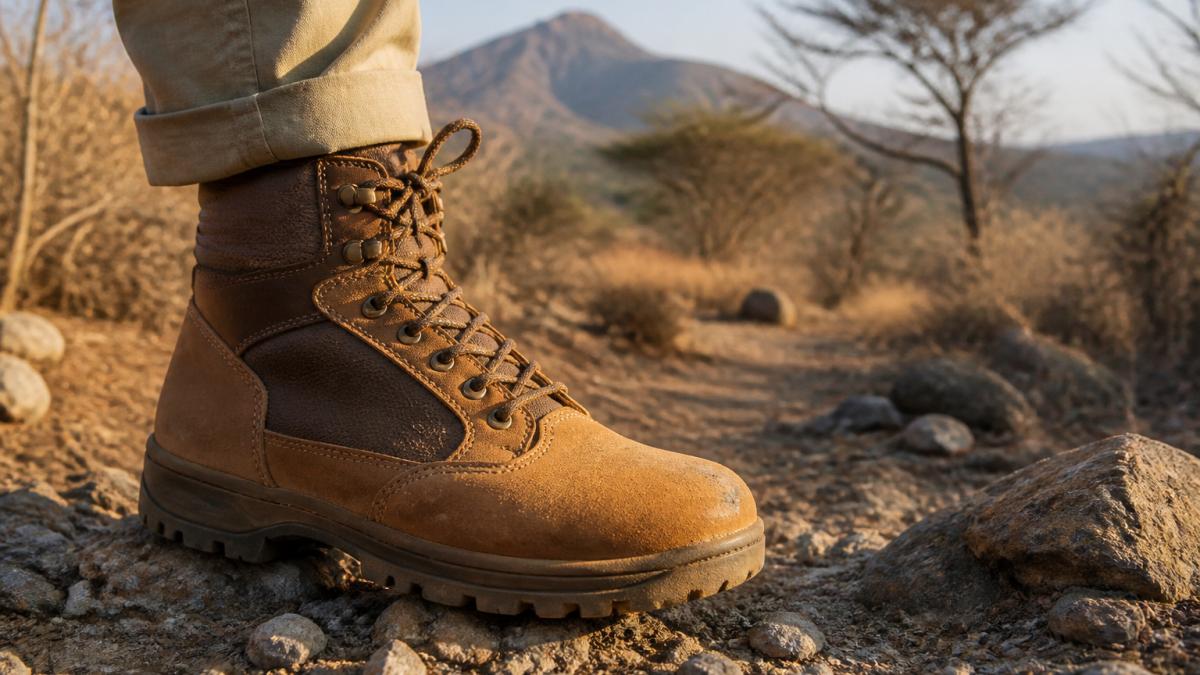
African Scope Owl Safari boot in sandback hatch leather →

Safari Footwear for Game Drives and Forest Walks
Game drives and forest walks ask different things of your footwear. On a vehicle-based game drive you sit for hours, step out onto sand or gravel, and get back in. You want something easy to slip on, cool, and stable on a step ladder. Forest walks bring damp ground, leaf litter, and roots, so grip and water resistance move up the list.
Our advice is to avoid taking two pairs if you can. One well-chosen leather boot handles both: it is comfortable enough to sit in during a drive and supportive enough for a forest walk when the vehicle stops. The Marsh Harrier, a taller laced boot with added water resistance and a Vibram Commando sole, suits itineraries where wetlands or river crossings are common. If you are packing light, one pair of leather boots plus a spare set of laces covers more ground than a canvas pair and a trail shoe combined.
Suede Safari Boots: The Overlooked Alternative to Canvas
Suede is a material worth considering for safari footwear. Suede safari boots give you the softness and light feel that people like about canvas, but with the structure and durability of leather. Suede is leather with a brushed nap, so it still resists thorns far better than woven fabric, still holds its shape around the ankle, and still takes a waterproof lining properly.
The catch is care. Suede marks, and it dislikes being soaked and left wet. Brush it dry, treat it before you travel, and it performs well. That is why we build several styles around it: the Harrier in tan leather and Felefrio suede, the Osprey Chic, and the Sparrowhawk. Each pairs suede with leather or a technical lining so you get the soft feel without losing protection. If you had written off suede as town-only, think again. You can browse the Sparrowhawk suede safari boot to see how the material works in a proper bush boot.
Drying Time, Care and Repair in the Field
Drying time is where material choice becomes a daily practical concern. Suede sits in between: it dries faster than full-grain leather but slower than canvas, and it needs more careful handling to avoid stiffness or staining.
A Field-Care Protocol for Each Material
Leather: If your boots get soaked, stuff them with newspaper or a dry cloth, keep them out of direct heat, and let them dry overnight. Never dry leather on a radiator or by a fire, the heat cracks the grain and shortens the boot's life. Carry a horsehair brush and a small tin of conditioner. Brush off dust and seeds each evening, and condition the leather every few days in dry conditions to keep it supple. Packing wet leather boots in a sealed bag is the fastest way to grow mould and ruin the upper.
Canvas: Shake out sand and seeds daily. Canvas can be scrubbed with a soft brush and cold water if muddy, but avoid harsh detergents that break down the fibres. It dries quickly in sun and air, but prolonged UV exposure weakens the fabric, so dry it in shade when possible. Once canvas tears or wears through at the toe or heel, it is rarely repairable, plan to replace rather than repair.
Suede: Suede needs a suede brush rather than conditioner. Brush off dust and mud when dry, and treat with a suede protector before you travel. If suede gets wet, stuff it with newspaper and let it dry naturally away from heat. Avoid soaking suede repeatedly, as it can stiffen and lose its nap. With proper care, suede holds up well in dry bush conditions and offers a lighter feel than full-grain leather.
Repair Versus Replace
Goodyear-welted boots are re-soleable, so a worn sole can be repaired rather than replaced. Canvas boots are rarely repairable once the upper tears or the sole wears through, they are a disposable purchase. Suede boots can sometimes be repaired if the damage is to the sole rather than the upper, but suede itself is harder to patch invisibly. If you are weighing up that decision, our guide on repairing leather boot soles versus replacing them sets out the costs and lifespan trade-offs.
Fit, Break-In and Blister Prevention
Fit decides whether a good boot becomes a great one. Leather boots need a proper break-in, and the biggest mistake is buying them the day before you fly. Give yourself a few weeks of short walks at home before a trip. Wear the socks you will actually walk in, because a thick trekking sock changes the fit completely. You can shop the Safari and Country Socks House of Cheviot Kyle in Forest Green to pair with your boots.
Our boots are made on an athletic last to allow for trekking and safari socks, and the internal last measurements are listed for each size. If you have wide feet or high arches, measure first and size against the last length. The lacing system combines ski hooks and D-rings for secure heel fitment.
Choosing Your Safari Boots from Field & Moor
Choosing comes down to your itinerary. Walking safaris and bush walks need ankle support, grip, and repairable construction. Game drives and forest walks need comfort and water resistance. Suede gives you a lighter feel without giving up protection. Leather remains the material we recommend for anyone who wants one pair to last several seasons.
Our African Scope Owl safari boot is the flagship for that job: sandback hatch leather, a Vibram sole, Goodyear welt and treble stitching, and a full leather insole with cork infill for insulation. It is re-soleable and built to give years of wear. You can view the African Scope Owl leather safari boot and check the last measurements against your own foot before ordering. For most safari-goers, that is the pair we would put on first.

Field & Moor boots are handcrafted in family-owned artisan factories in Spain, with Goodyear and storm-welted construction, Sympatex linings, and Vibram soles. If you want one pair that handles a bush walk in the morning and looks right in town afterwards, browse the Field & Moor range.
Frequently Asked Questions
Are leather or canvas boots better in hot weather?
Leather uppers with a breathable waterproof lining, such as Sympatex, are a practical option in warm conditions. The Field & Moor Harrier has a full leather insole with cork infill, which provides insulation in hot and cold temperatures.
Are canvas boots suitable for safari walks?
Canvas boots are a matter of personal preference for lighter itineraries. If your itinerary includes walking safaris, the Field & Moor leather boots with Vibram soles are built for walking on varied terrain.
Are suede boots a good alternative to canvas safari boots?
Yes. Suede safari boots give you the soft, flexible feel people like about canvas while adding far more structure and abrasion resistance. Suede is leather with a brushed nap. Field & Moor uses suede in several styles, including the Harrier in tan leather and Felefrio suede and the Harrier in chestnut leather and suede, both built on Goodyear-welted construction with Vibram soles. Brushing suede after use helps keep the nap in good condition.
How should safari boots fit for long walks?
Allow roughly a thumb's width at the toe and make sure your heel stays locked when you walk. Safari boots are worn with thicker trekking socks, so try them on with the socks you plan to use. Field & Moor publishes the internal last length for every size, for example the men's Harrier UK 8 measures 28.4 cm, which lets you compare against a boot you already own. The lacing system combines D-rings and ski hooks for secure heel fitment.
