
How to Decide Between Repairing Leather Boot Soles or Replacing

Last Updated: October 27, 2026
Quick Summary
Judge leather boot soles by the upper, not the sole: a worn sole is a maintenance item, while a cracked or collapsing upper is a structural failure. A stitched boot with a sound upper is nearly always worth repairing, but a cemented or moulded boot with a failing upper is not.
- Resoling is due when the outsole or heel has worn through to the midsole, not from surface scuffs.
- Goodyear welted soles can be cut away and replaced without touching the upper, supporting repeated resoles.
- Heel repair typically costs £25-£45, a standard resole £60-£110 and a full rebuild £110-£180.
- Replacement usually wins when a repair quote approaches the price of a new pair.
- Cracked leather across the flex point, a collapsed heel counter or a stretched upper are terminal.
Table of Contents
- Repair or Replace: The Decision Framework for Leather Boot Soles
- Signs Boots Need Resoling: A Practical Inspection Checklist
- Boot Construction and Resolability
- Goodyear Welted Boot Resoling Explained
- The Cost to Resole Leather Boots Versus Buying New
- How Long Does Boot Resoling Take?
- Repair Quality, Materials, and Warranty
- Environmental Impact and Cost Per Wear
- When Repair Is Not Worthwhile: Choosing Replacement Boots
- Deciding on Your Next Pair of Field & Moor Boots
- Frequently Asked Questions
Repair or Replace: The Decision Framework for Leather Boot Soles
A good pair of leather boots should not be thrown away because the sole has worn through. This guide sets out a decision framework: when a cobbler can save the boot, when replacement makes more sense, and what each route involves.
The core rule is simple. Judge the boot by its upper, not its sole. A worn sole is a maintenance item. A cracked, split or collapsing upper is a structural failure. Get that distinction right and the repair-versus-replace question mostly answers itself.
Below, we'll outline ways to inspect a pair, read the construction and weigh the decision.
Signs Boots Need Resoling: A Practical Inspection Checklist
Resoling is due when the outsole or heel has worn through to the midsole, when stitching has failed, or when the tread is smooth enough to slip. Surface scuffs are not a reason to resole. Penetration is.
Work through this checklist before you visit a cobbler:
- Tread depth: run a thumb across the forefoot. If the pattern has vanished in the middle, the sole is near the end.
- Heel wear: check the back edge. A heel worn at an angle needs a heel repair, which is cheaper than a full resole.
- Sole separation: flex the boot and look for gaps between sole and upper.
- Stitching: inspect the welt line for broken or frayed thread.
- Damp ingress: if water gets in through the sole rather than the upper, the sole is compromised.
- Upper condition: press the leather across the flex point. Cracks that open under pressure cannot be repaired.
Assessing the Leather Upper
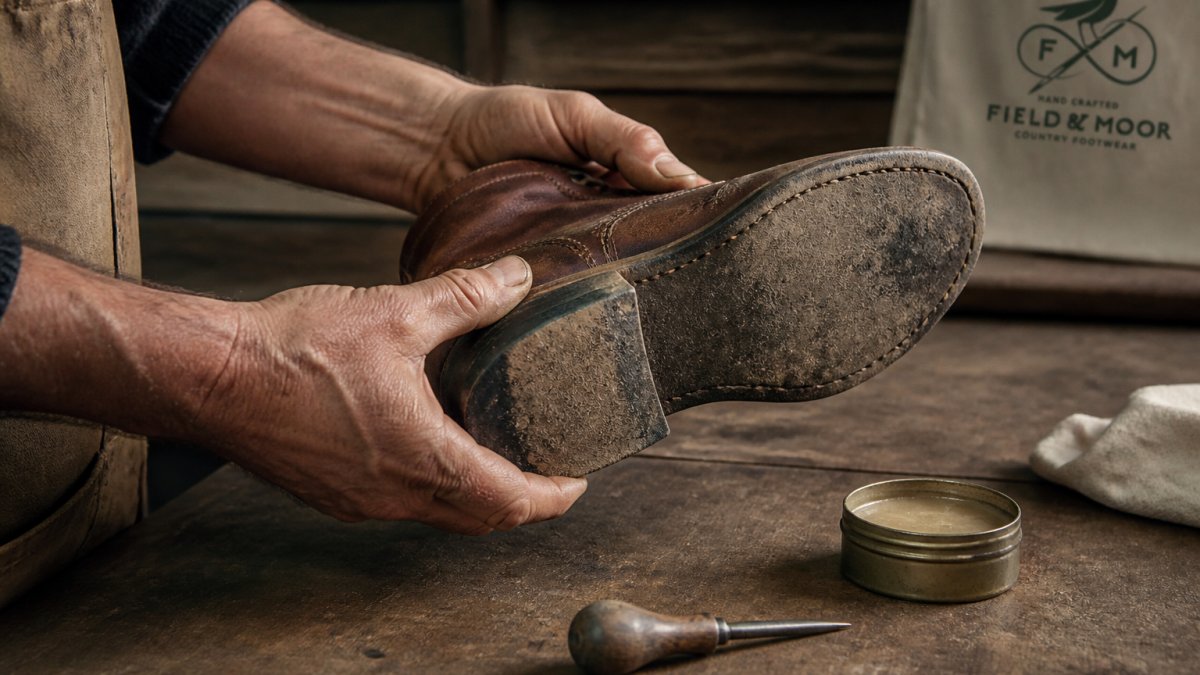
The upper decides everything. Press the leather where the foot flexes, just behind the toe cap. Fine surface creasing is normal and healthy. Deep cracks that stay open when you release the pressure mean the fibres have failed. That damage cannot be reversed by a cobbler, and a new sole on a cracked upper is money wasted.
Also check the lining, the eyelets and the welt itself. A soft, stretched-out upper that no longer holds the foot is another sign the boot has reached the end. For boots worth keeping, deeper guidance on long term maintenance leather dress shoes will help you slow that decline.
Types of Sole and Heel Damage
Not all sole damage is equal. Heel wear at the back edge is the most common and the cheapest to fix, usually as a heel repair rather than a full resole. A worn-out sole across the forefoot needs full replacement. Sole separation along the welt points to failed stitching or adhesive. Cracking in a rubber sole usually means the compound has aged, and a new sole is the only fix.
Boot Construction and Resolability
Resolability comes down to construction, and construction is not a two-way split between stitched and glued. There are four families you are likely to meet, and each one changes what a cobbler can do, what it costs, and how many times the boot can be saved.
The four constructions and what they mean for repair
Goodyear welted. A strip of leather (the welt) is stitched to the upper and to the insole, and the outsole is stitched to the welt. The sole can be cut away and replaced without touching the upper. This is the most repairable construction and the one that supports repeated resoles over a long life.
Stitched-down. The upper is turned outward and stitched directly to the sole, often with a visible row of stitching around the edge. Resolable, but the stitching runs through the upper, so each resole carries a small risk of weakening the leather at the stitch line. Good for casual and country boots, less suited to repeated rebuilds.
Blake stitched. The outsole is stitched directly to the insole from the inside of the boot. Resolable, but the sole is thinner and the stitch line sits close to the foot, so the repair is less robust than a welted job and the boot is harder to rebuild. Often found on lighter, dressier boots.
Cemented. The sole is glued to the upper. Some cemented boots can be resoled once if the bond fails cleanly, but the process is less reliable and many cobblers will not guarantee the result. A cemented boot with a failing upper is rarely worth repairing.
Moulded or injected. The sole is bonded to the upper as part of the manufacturing process, often on walking and hiking boots. Generally not resolable in the traditional sense; some can take a replacement sole unit, but the choice is limited and the cost often rivals a new pair.
How to tell which one you own
Turn the boot over and look at the edge where sole meets upper. A visible stitched line running around the perimeter, with a narrow strip of leather between the stitching and the upper, points to Goodyear welted. Stitching that runs through the upper itself points to stitched-down. No stitching at all, just a clean bonded edge, points to cemented or moulded. If you are unsure which construction you own, this guide on how to tell if boots are Goodyear welted walks through the tell-tale stitching and welt signs.
Why this matters for the repair-or-replace call
Construction is the single best predictor of a long, repairable life. A stitched boot with a sound upper is nearly always worth repairing, because the sole is a replaceable component rather than a sealed unit. A cemented or moulded boot with a failing upper is not, because there is no repair path that preserves the upper. Field & Moor boots use Goodyear and storm-welted construction.
Goodyear Welted Boot Resoling Explained
Goodyear welted boot resoling involves removing the worn outsole, inspecting and often replacing the midsole, then stitching a new sole to the existing welt. The upper is never cut. That is why the same pair can be resoled repeatedly over its life.
A cobbler typically works in this order:
- Cut the old stitching and lift off the worn sole.
- Check the midsole and cork filling for compression or damage.
- Replace the midsole where needed and renew the cork layer.
- Attach the new sole and re-stitch through the welt.
- Trim, sand and finish the edges, then polish the upper.
The Cost to Resole Leather Boots Versus Buying New
The useful comparison is the itemised cost of each repair tier set against the price of the boots you would otherwise buy. Break the quote down before you decide.
What each repair tier actually covers
- Heel repair: a new heel piece and the labour to fit and finish it. The cheapest intervention, and the right one when only the back edge has worn at an angle.
- Standard resole: a new outsole, re-stitching through the welt, edge trimming and finishing. The midsole is inspected but usually kept.
- Full rebuild: outsole, midsole, welt and cork layer all replaced, plus finishing. The highest repair tier, and the one that resets the boot's wear clock.
A realistic GBP range
Exact figures depend on the cobbler, the region and the sole unit specified, so treat any published number as a guide rather than a quote. As a working range for a stitched leather boot:
| Option | Typical GBP range | What drives the price |
|---|---|---|
| Heel repair | £25-£45 | Heel material, whether a full heel or a top piece |
| Standard resole | £60-£110 | Sole unit (rubber vs leather), stitching, finishing |
| Full rebuild | £110-£180 | Midsole, welt, cork, labour time |
| Replacement boots (like-for-like stitched) | £180-£350+ | Construction, leather grade, sole unit, brand |
The hidden costs on both sides
Repair has costs beyond the invoice: time without the boots, travel to and from the workshop, and postage if the cobbler works by mail. Replacement has its own hidden costs: the break-in period on a new pair, the risk that the last does not suit your foot as well as the old one, and the loss of a upper that had already moulded to you.
Factor those in and the true comparison is rarely as close as the sticker prices suggest. If you are weighing the outlay against a new pair, our piece on whether Goodyear welted boots are worth the money sets out the long-run maths.
When the quote changes the answer
If a repair quote approaches the price of a new pair, replacement usually wins, because you get a fresh upper and a fresh sole rather than a fresh sole on a tired upper. The exception is a boot with sentimental value or a last that suits you better than anything currently sold. In that case, a rebuild at the top of the range can still be the rational choice.
How Long Does Boot Resoling Take?
How long boot resoling takes depends on the workshop and the job. A heel repair can be turned around quickly, often within days. A standard resole usually takes longer because the sole must be stitched, trimmed and finished. A full rebuild takes longest, since the midsole and welt are replaced too.
Ask two questions when you drop boots off: the expected turnaround time, and whether the cobbler keeps your boots on site or sends them away. Sending away adds transit time in both directions. If you rely on the boots daily, ask about a loan pair or plan the repair for a quiet period.
Repair Quality, Materials, and Warranty
Repair quality hinges on three things: the sole material, the stitching and the cobbler's finishing. A cheap sole fitted badly will wear out fast and can damage the welt. Insist on a sole unit suited to how you use the boot, and ask what brand of sole the cobbler fits.
What most guides miss is the warranty question. Ask whether the cobbler guarantees the stitching and the sole bond, and for how long.
Environmental Impact and Cost Per Wear
Cost per wear tells the same story. Divide what you paid by the number of wears, then add the resole and divide again. A boot resoled twice and worn for years ends up costing very little per outing. A cheap pair replaced every season rarely does.
When Repair Is Not Worthwhile: Choosing Replacement Boots
Replacement is the right call when the upper has failed, when the boot is cemented and cannot be resoled, or when a repair quote approaches the price of a new pair. Cracked leather across the flex point, a collapsed heel counter or a stretched upper that no longer supports the foot are all terminal.
When you do retire a pair, store the old boots properly rather than leaving them damp in a shed. Our advice on how to store leather boots long term care covers cleaning, drying and shaping. Then choose the replacement on construction first: a stitched welt, a quality leather upper and a sole unit matched to your terrain.
Deciding on Your Next Pair of Field & Moor Boots
The pattern is clear. Judge the upper, read the construction, get a quote, then decide. A stitched boot with a sound upper is nearly always worth repairing. A cemented boot with a failing upper is not.
At Field & Moor, our boots feature Goodyear and storm-welted construction, waterproof Sympatex linings, rugged Vibram sole units and thick, soft leather uppers.
If your current pair has reached the end, browse the Hawk Country Boot in tan leather and start again with a boot designed to be resoled.
Frequently Asked Questions
How do I know if my leather boot soles need replacing?
Check for three things: heel wear that has eaten into the base layer, a sole that feels thin or flexible under the ball of your foot, and any separation between the sole and the upper. Look for cracks across the tread and exposed midsole.
Is it worth resoling a pair of leather boots?
It depends on the upper. If the upper is cracked across the flex point or the lining has worn through, replacement makes more sense.
How much does it cost to resole leather boots?
Pricing varies by cobbler, sole type, and construction. Always ask for an itemised quote covering sole, heel, stitching, and any welt repair. Compare that figure against the replacement cost of your boot model to judge value.
How long does boot resoling take?
Turnaround depends on the cobbler's workload and the repair type.
The challenge is not finding a boot that looks right. It is finding one that still performs years from now, when the sole is worn and the weather has done its worst. Field & Moor builds for that moment, with Goodyear and storm-welted construction, waterproof Sympatex linings and Vibram soles that can be replaced rather than discarded. Get started with Field & Moor and invest in a pair made to be repaired, not replaced.
