
7 Ways to Prevent Blisters Breaking In New Leather Boots

Last Updated: November 4, 2026
Quick Summary
To prevent blisters when breaking in new leather boots, wear them in short, frequent sessions and stop early at the first hot spot. Control the blister triangle of friction, heat and moisture with well-fitted merino wool socks, a thin sock liner, and gradual wear over one to three weeks.
- New leather boots cause blisters through friction, heat and moisture, so removing any one prevents them.
- Wear boots one hour indoors first, building gradually to full days over about a fortnight.
- Boots fit properly when your heel stays put and you have a thumb's width at the toe.
- A thin synthetic liner under a cushioned wool sock reduces abrasion by rubbing against the sock.
- Apply leather conditioner sparingly to soften stiff leather, and never bake it with direct heat.
Table of Contents
- Why New Leather Boots Cause Blisters
- How to Break In Leather Boots Gradually
- How to Tell If Boots Fit Properly Before You Walk
- Best Socks for Preventing Blisters
- How Long to Break In New Boots
- Softening Stiff Leather with Conditioners and Heat
- Lacing Patterns and Pressure Point Relief
- Post-Break-In Maintenance and Blister Prevention
- Choosing Blister-Ready Field & Moor Boots and Socks
- Frequently Asked Questions
Why New Leather Boots Cause Blisters
New leather boots cause blisters because stiff leather rubs against skin before it has moulded to your foot. The friction builds heat, heat softens the skin, and moisture turns that softened skin into a blister. Learning how to prevent blisters when breaking in new leather boots starts with understanding that simple chain, and the steps below show you how to prevent blisters at every stage.
At Field & Moor, we build boots from thick, high-quality leather.
Friction, Heat and Moisture: The Blister Triangle
Three things combine to create a blister: friction, heat and moisture. Remove any one of them and the blister never forms.
- Friction: stiff leather dragging against your heel or toes
- Heat: the warmth generated by that repeated rubbing
- Moisture: sweat that softens skin and makes it tear more easily
The NHS guidance on blisters is clear: most blisters heal on their own, but preventing them is far easier than treating them. That is why the blister triangle matters. Control friction, heat and moisture, and you control the outcome.
How to Break In Leather Boots Gradually
The safest way to break in leather boots is short, frequent wears rather than one long slog. Wear them for an hour at home, then two, then a short walk. Each session softens the leather a little more and shows you where pressure points form.
Rushing this is the single biggest mistake. A brutal three-week break-in is not a badge of honour. It is a sign the process was handled badly.
A Day-by-Day Wear-In Schedule
Follow this schedule and most boots will feel comfortable within a fortnight:
| Day | Wear Time | Setting | What to Watch |
|---|---|---|---|
| 1-2 | 1 hour | Indoors, thick socks | Hot spots forming |
| 3-4 | 2 hours | Indoors and short walks | Heel slippage |
| 5-7 | 3-4 hours | Light outdoor use | Toe pressure |
| 8-10 | Half days | Normal daily wear | Overall comfort |
| 11-14 | Full days | Full activity | Any recurring rub |
Stop a session early if you feel a hot spot. A hot spot is a blister waiting to happen. That is your warning, not a challenge to push through.
How to Tell If Boots Fit Properly Before You Walk
Boots fit properly when your heel stays put, your toes have room to wiggle, and the widest part of your foot lines up with the widest part of the boot. Check all three before you commit to a single long walk.
Here is how to test fit at home:
- Heel check: walk a few steps. Your heel should lift slightly but not slide up and down freely.
- Toe check: you need a thumb's width between your longest toe and the boot end.
- Width check: the ball of your foot should sit at the boot's widest point, with no pinching.
- Arch check: your arch should feel supported, not pressed.
If a boot fails the heel or width check, no amount of breaking in will fix it. Fit problems are not break-in problems.
Best Socks for Preventing Blisters
The right socks for long days out depend on your foot shape and where you typically feel pressure. Merino wool blend socks with a cushioned foot and a snug fit are a sensible starting point.
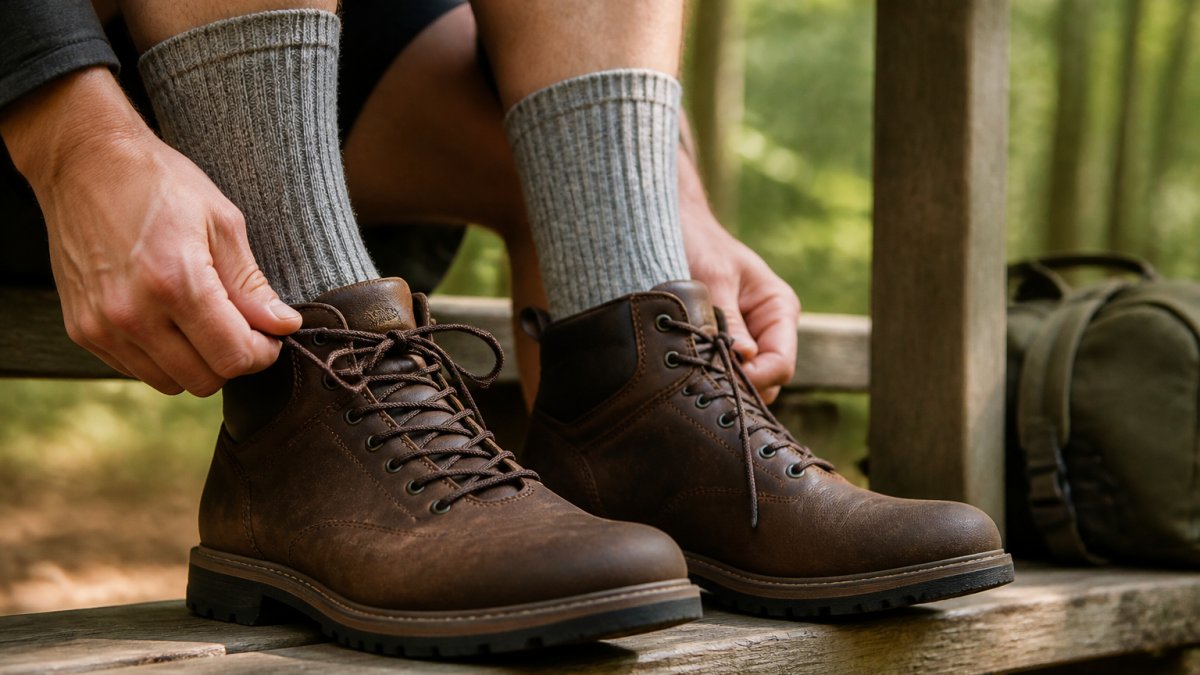
Merino wool regulates temperature, which is why it suits long days out.
Matching Socks to Your Foot Shape
The right thickness and cushioning pattern depends on your foot's architecture. If you have a high arch, you need cushioning under the midfoot and a sock that does not bunch under the instep, because that bunching creates a pressure point against stiff leather. A wide forefoot needs a sock with a roomy toe box and flat seams to avoid rubbing the little toe against the boot's edge. A narrow heel benefits from a sock with a snug heel pocket and added padding at the achilles, where heel slip is most likely during break-in.
A simple test: wear your normal socks and walk on a hard floor for five minutes. Note where you feel warmth or pressure. Those are your personal hot spots. Choose a sock with cushioning mapped to those zones rather than a uniform thickness throughout.
Our House of Cheviot Ben Trek hiking socks are built for all-day comfort. The merino wool blend cushions the foot to reduce fatigue, the ventilated ribs add breathability, and the Lycra support at the ankle and instep ensures a great fit at £16.50. For a deeper look at choosing the right pair, see our guide to choosing country walking socks, and if you want to understand the material itself, read why merino wool socks work for stalking.

Layering and Sock Liners
A thin sock liner under a thicker wool sock is a proven way to reduce abrasion. The two layers rub against each other instead of against your skin. The liner should be a smooth, synthetic material that wicks moisture, and the outer sock should be your cushioned wool pair. Watch out: if the liner is too thick or bunches, it creates new pressure points, so choose a liner that fits like a second skin.
How Long to Break In New Boots
Most leather boots take one to three weeks of regular wear to break in fully. Goodyear-welted boots with thick leather can take longer than thinner, softer styles. The timeline depends on the leather, the construction and how often you wear them.
Men's Hiking and Trekking Socks Ben Trek charcoal by House of Cheviot - New →
A common mistake is judging the boot after one hard day. Leather moulds gradually. Give it a fortnight of steady wear before you decide anything.
Softening Stiff Leather with Conditioners and Heat
Leather conditioners soften stiff leather by restoring oils and making the fibres more supple. Apply a small amount, work it in, and let it absorb. This is the most reliable way to speed up moulding without damaging the leather. Heat can help, but gently. Warm the leather slightly before wearing, never bake it. Direct high heat dries leather out and causes cracking.
Material-Specific Care: Full-Grain, Suede and Nubuck
Full-grain, suede and nubuck each respond differently to conditioners and heat.
Full-grain leather has open pores and a smooth, intact surface. It takes conditioner well and softens nicely with a quality shoe cream or renovator. Apply sparingly and buff off any excess. Watch out: over-conditioning full-grain leather makes it too soft and can weaken the structure. A little, applied evenly, goes much further than a heavy coat.
Suede has a napped surface that conditioner can mat down or stain. Never use a standard cream or wax on suede. Instead, use a suede-specific protector and a soft brush to lift the nap. Heat should be avoided entirely on suede, as it can shrink the material and set creases. Break in suede boots with gradual wear and a thin sock liner rather than conditioners.
Nubuck is similar to suede but with a finer nap. It tolerates a light nubuck conditioner, but apply it with a sponge in thin layers and let it dry fully between applications. Heat is risky here too: a hairdryer on nubuck can cause the nap to flatten permanently. A common pattern is to use a nubuck eraser for scuffs and a spray protector for moisture, relying on wear rather than heat to soften the leather.
For all three materials, the safest approach is to condition less than you think you need and to let wear do most of the work. If you are unsure which leather you have, check the product description or look for the characteristic nap of suede and nubuck versus the smooth surface of full-grain.
Lacing Patterns and Pressure Point Relief
Lacing patterns relieve pressure points by changing how the boot grips your foot. A heel-lock lacing pattern holds your heel down and stops the slippage that causes blisters. Looser lacing across the top of the foot relieves pressure on a high instep.
Try these adjustments:
- Heel lock: use the top eyelets to create a locking loop that secures the heel.
- Skip a crossover: leave one set of eyelets unlaced over a hot spot.
- Loosen the top: relieve pressure across a high instep or wide foot.
Small lacing changes often solve problems that feel like fit problems. Test them before you assume the boots are wrong.
Post-Break-In Maintenance and Blister Prevention
Post-break-in maintenance keeps leather supple and stops blisters returning. Clean off dirt, condition regularly, and let boots dry naturally away from direct heat. Well-cared-for leather stays soft and moulds to your foot instead of stiffening up.
Our step-by-step guide on how to maintain leather boots covers the full routine. For a deeper boot-specific walkthrough, see how to break in Goodyear welted boots.
Choosing Blister-Ready Field & Moor Boots and Socks
The right boots and socks do most of the work before you take a single step. At Field & Moor, our boots use thick, soft leather uppers and rugged Vibram soles, built for long days of activity. The waterproof Sympatex lining provides all-weather protection.
Pair them with the right socks and the break-in period becomes far gentler. Our House of Cheviot socks, knitted and hand-finished in the Scottish borders, offer cushioning for comfort.
Frequently Asked Questions
How do you break in new leather boots without getting blisters?
Wear them in short bursts of 30 to 60 minutes at home for the first few days, then build up gradually. Pair them with cushioned merino wool blend socks, and stop the moment you feel a hot spot.
How long should you wear new boots for the first time?
Start with 30 minutes indoors or on short, flat walks. Add roughly 30 minutes every second day, and avoid a full day of fieldsports until the leather has moulded to your foot. Most quality boots need one to three weeks of regular wear before they feel supple and settled.
What socks are best for preventing blisters in new boots?
Choose merino wool blend socks with cushioned feet and a snug cuff, such as House of Cheviot's Ben Trek at £16.50. Merino regulates temperature, which suits long days out.
Should you use blister plasters before new boots start rubbing?
Yes, on known hot spots. Applying a blister plaster or a thin protective patch to the heel and any pressure points before a long walk creates a barrier against friction. Check it stays in place, and replace it if it starts to peel. This is far easier than treating a blister after it has formed.
Breaking in new leather boots does not have to mean weeks of pain. Start with the right fit, wear them gradually, choose moisture-wicking socks, and maintain the leather properly. Field & Moor boots are handcrafted with Goodyear and storm-welted construction, waterproof Sympatex linings and rugged Vibram soles, designed for comfort across country pursuits and town wear alike. Get started with Field & Moor and break in your boots the right way, with fewer blisters and more miles.
