Best Boots for Safari Travel 2026: Top Picks & Guide

Table of Contents
- Quick Comparison: Best Safari Travel Boots for 2026
- How to Choose Walking Boots for Safari
- Top Picks: Best Boots for Safari Travel in 2026
- Best Socks for Safari Travel: Kyle and Ben Trek
- Breathability, Waterproofing and Dust Resistance Explained
- Durability, Repairability and Sustainable Manufacturing
- Weight, Packability and Post-Safari Versatility
- Footwear for Specific Medical Needs and Blister Prevention
- Frequently Asked Questions
Last Updated: September 16, 2026
Quick Comparison: Best Safari Travel Boots for 2026
Choosing the best boots for safari travel in 2026 comes down to matching footwear to how you'll actually move through the bush. At Field & Moor, we build handcrafted leather boots for exactly this split: long walking days on uneven ground, and long seated hours in a vehicle. Get it right and your feet disappear from your mind entirely.
The shortlist below covers four boots from our range, each suited to a different safari style, plus the socks that keep them comfortable. Prices are per pair.
| Boot | Height | Best For | Price |
|---|---|---|---|
| Marsh Harrier | 9 inch | Wetlands, river crossings, all-round safari | £225 |
| Harrier | 8 inch | Long walking days, light trekking | £224-£240 |
| Osprey | 11 inch | Rugged terrain, heavy going | £270 |
| Eagle | 17 inch | Camp life, cold mornings, tall grass | £270-£290 |
Below, we'll break down what actually matters when choosing safari footwear, then walk through each boot in detail.

How to Choose Walking Boots for Safari
How to choose walking boots for safari starts with one question most guides skip: are you walking or driving? A boot that excels on a game drive can be genuinely uncomfortable on a three-hour bush walk, and the reverse is equally true. Terrain, climate and daily routine decide everything else.
Three factors carry the most weight:
- Terrain: sand, mud, rock and riverbeds demand different outsoles and ankle support
- Duration: a two-hour morning walk needs less structure than a full-day trek
- Climate: heat and humidity punish non-breathable materials faster than cold ever will
Get these right and the boot choice almost makes itself.
Walking Safari vs. Game Drive: Why One Boot Doesn't Fit All
Walking safaris and game drives place opposite demands on footwear. On a walking safari you're covering uneven ground for hours, so ankle support, a grippy outsole and cushioning matter most. On a game drive you're seated for long stretches, stepping in and out of a vehicle on loose sand and gravel, so easy on-and-off and all-day seated comfort win.
The compromise most travellers land on is a mid-height laced boot with a supportive collar and a sole that grips without being clunky. Our Marsh Harrier and Harrier both sit in that zone. If your itinerary is mostly vehicle-based with short walks, the taller Eagle is the smarter pick.

Closed-Toe Protection, Ankle Support and Terrain Stability
Closed-toe protection is non-negotiable on safari. Thorns, sharp rocks, insect bites and sun-baked ground all punish open footwear, and many camps and reserves simply won't allow sandals on walks.
Ankle support matters most on uneven savanna, where a rolled ankle ends your trip. Look for a boot that laces above the ankle and holds the heel firmly. A Vibram outsole with a deep lug pattern handles loose sand, mud and rock without slipping, while a cushioned midsole absorbs the repeated shock of long days on hard ground. Our boots pair Vibram Commando soles with full leather insoles and cork infill for exactly this reason.
Top Picks: Best Boots for Safari Travel in 2026
The best boots for safari travel in 2026 are the ones matched to your itinerary, not the most expensive pair on the shelf. We've grouped our range by safari style so you can pick with confidence rather than guesswork.
Marsh Harrier: The All-Rounder for Wetlands and River Crossings
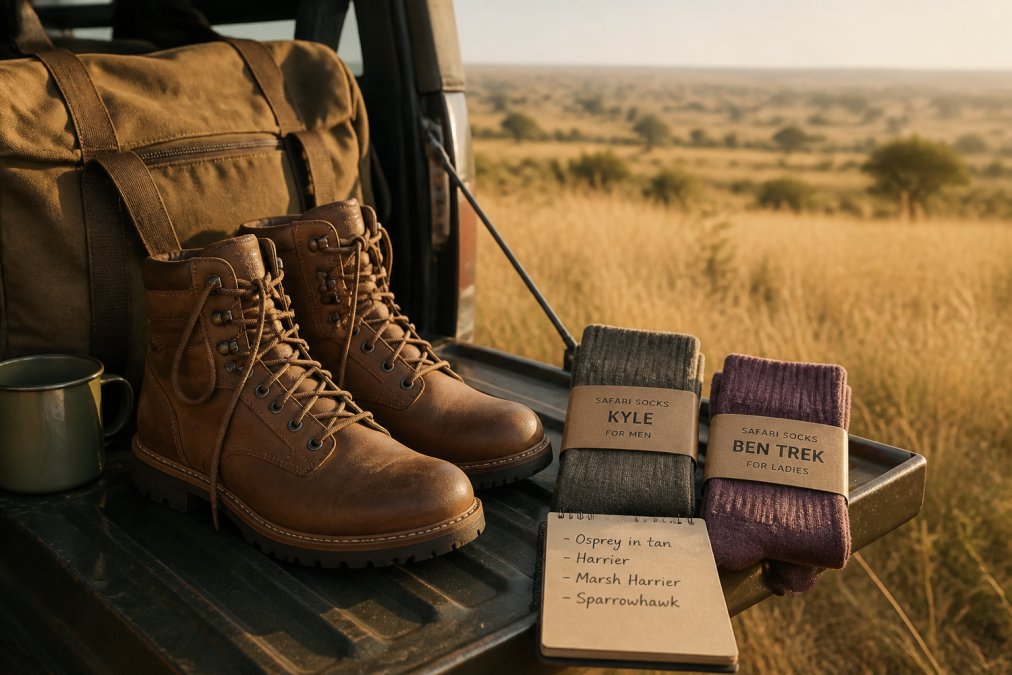
The Marsh Harrier is our top pick for most safari travellers. It's a 9-inch boot built around thick hydrophobic chestnut grain leather, a Sympatex waterproof and breathable lining, and a Vibram Commando sole for grip in mud and on wet rock. For itineraries that include wetlands or river crossings, it's the boot we'd reach for first.
The full leather lining includes cork in the footbed to regulate temperature and cradle the foot, which matters when days swing from cold dawns to hot afternoons. It comes with an extra pair of laces and a boot brush.
Pros: versatile across walking and driving, genuinely waterproof, comfortable from day one Cons: the 9-inch height is more than a pure game-drive traveller needs
Available in our ladies Marsh Harrier laced boot and a matching men's version.
Harrier: Lightweight Trekking Boot for Long Walking Days
If your safari leans toward trekking, the Harrier is the lighter, more agile option. It combines thick tan grain leather with Felefrio suede, a Sympatex waterproof and breathable lining, and a Vibram sole unit for grip on challenging ground. Goodyear welting and treble stitching give it real structural strength.
The full leather insole, cushioned footbed and cork infill insulation keep it wearable over long distances. It ships with spare laces and horsehair brushes for both leather and suede.
Pros: lighter feel for long walks, secure heel fitment, repairable construction Cons: the suede panels need more care than an all-leather upper
See the men's Harrier in tan leather and Felefrio suede and the ladies' equivalent.
Osprey: Full Leather Support for Rugged Terrain
For genuinely rough ground, the Osprey steps up the support. This 11-inch laced country boot uses a thick greased, hydrophobic leather upper with a Sympatex waterproof and breathable lining and a Vibram rubber Commando sole for traction on mud and snow. Storm-welted construction adds waterproofing at the seam.
The full leather-lined insole adds comfort, and treble stitching reinforces the whole build. It comes with two pairs of laces and a horsehair brush.
Pros: maximum support on difficult terrain, storm-welted waterproofing, built to last Cons: heavier than the Harrier, so less ideal for fast, light travel
The Osprey is available in greased brown leather and chestnut grained leather.
Eagle: Tall Boot for Camp Life and Cold Mornings
The Eagle solves a different problem: cold dawns, tall wet grass and quick transitions between vehicle and camp. At 17 inches it's a full-length country boot, Goodyear welted with a repairable Vibram Commando outsole and treble stitching for strength.
The soft but thick brown grain leather upper pairs with a Sympatex waterproof and breathable lining, while a double buckle and gusset combined with a half zip make it genuinely quick to pull on and off. A full-length insole with cork infill underfoot keeps cold ground at bay.
Pros: excellent insulation on cold mornings, fast on-and-off, tall protection Cons: overkill for hot, dry itineraries with little walking
Choose the men's Eagle long hunting and shooting boot or the ladies' Eagle.
Best Socks for Safari Travel: Kyle and Ben Trek
The best socks for safari travel do more work than most people realise. A quality sock manages moisture, cushions impact and prevents the friction that causes blisters, which is why we pair our boots with House of Cheviot socks knitted and finished by hand in the Scottish Borders. Matching these technical layers with versatile travel apparel ensures your entire kit remains as adaptable and resilient as your footwear when navigating unpredictable bush terrain.
For men, the Kyle is a hard-wearing walking sock built for full days on your feet. For ladies, the Ben Trek comes in fashion colours that work as well in camp as they do on the trail. Both are cushioned where it counts and breathe well under a leather boot.
- Kyle: durable, all-day performance for men
- Ben Trek: cushioned comfort in colours that suit safari wear for ladies
Pairing the right sock with the right boot is the cheapest comfort upgrade you can make.
Breathability, Waterproofing and Dust Resistance Explained
Breathability and waterproofing sound like opposites, and in cheap footwear they are. A waterproof membrane that doesn't breathe turns your boot into a sauna, and a breathable boot that isn't waterproof soaks through the first river crossing. The way out of that trade-off is a membrane that does both, which is why our boots use a Sympatex waterproof and breathable lining across the range.
How a Waterproof and Breathable Membrane Actually Works
A membrane like Sympatex sits as a thin layer between the leather upper and the lining. Its pores are small enough that liquid water droplets can't pass through, but large enough that water vapour, the sweat your foot produces, can escape. That's the whole trick: liquid water stays out, vapour gets out.
Leather vs. Mesh in Dust and Heat
Dust resistance is the underrated third factor. Fine African dust works into seams, zips and lacing hardware, and once it's in, it acts like sandpaper on the lining and the membrane. A secure lacing system limits how much grit reaches your foot.
Leather uppers resist dust better than mesh-heavy designs because there are fewer openings for particles to enter. Mesh dries faster after a river crossing, but it also lets dust straight through to the sock. For most safari itineraries, hot, dry, dusty with occasional water, a full-leather or leather-dominant upper is the better long-term choice. Our Marsh Harrier, Harrier, Osprey and Eagle all use leather-dominant uppers for exactly this reason.

The Maintenance Routine That Keeps Both Working
A waterproof and breathable boot only stays that way with the right care:
- Clean dust off after every few wears. A soft brush and clean water remove the grit that abrades the membrane.
- Use a leather-suited conditioner or wax, not a generic waterproofing wax. A standard wax that blocks the membrane turns a breathable boot into a sauna.
- Reapply after every few wears in dusty conditions. Leather dries and cracks when it's stripped of its oils, and cracked leather leaks.
- Dry boots at room temperature, never on a radiator or in direct sun. Heat degrades both the leather and the membrane.
Pairing Socks With the Membrane
The membrane handles the boot side of moisture management; the sock handles the foot side. A merino-rich walking sock like the Kyle for men or the Ben Trek for ladies moves sweat away from the skin and into the lining, where the membrane can push it out as vapour. Pair the right sock with the right boot and the membrane has a chance to do its job.
Durability, Repairability and Sustainable Manufacturing
Durability on safari means two things: surviving harsh conditions, and being worth repairing rather than replacing. Goodyear and storm-welted construction allow a boot to be resoled.
Our boots are handcrafted in family-owned artisan factories in Spain, using carefully chosen leathers and traditional welted construction. That approach matters for sustainability too.
- Goodyear and storm-welted construction for resoling
- Treble stitching for structural strength
- Vibram soles that can be replaced rather than discarded
Weight, Packability and Post-Safari Versatility
Weight and packability matter when you're flying long-haul with a luggage limit. A mid-height boot packs down more easily than a tall one, and leather boots can be stuffed with socks to save space. If you're travelling with one pair, choose a boot that works for both the bush and the town.
This is where a smart-casual leather boot earns its place. Our Harrier and Marsh Harrier in tan and chestnut read as heritage country boots rather than technical hiking gear, so they look right with chinos at dinner as well as on a game drive. Post-safari versatility means one pair does the work of two.
Footwear for Specific Medical Needs and Blister Prevention
Most safari footwear guides ignore the traveller with wide feet, high arches or plantar fasciitis. The good news is that a well-made leather boot with the right insole and the right sock handles most of these needs without a custom orthotic.
Fit for Wide Feet, High Arches and Plantar Fasciitis
- Wide feet: Look for a boot with a roomy toe box and a lacing system that lets you adjust volume across the instep. A full leather upper will stretch slightly with wear; a synthetic upper won't.
- High arches: A supportive footbed with cork infill moulds to the arch over the first few wears, spreading pressure instead of concentrating it under the ball of the foot.
- Plantar fasciitis: Cushioning under the heel and a firm heel counter matter more than arch height alone. A full leather insole with cork infill, the setup across our range, gives both, and the lacing that secures the heel reduces the sliding that aggravates arch pain.
- Orthotic compatibility: If you wear custom orthotics, choose a boot with a removable insole so the orthotic sits on the boot's lasting rather than on top of a fixed footbed. Check the depth before you fly, a thick orthotic can crowd the toe box.
Why Cork and Leather Insoles Help
Cork is a natural shock absorber. Under body heat and pressure it compresses slightly and takes the shape of your foot, which is why a cork-infill footbed feels custom after a week of wear. Leather insoles wick moisture and resist odour better than foam.
A Blister-Prevention Protocol That Actually Works
Blisters come from three things: friction, moisture and heat.
- Size correctly. Measure your feet in the afternoon, when they're largest, and size to your normal walking sock, not a thicker one you might wear later.
- Choose the right sock. A cushioned, moisture-wicking sock like the Kyle for men or the Ben Trek for ladies moves sweat away from the skin and pads the heel and ball. Cotton holds moisture against the foot and is the single most common cause of safari blisters.
- Break boots in before you fly. Wear them around the house and on short walks for at least a week. Never debut a new boot on a safari.
- Lace firmly across the instep. This stops the foot sliding forward on descents, which is where heel blisters start.
- Carry blister plasters and a spare pair of socks. Changing socks mid-walk removes the moisture that softens skin and makes it vulnerable.
Sock Pairing: The Cheapest Comfort Upgrade
Boots are only as good as the socks worn with them. The Kyle for men is a hard-wearing walking sock built for full days on your feet, cushioned at the heel and ball. The Ben Trek for ladies comes in fashion colours that work as well in camp as they do on the trail. Both breathe well under a leather boot and manage moisture the way the membrane needs. If you do nothing else before your safari, get the sock right, it's the cheapest comfort upgrade you can make.
Frequently Asked Questions
What are the best boots to wear on a safari?
The best safari travel boots combine closed-toe protection, ankle support and a grippy Vibram outsole. For walking safaris, a mid-height lace-up with a waterproof Sympatex lining and breathable leather upper works well. For game drives, a lighter boot with slip-on convenience suits camp life. Look for moisture-wicking linings, a cushioned footbed and a lug pattern that handles loose sand, mud and rocky ground without slipping.
Are trainers suitable for walking safaris?
Trainers lack the ankle support, closed-toe protection and grip needed for walking safaris. Bush walks often cross uneven terrain, thorny scrub and loose gravel, where a proper safari boot with a Vibram sole and reinforced toe keeps feet stable and protected. If you only plan game drives and camp time, a lightweight boot or sturdy trainer can work, but for any walking component, choose a dedicated safari or trekking boot.
How do I choose the right socks for safari travel?
Pair your safari travel boots with moisture-wicking socks that cushion the foot and reduce friction. Merino wool or bamboo blends dry quickly and regulate temperature, while a reinforced heel and toe add durability. The Kyle sock for men and Ben Trek for ladies offer breathable comfort in fashion colours, making them a practical match for long days on foot. Bring at least three pairs so you always have a dry set.
What colours should you avoid wearing on safari?
Avoid bright white, black and vivid colours, which stand out in the bush and can alarm wildlife. Neutral tones such as khaki, olive, tan and brown blend into the savanna and reduce glare. Dark blue and black also attract tsetse flies in some regions. Choose boots and clothing in earthy shades for stealth during wildlife viewing and to stay cooler under strong sun.
How do I know if safari boots will fit wide feet and high arches?
Check the internal length measurement of the boot last, not just the stated size. Field & Moor lists inside lengths in centimetres for each size, so you can compare against your own foot measurement. A full leather insole with cork infill moulds to high arches over time, while a lacing system with D-rings and ski hooks lets you adjust heel fitment. Order your usual size and allow a little room for thicker socks.
Safari footwear fails when it's chosen for looks alone or borrowed from a general hiking list. Match the boot to your itinerary, pair it with a proper sock, and break it in before you travel. Field & Moor handcrafts leather safari boots with Sympatex waterproof linings, Vibram Commando soles and Goodyear-welted construction that can be resoled for years of use, alongside House of Cheviot Kyle and Ben Trek socks. Get started with Field & Moor and step onto the savanna with footwear built to last.