
Best Durable Country Socks for Long-Lasting Performance

Table of Contents
- What Separates Durable Country Socks From Ordinary Pairs
- Why Merino Wool Blends Outperform in the Field
- The Best Socks for Country Boots: Three Proven Options
- Reinforced Heel and Toe Socks: Where Durability Is Built
- Country Sock Sizing and Fit: Getting It Right First Time
- How to Wash Merino Wool Socks Without Shrinking Them
- Rotation of Socks and Boots: The Habit That Doubles Lifespan
- Choosing the Right Country Socks for Your Needs
- Frequently Asked Questions
Last Updated: October 9, 2026
What Separates Durable Country Socks From Ordinary Pairs
A durable country sock is a knitted wool-blend sock built with reinforced heel and toe zones, a cushioned footbed and a supportive cuff, designed to hold its shape through repeated wear and washing. Ordinary socks use thin yarn and single-layer construction; country socks add nylon for abrasion resistance and Lycra for fit. At Field & Moor, we stock House of Cheviot socks knitted and hand-finished in the Scottish borders, and this guide covers what to look for, how to size them, and how to make a pair last.
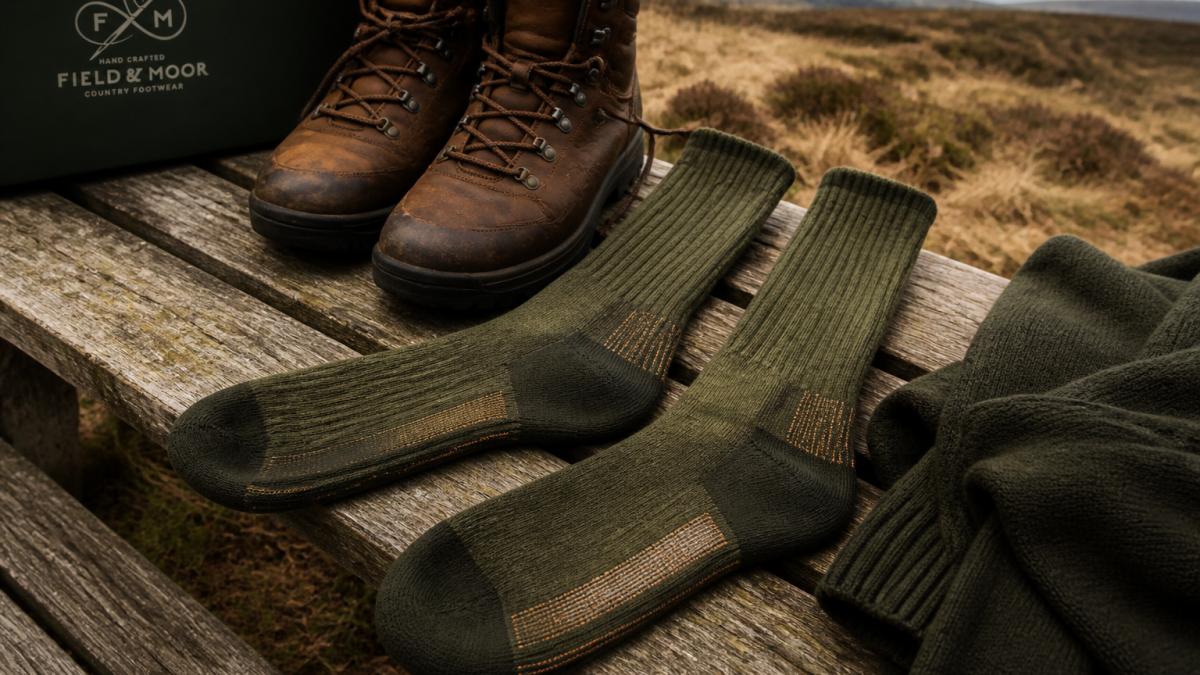
The difference shows up fastest at the stress points. A sock fails at the heel, the toe and the cuff long before the rest of the knit wears through. That is why yarn composition matters more than thickness: a high merino wool blend regulates temperature and resists odour, while nylon and Lycra do the structural work that wool alone cannot.
Why Merino Wool Blends Outperform in the Field
Merino wool is the fibre that makes a country sock worth its price. It regulates temperature, wicks moisture away from the skin and naturally resists odour, which matters when you are standing in a field all day. The catch is that pure wool has poor abrasion resistance and no memory, so it stretches out of shape.
The solution is blending. House of Cheviot socks use a high merino wool blend, typically 85% merino and acrylic, with 10% nylon and 5% Lycra in the technical styles. The nylon adds durability where the boot rubs; the Lycra pulls the sock back into shape after every wear and wash. For a fuller picture of how wool blends compare with synthetics, the British Wool guidance on wool fibre performance is a useful reference.
That balance is why we favour these blends over both pure wool and pure synthetic. Pure wool feels wonderful and wears out fast. Synthetic socks last but hold odour and feel clammy after a long day.
The Best Socks for Country Boots: Three Proven Options
Choosing the best socks for country boots comes down to matching the sock to the boot and the day. A heavily cushioned sock suits a stiff leather boot on a cold shoot; a lighter, ventilated sock suits a long summer walk. All three options below are House of Cheviot, knitted and hand-finished in Scotland, and all three sit at £15 to £16.50.
Sock |
Price |
Composition |
Best For |
|---|---|---|---|
Munro (Olive Green) |
£15.00 |
Wool/acrylic blend, 8% nylon, 5% Lycra |
Cold-weather shooting and long days in stiff boots |
Glen (Charcoal) |
£15.00 |
85% merino/acrylic, 10% nylon, 5% Lycra |
All-round country wear with a smarter finish |
Ladies Ben Trek (Fuchsia) |
£16.50 |
85% merino blend, 10% nylon, 5% Lycra |
Walking, trekking and warm-weather comfort |
Munro in Olive Green: Cushioned Comfort for Long Days
The Munro is our pick for anyone who spends a full day in a heavy country boot. It pairs a wool and acrylic blend with 8% nylon reinforcement and 5% Lycra, and the cushioned foot takes the sting out of standing on cold, hard ground. The olive green colourway sits naturally with tweed and shooting attire.

Where it falls short: it is a warmer sock, so it is not the one to reach for in high summer. If you want maximum cushioning for winter fieldsports, this is the pair. Munro in Olive Green
Glen in Charcoal: Technical Performance With a Smart Finish
The Glen is the most versatile sock in the range. The merino wool and acrylic blend makes up 85% of the sock, with 10% nylon reinforcement and 5% Lycra, and the charcoal grey with navy trim collar looks smart enough to wear in town without looking like you have just come off the moor.
Glen in Charcoal
Ladies Ben Trek: Lightweight Support for Walkers
The Ben Trek is built for walkers who want support without bulk. The soft cuff gives a gentle hold without pinching, ventilated ribs keep air moving, and Lycra support at the ankle and instep holds the sock in place on long descents. The cushioned foot is designed to reduce fatigue, which is the complaint we hear most from walkers covering serious distance.
The merino blend regulates temperature in both directions, so it works as an all-year sock. The fuchsia colourway is a deliberate choice: it is easy to find in a kit bag and it looks the part on the trail. Ladies Ben Trek
Reinforced Heel and Toe Socks: Where Durability Is Built
Reinforced heel and toe socks add extra nylon at the two zones that wear through first, which is the single most effective way to extend a sock's working life. In practice, this means looking at the yarn composition and the knit density at the heel cup and toe cap, not just the overall thickness.
A common mistake is assuming that a thicker sock is a tougher sock. It is not. A thin sock with 10% nylon at the heel will outlast a thick pure-wool sock every time, because the failure mode is abrasion, not cold. When you inspect a pair, turn it inside out and look for a denser knit at the heel and toe, and check that the cuff has a defined rib rather than a loose band.
Country Sock Sizing and Fit: Getting It Right First Time
Country sock sizing and fit comes down to two measurements: your shoe size and your calf circumference. Sock sizes are usually given as ranges rather than single sizes, and the cuff has to sit comfortably below the knee without cutting in. A sock that is too small will stretch thin at the heel and fail early; one that is too large will bunch and rub.
Fit checklist:
Men's Hiking and Country House of Cheviot socks - Munro in olive Green →
- Measure your foot in the boot you will wear the socks with, not barefoot
- Match your shoe size to the sock's stated range, and size up if you are at the top of a band
- Check the cuff sits smoothly below the knee with no tight band
- Confirm the heel cup sits on your heel, not halfway up the back of your leg
- Allow for a slightly thicker sock if you wear boots with a roomy fit
If you are between sizes, go up. A slightly generous sock will shrink marginally with correct washing; an over-stretched one never recovers.
How to Wash Merino Wool Socks Without Shrinking Them
How to wash merino wool socks without shrinking them comes down to three rules: turn them inside out, wash at 30 degrees or below with a wool-friendly detergent, and never tumble dry. Heat and agitation are what shrink wool, not water. The Woolmark care guidance for wool garments sets out the same principle for all wool textiles.
The full method:
- Turn the socks inside out to protect the outer knit
- Use a wool-friendly detergent, not a biological powder
- Wash at 30 degrees or below, on a gentle spin, or hand wash
- Do not tumble dry, ever
- Lay flat to air dry naturally, away from direct heat
That last step is the one people skip. A radiator will shrink a wool sock just as effectively as a dryer.
Rotation of Socks and Boots: The Habit That Doubles Lifespan
Rotation of socks and boots is the simplest habit that extends the life of both. Socks need a rest day between wears so the Lycra can recover and the wool can dry fully. Boots need the same, because leather holds moisture from the inside as well as the outside, and a boot that never dries will crack and lose its shape.
A practical rotation looks like this: three or four pairs of socks in service, worn in turn, with each pair airing for at least 24 hours between wears. The same logic applies to boots. Alternate two pairs where you can, use cedar or similar shoe trees to draw moisture out, and let them dry at room temperature rather than by a fire.
Choosing the Right Country Socks for Your Needs
The right pair depends on how you will use it. Cold-weather shooting in stiff leather boots calls for maximum cushioning and a warmer blend. Year-round country wear calls for a technical merino blend with a smart finish that works in town as well as in the field. Long-distance walking calls for lighter construction with proper ankle support and ventilation. Matching these specialized socks to the correct durable work boots ensures that your feet remain protected and comfortable across the most demanding terrain.
If you are unsure, start with one pair of each and see which you reach for. Socks are the cheapest upgrade in any country wardrobe, and the difference between a good pair and an ordinary one is felt within the first hour.
For boots to wear them with, our range is built on Goodyear and storm-welted construction, waterproof Sympatex linings and Vibram soles, with British design by Hannah Stiles and handcrafting in family-owned artisan factories in Spain. Good boots and good socks work as a system, and both last longer when you look after them.
The gap between a sock that lasts a season and one that lasts several comes down to yarn composition, correct sizing and how you wash and rotate them. If you want socks that already get all of that right, Field & Moor stocks House of Cheviot country, shooting and walking socks, hand-finished in the Scottish borders and priced at £15 to £16.50. Pair them with our handcrafted country boots, built with waterproof Sympatex linings and rugged Vibram soles for long days in the field and smart wear in town. Get started with Field & Moor and build a footwear system that performs season after season.
Frequently Asked Questions
What materials make country socks durable?
Durability comes from the fibre blend, not one material alone. A high merino wool content provides natural moisture management and temperature regulation, while nylon reinforcement at high-wear zones adds abrasion resistance. Lycra contributes stretch recovery so the sock holds its shape after repeated washing and wear. The Munro sock, for example, combines a wool and acrylic blend with 8% nylon and 5% Lycra, while the Glen uses 85% merino wool blend, 10% nylon and 5% Lycra. That balance of softness and structural support is what keeps country socks going season after season.
Are merino wool socks good for country wear?
Merino wool is well suited to country wear because it regulates temperature, keeping feet warm in winter and cool in summer, and it manages moisture so feet stay drier during long days outdoors. It also resists odour naturally, which matters when you are wearing the same boots from morning to dusk. A merino wool blend reinforced with nylon and Lycra gives you the comfort of wool with the shape retention and abrasion resistance that pure wool alone cannot match.
How should country socks fit inside boots?
Country socks should sit close to the foot without wrinkling or bunching, because folds create friction and lead to blisters. The heel pocket needs to sit directly under your heel, and the cuff should hold gently without pinching. If you can pinch more than a centimetre of loose fabric at the arch, the sock is too big. Cushioned foot designs, like those in the House of Cheviot range, fill the boot without adding bulk, so your foot stays stable on uneven ground.
How often should you rotate socks and boots?
Rotate socks daily and boots every other day where possible. Socks absorb sweat and lose shape with continuous wear, so giving them 24 hours to dry and recover extends their life. Boots benefit from a rest day too: leather needs time to dry naturally away from direct heat, and alternating pairs prevents moisture building up in the lining. If you walk or shoot most days, keep at least three pairs of socks and two pairs of boots in rotation.
Where should durable socks have reinforced areas?
The heel and toe take the most abrasion, so that is where reinforcement matters most. Look for nylon content concentrated at these stress points, plus a cushioned foot panel that absorbs impact without flattening over time. Lycra at the ankle and instep helps the sock grip the foot and return to shape after washing. Reinforced heel and toe socks last noticeably longer than plain wool pairs because the fibres at those contact points resist thinning and eventual holes.