
Country Boots for Women: The 2026 Field Guide

Table of Contents
- What to Look For in Country Boots for Women
- Waterproof Country Boots for Women: Sympatex vs GORE-TEX
- Leather Country Boots: Construction and Durability
- Chelsea Boots vs Tall Boots for the Countryside
- How to Clean Leather Country Boots
- Styling Country Boots for Women: From Field to Town
- Conclusion: Choosing Your Perfect Pair
- Frequently Asked Questions
Last Updated: September 6, 2026
What to Look For in Country Boots for Women
Country boots for women are no longer a single-purpose purchase for the shooting field or the stables. The best pairs now carry you from a wet morning walk to a lunch meeting in town without demanding a change of footwear. That versatility is exactly why the buying decision has become harder: you are choosing a system of construction, a waterproofing method, and a sole that will either grip or slip when you need it most.
We design boots for this dual life, so we have spent years refining what separates a boot that lasts a decade from one that spends most of its life in the cupboard. Before you compare styles or colours, focus on four fundamentals: the waterproof membrane, the welt construction, the leather quality, and the sole unit.
The single most important decision is the construction method. A Goodyear-welted or storm-welted boot allows the sole to be replaced when it wears down, which means the upper, the part that has moulded to your foot, lives on (wikipedia.org). Cheaper cemented constructions are disposable by design; when the sole goes, so does the boot.
Waterproof Country Boots for Women: Sympatex vs GORE-TEX
The waterproofing debate comes down to two membrane technologies. GORE-TEX is the name most people recognise, and it performs admirably, but Sympatex offers a compelling alternative. Both work on the same principle: a microporous membrane that blocks liquid water from entering while allowing water vapour, your sweat, to escape (gore-tex.com).
The practical difference lies in how the membrane is integrated. Sympatex is often bonded directly to the lining and outer materials, reducing weight and improving flexibility. For country boots for women that need to feel responsive on uneven ground, that lightness translates into less fatigue. GORE-TEX, by contrast, is typically used as a separate layer.
What matters more than the brand of membrane is the quality of the boot surrounding it. A waterproof lining is only as good as the seams it protects; a poorly constructed boot will leak through the stitching long before the membrane fails. Look for a full bellows tongue and sealed seams.
Leather Country Boots: Construction and Durability
Leather is the material that gives a country boot its character, its longevity, and its ability to mould to your foot over time. The best country boots use full-grain or top-grain leather that is thick enough to resist thorns and brambles but soft enough to break in without weeks of suffering.
The construction method determines how long that leather upper lasts. A Goodyear welt involves stitching the upper to a strip of leather, the welt, which is then stitched to the sole. This traditional method allows for multiple resoles over the boot's life. Storm-welting goes further, with the welt turned upward to create a barrier against water penetration at the seam.
The break-in period is where many buyers abandon a good boot. A well-made leather boot should feel snug but not punishing from the first wear. If a boot causes blisters in the first hour, the fit is wrong, not the leather. Expect a settling-in period of several days, but never accept pain as normal.
Chelsea Boots vs Tall Boots for the Countryside
The choice between an ankle-height Chelsea and a tall boot is less about fashion and more about the terrain you will cross and the fit your calf demands. Both styles solve different problems, and the right answer depends on how you split your time between farm track, town pavement, and muddy field.
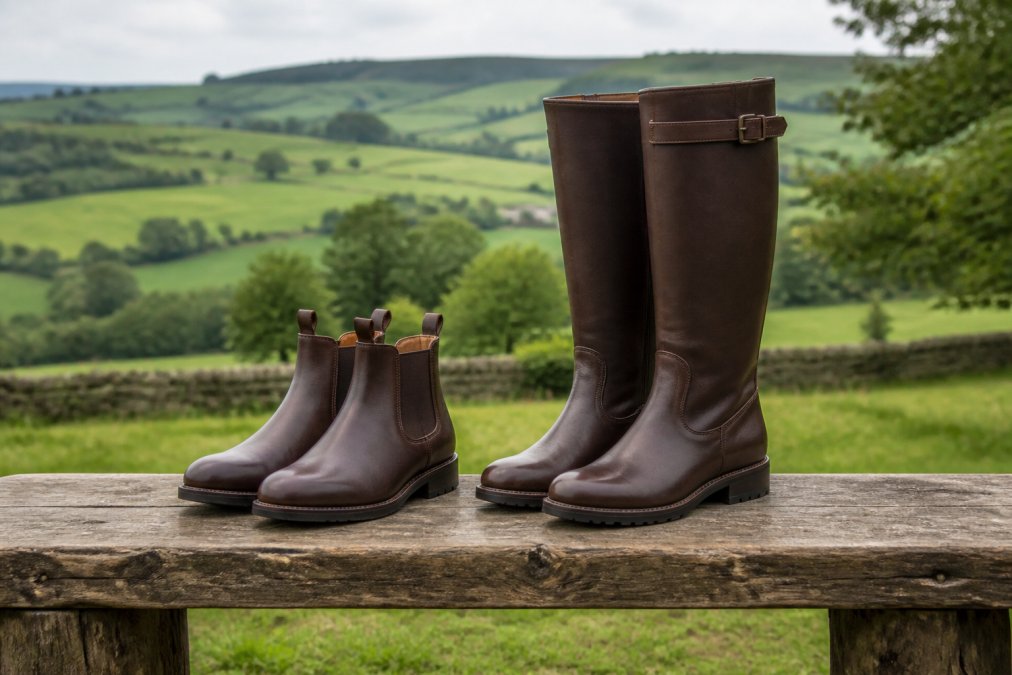
Chelsea boots for women, with their elasticated side panels and pull tabs, are the ultimate slip-on solution for quick transitions: dog walks, the school run, a drive to the farm shop. They offer excellent ankle mobility and are easier to pack, but they sit lower on the leg, so deep mud or long wet grass will find its way over the top. For light-duty countryside use, short walks on firm ground, popping to the stables, or driving between gates, a Chelsea is hard to beat.
Tall country boots, reaching mid-calf or higher, provide protection that ankle boots cannot match. They keep your lower leg dry when striding through bracken or standing in a wet field, and they offer additional support for the ankle joint on uneven ground. The trade-off is weight and flexibility; a tall boot is inherently heavier and less convenient to pull on and off.
Fit and Calf Width: The Hidden Decider
One factor that rarely appears in glossy marketing but dominates real-world satisfaction is calf fit. Tall boots are not one-size-fits-all; a boot that fits perfectly around the foot can be unwearable if the calf circumference is too narrow or too wide. Most quality brands offer multiple calf widths.
Before you buy a tall boot, measure your calf at its widest point while wearing the socks you plan to use in the field. Then check the brand’s size chart, not just for foot length but for calf circumference. If you are between widths, err on the side of roomier; a boot that is too tight will cut off circulation, while a slightly loose shaft can be snugged with a boot sock or an insole.
Terrain-Specific Performance
The real test of a boot is how it behaves on the ground you actually walk. On a wet, muddy bridleway, a tall boot with a deep-lugged sole, think Vibram or a similar aggressive tread, will give you the grip and coverage you need to stride through puddles. A Chelsea with a shallower tread is fine for a dry path or a quick trip to the post box, but it will slide on wet grass on a slope.
For heavy-duty agricultural or equestrian use, where you might be on your feet for six hours mucking out or schooling a horse, a tall boot with a supportive shaft and a robust sole is non-negotiable. The shaft helps stabilise the ankle when lifting hay bales or leading a horse over uneven ground, and the height keeps nettles and thorns off your lower leg.
The Verdict: Which Should You Choose?
If you can only buy one pair now, consider your dominant activity. Daily dog walking on varied ground points toward a tall boot; frequent transitions between car, office, and field point toward a Chelsea. But the honest answer for most women who split their time between genuine countryside work and town errands is that a single pair rarely covers both extremes.
| Boot Style | Best For | Key Trade-off |
|---|---|---|
| Chelsea Boots | Everyday versatility, quick changes, town wear | Limited protection in deep mud or wet grass; calf fit less adjustable |
| Tall Boots | Field sports, long walks, wet terrain | Heavier, less convenient to remove; calf width must be measured |
How to Clean Leather Country Boots
Cleaning leather country boots is a maintenance ritual that determines whether they last five years or twenty, yet it is the step most owners skip until the damage is done. The golden rule is to clean after every muddy outing, not when the boots start to look tired. Mud contains acids and grit that dry into the leather's pores and act like sandpaper on the surface with every step you take (extension.org).
The Essential Kit
Before you start, gather the right tools. A few basics will make the job easier and safer for the leather:
- A soft-bristled brush (horsehair is ideal) for removing dry mud.
- A damp, lint-free cloth for wiping down the uppers.
- A specialist leather cleaner, look for a pH-neutral formula that does not strip oils.
- A high-quality leather balm or dubbin. Beeswax-based balms are a traditional favourite; lanolin-rich conditioners are excellent for softening and waterproofing.
- A separate brush or cloth for applying the balm.
- Wooden boot trees (cedar is best) to help the boots keep their shape while drying.
Avoid saddle soap and harsh detergents. These strip the leather of its natural oils, leaving it dry, brittle, and far more susceptible to water damage.
Step-by-Step Cleaning Routine
- Remove the laces and any insoles. This lets you clean the tongue and the inside of the boot properly and allows the lining to dry.
- Let the boots dry naturally, away from direct heat. Never place wet leather boots on a radiator or near a fire; the rapid drying causes the leather to crack and the welt to shrink. Instead, stuff them with newspaper or use boot trees to absorb moisture and hold their shape. Leave them in a cool, dry, well-ventilated room for at least 12 hours.
- Once dry, brush off all loose mud and dirt. Use the soft brush in a gentle, circular motion, paying particular attention to the welt seam where debris accumulates.
- For stains that remain, use a specialist leather cleaner. Apply a small amount to a damp cloth and work it into the stain with circular motions. Wipe off any residue with a clean, damp cloth. Do not soak the leather.
- Recondition the leather. After cleaning, apply a thin layer of leather balm or dubbin with a soft cloth. Work it into the leather with gentle, circular strokes, covering the entire upper, including the tongue and the shaft. Pay extra attention to the creases where the boot flexes. Allow the balm to absorb for several hours, overnight is even better, then buff with a clean cloth to a soft sheen.
- Waterproof if needed. If your boots are not lined with a membrane like Sympatex or GORE-TEX, or if you are heading into a wet spell, apply a waterproofing spray or wax after conditioning. Some sprays darken the leather, so test on a small area first.
Seasonal Care and Storage
Leather boots need different attention through the year. In winter, when they are exposed to salt, mud, and constant wet, clean them more frequently, ideally after every second or third wear. Salt stains can be lifted with a solution of equal parts water and white vinegar, applied with a cloth, then rinsed and conditioned.
For long-term storage, keep your boots in a cool, dry place away from direct sunlight and radiators. Use cedar boot trees to maintain shape and absorb moisture. Avoid plastic bags, which trap damp and encourage mould; a cotton dust bag or a cardboard box with holes is better.
Common Mistakes to Avoid
- Drying on a radiator or in front of a fire. This is the fastest way to crack leather and shrink the welt. Always air-dry at room temperature.
- Using saddle soap. It strips oils and leaves leather vulnerable. Stick to pH-neutral cleaners.
- Over-conditioning. Too much balm can clog the leather’s pores and make it sticky. A thin, even layer is enough.
- Ignoring the soles. Clean the treads regularly to remove stones and mud that can damage the sole unit and reduce grip.
- Skipping the waterproofing. Even if your boots have a membrane, the leather upper still needs protection from the elements.
Styling Country Boots for Women: From Field to Town
The modern appeal of country boots for women lies in their ability to cross the boundary between rural function and urban style. A well-chosen pair should look as natural with jeans and a waxed jacket as it does with tailored trousers or a woollen dress.
For the field, pair your boots with sturdy moleskin or cord trousers that can be tucked in or worn over the boot top depending on the height. A waxed jacket, a knitted jumper, and a flat cap complete a look that is both practical and unmistakably countryside.
Transitioning to town requires only a shift in the upper half of the outfit. Swap the waxed jacket for a tailored wool coat, and choose dark denim or tailored chinos instead of moleskin. A Chelsea boot works particularly well here, slipping under a trouser hem or pairing with a skirt and tights for a smart-casual look.
Conclusion: Choosing Your Perfect Pair
The best country boots for women are the ones that fit your specific routine, your terrain, and your willingness to maintain them. A boot that spends its life in the cupboard is a poor investment, no matter how fine its leather or how advanced its membrane.
Field & Moor builds its country boots around these principles: handcrafted in family-owned artisan factories in Spain, with Goodyear and storm-welted construction, waterproof Sympatex linings, and rugged Vibram soles. Each pair is designed in Britain by Hannah Stiles, using thick, soft leather uppers that mould to your foot and last for years of wear. Whether you are on a Saturday shoot, a long dog walk, or a working day in town, these boots are built to carry you through all of it.
Frequently Asked Questions
What are the best country boots for women?
The best country boots for women balance waterproofing, durability, and comfort. Look for leather uppers, a storm-welted or Goodyear-welted construction for resoling, and a rugged sole with good grip. A breathable membrane like Sympatex or GORE-TEX keeps feet dry without overheating. Chelsea boots suit dog walks and pub visits, while tall boots offer more protection for longer days in the field.
Are leather or synthetic country boots better for wet weather?
Full-grain leather country boots are better for wet weather when they include a waterproof membrane. Leather is naturally water-resistant and, when treated with wax or dubbin, sheds water effectively. Synthetic boots dry faster but often lack the breathability and longevity of leather. A leather boot with a Sympatex lining offers the best combination of durability, comfort, and all-weather performance.
How should country boots fit for maximum comfort?
Country boots should fit snugly around the heel and instep with enough room in the toe box to wiggle your toes. Wear the socks you plan to use, ideally a moisture-wicking pair. There should be about a thumb's width between your longest toe and the boot's end. Leather boots will stretch slightly with wear, so avoid buying them too large.
Can country boots be worn for smart-casual occasions?
Yes, leather Chelsea boots and sleek tall boots transition well from the field to town. Choose a polished leather finish and a clean silhouette. Pair them with dark jeans or tailored trousers and a smart jumper for a smart-casual look. Keep them well-cleaned and conditioned so they look presentable for lunch dates or evening events.
How do I care for leather country boots to ensure longevity?
After each wear, remove mud and dirt with a soft brush. Wash with a dedicated leather cleaner, then allow them to dry naturally away from direct heat. Apply a conditioner or wax-based dressing to keep the leather supple and waterproof. Re-treat the boots regularly, especially before wet seasons, and replace worn soles promptly.
Choosing the right pair of country boots is a decision about how you want to spend your time outdoors, and the wrong pair will make every wet morning a reminder of the mistake. Field & Moor offers handcrafted boots that combine fully waterproof and breathable comfort with the versatility to move from field to town without compromise. Explore the collection and find a pair built to last through years of country living.