
Goodyear Welted Shoes Explained: Are They Worth It?

Table of Contents
- Goodyear Welted Shoes: What the Construction Actually Means
- The Anatomy of a Goodyear Welted Shoe
- Why Choose Them? The Core Benefits of the Welt
- The Resoling Process and True Footwear Longevity
- Goodyear Welt vs Blake Stitch: Key Differences
- Storm Welted vs Goodyear: Benefits of Storm Welted Construction
- How to Care for Goodyear Welted Boots
- Is the Investment Worth It? A Cost-Per-Wear Analysis
- Conclusion: The Lasting Value of Traditional Craftsmanship
- Frequently Asked Questions
Last Updated: September 9, 2026
Goodyear Welted Shoes: What the Construction Actually Means
A Goodyear welted shoe is a type of footwear where the upper, insole, and outsole are locked together by a strip of leather called a welt, which is stitched to all three layers. This construction method, named after its 19th-century inventor Charles Goodyear Jr., stands apart from cheaper alternatives because it allows the sole to be replaced multiple times without damaging the upper (britannica.com). The result is a boot that can outlast several pairs of conventionally made footwear. At Field & Moor, we believe a boot should be a long-term investment, not a seasonal purchase.
The distinction matters more than most buyers realise. When you purchase mass-produced footwear, the sole is often glued or directly moulded to the upper, meaning the boot dies when the tread wears out. With a Goodyear welt, the upper remains intact and can be fitted with a fresh sole by a cobbler. This single difference transforms the economics of footwear ownership and explains why this technique has remained the gold standard for over a century. Below, we will break down exactly how the construction works, what it costs you over time, and how to tell if it is worth the premium.
The Anatomy of a Goodyear Welted Shoe
Understanding the structure of a Goodyear welted shoe is the quickest way to appreciate why it performs differently. While most guides offer a single cross-section image, a true understanding comes from breaking down each layer and its specific function in the machine's operation. This is the visual anatomy that separates a genuine investment from a mere purchase.
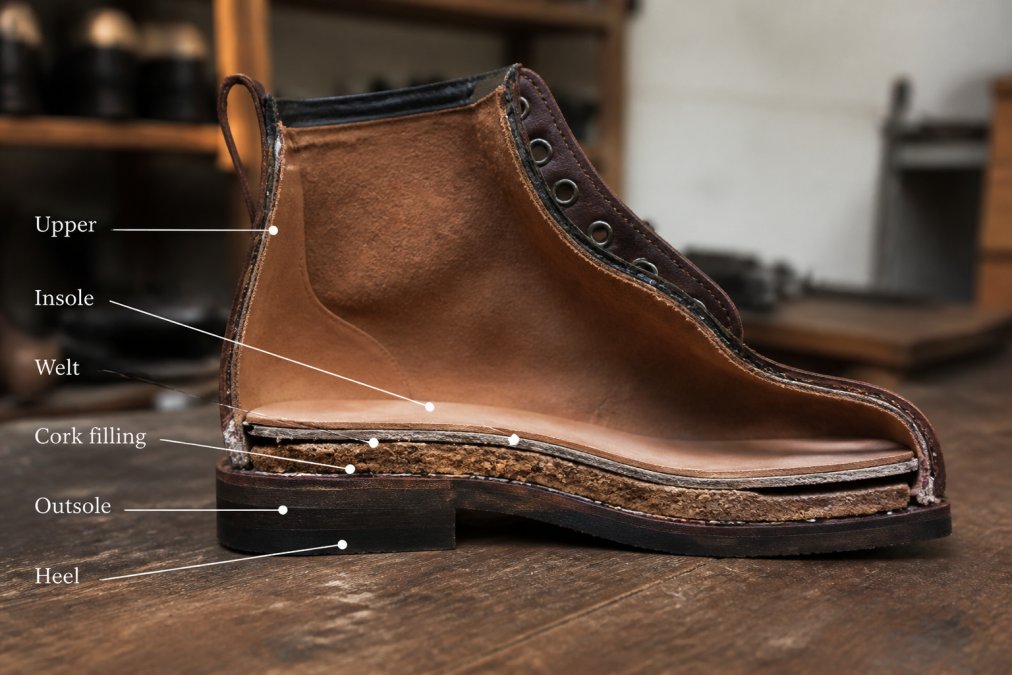
Let's examine each component in the order it is assembled on the factory floor:
-
The Upper: This is the visible leather that wraps your foot. In quality construction, this is cut from a single piece of full-grain leather, minimising weak points. It is pulled taut over a last (the foot-shaped form) and temporarily nailed to the insole.
-
The Insole: This is the internal foundation, often made of thick, vegetable-tanned leather. It is not just a footbed; it is the structural anchor to which everything else is attached. Its quality dictates how well the shoe holds its shape over decades.
-
The Welt: This is the defining strip of leather or synthetic material. A specialised Goodyear welt machine performs the crucial first stitch, locking the upper and the insole to the welt. This is the 'welt stitch' you can see from the outside.
-
The Cork Filling: After the first stitch, the cavity between the insole and the outsole is filled with a layer of ground cork and adhesive. This is not mere padding. As you wear the shoe, the cork compresses and moulds to the unique contours of your foot, creating a personalised footbed over time (peer-reviewed research). This is the primary source of the 'custom fit' feeling.
-
The Outsole: Finally, the outsole (leather, rubber, or a combination) is attached. A second row of stitching, the 'outsole stitch', secures it to the welt. This is the stitch that a cobbler will later cut and replace during a resole.
:::tip A Visual Check Look at the side of a Goodyear welted shoe. You should see two distinct rows of stitching: one close to the upper (the welt stitch) and another further out on the sole (the outsole stitch). If you only see one row, it is likely a different, less repairable construction.
This layered architecture is the key to the shoe's longevity. The cork filling provides the comfort, the welt provides the repairability, and the multiple layers provide a physical barrier against the elements. When you understand this anatomy, you can see why a Goodyear welted shoe feels rigid initially, the layers are stiff and new, and then transforms as the cork gives way and the leather softens. It is a mechanical system designed for a long service life, not a quick disposal.
Why Choose Them? The Core Benefits of the Welt
The benefits of Goodyear welted shoes go far beyond the ability to resole them, though that is the headline feature. The construction creates a physical barrier between your foot and the ground, which significantly improves breathability. Because the upper is not glued directly to a synthetic sole, air can circulate through the natural materials, reducing sweat and keeping your feet drier during long days out in the field.
Durability is the second pillar. The thick, soft leather uppers used in quality Goodyear welted boots are chosen to withstand abrasion from undergrowth, mud, and rough terrain. Combined with the strong stitching, these boots resist the kind of sidewall splits and seam failures that end the life of cheaper footwear. Water resistance also improves, as the welt and the tight stitching help prevent moisture from seeping in through the sole joint, provided the leather is properly treated.
There is also the matter of shape retention. The internal structure, supported by a steel or wooden shank and the cork filling, means the boot holds its form rather than collapsing around your foot. This provides arch support and stability on uneven ground. For anyone who spends hours on their feet, whether at a shoot or walking the dog, this structural support translates directly into reduced fatigue.
The Resoling Process and True Footwear Longevity
A Goodyear welted boot is designed to be repaired, not replaced. When the tread wears down after years of use, you take the boot to a cobbler who carefully removes the old outsole by cutting the welt stitches. A new sole is then attached, and the boot is returned to you looking and performing much as it did when new. This process can be repeated several times over the life of the upper, which is why a well-maintained pair can last decades.
This is the point where the cost-per-wear calculation shifts dramatically in your favour. A cheaper boot might cost less upfront, but when it wears out in eighteen months, you buy another (the CDC). A Goodyear welted boot costs more initially, yet the resoling fee is a fraction of the replacement cost, and you only pay it every few years. Many owners find they get ten or more years of service from a single pair of uppers with periodic resoling.
The break-in period is the trade-off you accept for this longevity. The rigid construction and thick leather require a settling-in phase, typically lasting a week or two of regular wear. During this time, the cork moulds to your foot and the leather softens. It is a short-term discomfort for a long-term gain, and it is the reason these boots feel increasingly bespoke the longer you own them. Choosing a boot with a full leather insole and quality leather will make this process smoother than cheaper alternatives.
Goodyear Welt vs Blake Stitch: Key Differences
| Feature | Goodyear Welt | Blake Stitch |
|---|---|---|
| Construction | Welt strip sewn to upper and outsole | Outsole sewn directly to upper |
| Resoling | Easy, multiple times | Possible, but more complex |
| Water Resistance | Higher, due to layered barrier | Lower, stitching penetrates sole |
| Weight | Heavier and more strong | Lighter and more flexible |
| Break-in Period | Longer, requires moulding | Shorter, flexible from the start |
| Best For | Country wear, rugged terrain | Dress shoes, sleek silhouettes |
The Blake stitch is the primary alternative to Goodyear construction, and the differences between the two are significant. In a Blake stitched shoe, the outsole is sewn directly to the upper, folding inward, which eliminates the need for a welt. This makes the shoe lighter, more flexible, and easier to break in, which is why it is favoured for elegant dress shoes. However, the direct stitching means water can more easily penetrate the sole, and resoling is a more delicate operation that not all cobblers can perform.
For the purposes of country boots and outdoor footwear, the Goodyear welt is generally the superior choice. The added weight is a small price for the increased water resistance and the ruggedness required for uneven terrain. The key difference comes down to intent: if you need a sleek city shoe, Blake offers a sleeker profile, but if you need a boot that will handle mud, rain, and years of hard wear, the Goodyear welt is the more practical engineering solution.
Storm Welted vs Goodyear: Benefits of Storm Welted Construction
A storm welt is a variation of the Goodyear welt designed specifically for wet conditions. The welt is cut wider and turned upward to create a raised lip where it meets the upper. This lip acts as a gutter, channeling water away from the vulnerable seam between the upper and the sole. For anyone who spends full days outdoors in rain or damp undergrowth, this is a decisive advantage. value of expensive clothing.
The benefits of storm welted construction are most apparent in prolonged exposure to moisture. Standard Goodyear construction offers decent water resistance, but the storm welt raises the boot's defence against standing water and heavy rain. Combined with a waterproof lining, such as the Sympatex membrane used in many of our boots, a storm welted boot can keep your feet dry in conditions that would soak through a standard construction.
The trade-off is a slightly bulkier appearance at the base of the boot, but for fieldsports and country pursuits, function rightly trumps sleekness. A storm welt is essentially the Goodyear system optimised for the British climate. When you are choosing between the two, consider your primary environment: for mixed use including town, a standard Goodyear welt offers a cleaner line, while for dedicated outdoor work, the storm welt is the more resilient option.
How to Care for Goodyear Welted Boots
Proper care is not optional with Goodyear welted boots; it is the difference between a boot that lasts a decade and one that fails prematurely. Beyond the standard advice of cleaning and conditioning, a deeper understanding of troubleshooting common issues is what separates a seasoned owner from a novice. This section covers the essential maintenance routine and, crucially, how to diagnose and solve the problems that can arise.
The Essential Maintenance Routine
-
Cleaning: After each day in the field, remove mud and dirt with a soft brush. Pay special attention to the welt and the crevice where it meets the upper. Grit left to dry can work its way into the stitching and act like sandpaper, accelerating wear on the threads.
-
Drying: Always allow boots to dry naturally at room temperature, away from direct heat sources like radiators or fires. Intense heat will dry out the leather, causing it to crack, and can shrink the welt, compromising the structural integrity of the boot.
-
Conditioning: The thick, full-grain leather uppers need periodic nourishment to stay supple and maintain their water resistance. A quality leather balm or wax applied every few weeks, or after heavy use in wet conditions, will keep the leather hydrated. A common pattern is to apply a light coat, let it absorb, and then buff with a soft cloth.
-
Using Shoe Trees: Invest in a pair of cedar shoe trees. Inserting them after wear helps the boots retain their shape, draws out moisture, and reduces odour. This simple step is critical for extending the life of the upper.
:::tip The Welt's Specific Needs The welt itself is a piece of leather that takes a lot of stress. When conditioning your boots, do not neglect this strip. A dry, cracked welt can fail, which is a far more complex repair than a simple resole.
Troubleshooting Common Issues
Even with the best care, you may encounter issues. Here is how to diagnose and address them.
Issue 1: The Break-In Period
The most common pain point is the break-in period. The rigid construction and thick leather require a settling-in phase, typically lasting one to two weeks of regular wear. During this time, the cork moulds to your foot and the leather softens.
- Symptom: Heel slippage, pressure points on the instep, or a general feeling of stiffness.
- Solution: Do not try to speed this up with excessive wear. Instead, wear them for a few hours each day, gradually increasing the duration. Use thick socks. If you experience a specific hot spot, a cobbler can stretch that area of the upper. The discomfort is temporary and a sign the materials are conforming to you.
Issue 2: A Failing Welt
Knowing how to tell if a welt is failing is crucial. A well-maintained welt should last for many years, but it is not indestructible.
- Symptom: You may see a visible gap or separation between the welt and the upper, or the stitching may appear frayed or broken. You might also feel a 'sponginess' underfoot, indicating the cork filling has broken down.
- Solution: If you notice a gap, do not delay. A cobbler can often re-stitch a section of the welt. If the cork has degraded, it can be replaced during a full rebuild. Ignoring these signs can lead to water ingress and damage to the upper, turning a simple repair into a costly one.
Issue 3: When to Resole
Do not wear a boot down to the welt. This is the most common and avoidable mistake.
- Symptom: The tread is smooth, and you can see the stitching on the outsole beginning to wear through.
- Solution: Take the boots to a cobbler as soon as the tread looks low. Catching it early keeps the resoling process simple and affordable, preserving the upper for another cycle of wear. Wearing it down further damages the welt stitching and increases the cost of the repair.
By understanding both the routine care and the common failure points, you can ensure your Goodyear welted boots deliver on their promise of decades of service.
Is the Investment Worth It? A Cost-Per-Wear Analysis
The question of whether goodyear welted shoes are worth the premium is best answered with a cost-per-wear calculation. Say a quality pair of Goodyear welted boots costs around £120 to £150. A standard glued boot might cost £60 to £80. The initial outlay is clearly higher, but the analysis changes when you factor in lifespan.
Assume the cheaper boot lasts two years of regular country wear before the sole degrades and the upper begins to fail. Over a six-year period, you would buy three pairs, spending roughly £180 to £240. A Goodyear welted boot, by contrast, will still be on its original sole after two years, and with a resole costing a fraction of the boot price, it will continue performing for several more. Over that same six-year window, your total spend on the welted boot, including one resole, is likely comparable, and you have owned a superior product throughout.
The calculation improves further when you value comfort and performance. The cork filling that moulds to your foot and the structural support of the shank offer a level of comfort that cheap boots cannot replicate. For anyone who spends long days on their feet, the reduced fatigue and the avoidance of blisters and foot pain have a tangible value. The true worth of the construction is not just in the longevity, but in the quality of every single wear.
Conclusion: The Lasting Value of Traditional Craftsmanship
Choosing Goodyear welted shoes is a decision to prioritise longevity and repairability over the convenience of disposable fashion. The construction method, perfected over a century ago, remains the benchmark because it delivers a boot that conforms to your feet, withstands the elements, and can be rebuilt rather than discarded. It is a sustainable choice in an era of mass consumption, and a practical one for anyone who demands performance from their footwear.
The premium price reflects the genuine cost of hand-crafted construction, quality leathers, and the time required to build a boot properly. It is an investment that pays dividends in comfort, durability, and ultimately, cost-per-wear. Whether you are navigating a muddy field or stepping into a country pub, a well-made welted boot carries you in style and substance for years.
At Field & Moor, we build our range of country, Chelsea, and safari boots around Goodyear and storm welted construction, pairing it with waterproof Sympatex linings, thick soft leather uppers, and rugged Vibram soles for a boot that is as comfortable in town as it is on the hill. Get started with Field & Moor and experience the difference that true craftsmanship makes on your next adventure.
Frequently Asked Questions
Are Goodyear welted shoes worth the higher price point?
For most buyers, yes. The higher upfront cost is offset by the ability to resole them. A quality pair can last 10-20 years with proper care, whereas cemented shoes often need replacing every 1-2 years. When you divide the initial cost by the years of use, a Goodyear welted shoe often has a lower cost-per-wear than cheaper alternatives. The construction also offers better support and shape retention, which adds to the value for those who spend long hours on their feet.
How does a Goodyear welt differ from a Blake stitch?
The main difference is how the upper is attached to the sole. A Goodyear welt uses a strip of leather (the welt) stitched to both the upper and the outsole, leaving a hollow space filled with cork. A Blake stitch uses a single seam that goes directly through the insole, outsole, and upper, allowing for a more flexible and slimmer shoe. Goodyear welted shoes are generally more durable and easier to resole, while Blake-stitched shoes are lighter and require less break-in time.
Can Goodyear welted shoes be resoled?
Yes, this is their primary advantage. The welt acts as a sacrificial layer. When the outsole wears down, a cobbler can remove it and stitch a new one onto the existing welt. This process can be repeated several times before the welt itself needs replacing, which is a more involved repair. This repairability is what makes them a sustainable investment, as you can keep the upper, which moulds to your foot, for many years.
What are the benefits of storm welted construction for country boots?
A storm welt is an extension of the Goodyear method where the welt is cut flush with the upper and turned upward. This creates a raised lip that directs water away from the seam where the upper meets the sole. The result is significantly improved water resistance, making it the preferred choice for wet and muddy conditions. For country boots, this means your feet stay drier for longer compared to a standard flat welt.